Washington State History Museum
Museum that chronicles the Evergreen State’s history from its early native civilizations through its transformation by the railroad, timber, and aviation industries that shaped the Pacific Northwest
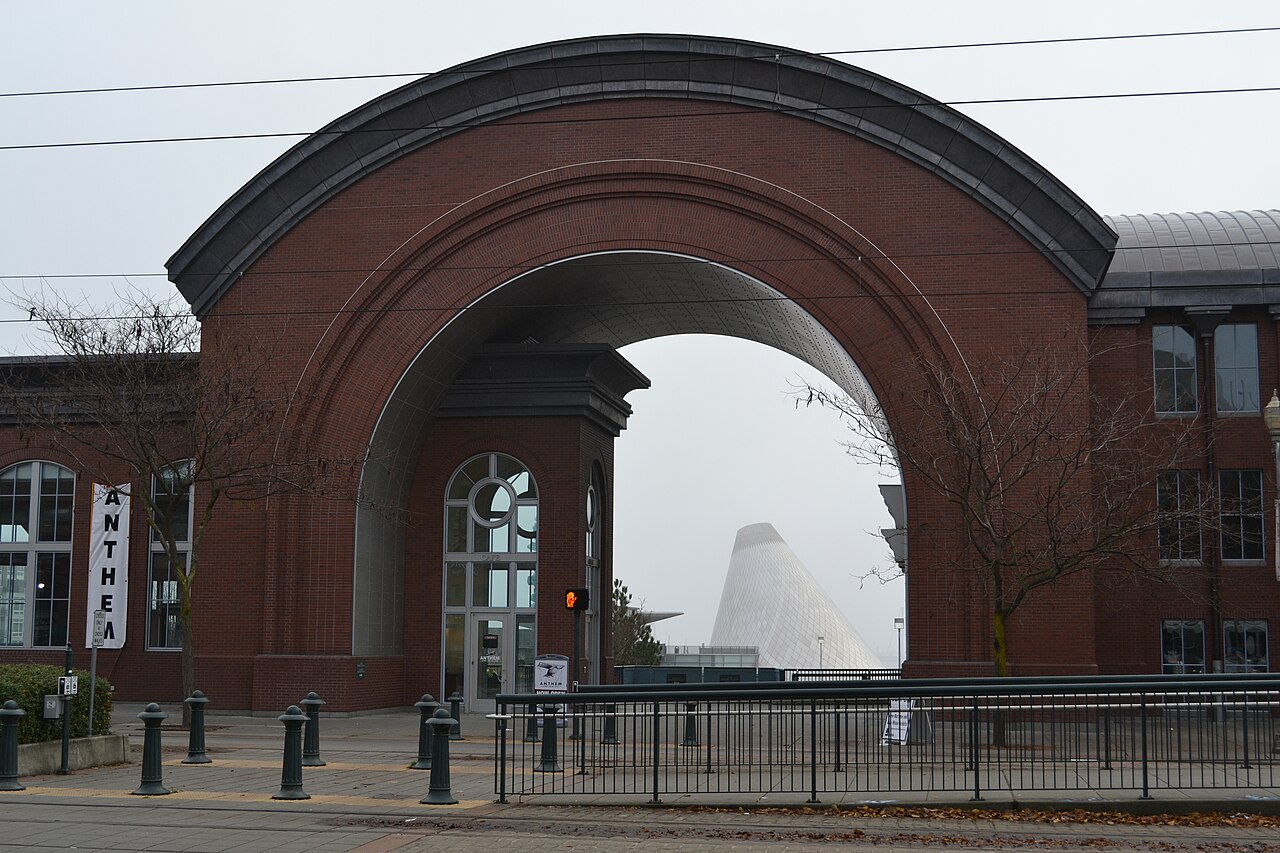
Site Details
Pin location is approximate.
1911 Pacific Ave
Tacoma, WA 98402
Family Friendly?
Yes
Visitors Per Year
73,000
The museum has two floors of exhibits:
- A good exhibit on Washington’s prehistory, including Clovis era (c. 11,000 B.C.) spearheads;
- Numerous interactive exhibits for children;
- An excellent half-hour movie on the Columbia River that provides an overview of this important waterway;
- A display containing recorded stories of 20 individuals whose families immigrated to Washington state;
- An exhibit that recreates part of a “Hooverville” (a collection of shacks housing unemployed men during the Great Depression) that was in Seattle;
- An extensive exhibit on the internment of Japanese Americans who lived in Washington state;
- Good exhibits on industry in the state, especially logging and aeronautics;
- Interesting temporary exhibits: In the summer of 2025, they were on Gilded Age fashion, a hovercraft that was built by a Washington company, and artifacts that Vietnam veterans brought home from the war; and
- An annual exhibit of contemporary Native American art.
The museum provides a selective overview of Washington State’s history. The information presented is accurate but overemphasizes discriminatory actions against racial minorities. Civic leaders from Washington, at both the state and national level, are completely ignored.
Exhibits highlight negative aspects of Washington’s and America’s history, such as violence toward Native Americans, discrimination against African Americans, expulsion of South Asians from Bellingham, and the internment of Japanese Americans in the Second World War. While accurate, such exhibits are overwhelming.
The fifth floor of the museum has numerous exhibits intended for children. A huge model train exhibit is a particularly interesting attraction. The train moves through a diorama that looks like different parts of the state. Two stuffed oxen that pulled a cart across the Oregon Trail are attached to a cart that children can climb into.
American sailors, traders, and explorers visited Washington State as early as the late 18th century, but settlers did not arrive until the 1830s. At the time, it was not self-evident that all of what we know as Washington State was going to be in America. The British thought the boundary between Canada and the United States should be the Columbia River—the current boundary between Oregon and Washington. Indeed, when American settlers arrived at Fort Vancouver (in current day Vancouver, Washington), it was a Hudson’s Bay Company outpost. The chief factor (the principal officer of the trading post) John McLaughlin would help American settlers and then send them south into Oregon. Americans, on the other hand, wanted the border to be above the 54th parallel line; “54° 40’ or fight!” was a popular slogan in the 1844 presidential election. That would have put the border well into what is today Canada.
The Oregon Treaty of 1846 established the current boundary between the United States and Canada; Washington became a territory in 1853; and the territory became the 42nd state in 1889. The state is named for President George Washington, whose image is on the state’s flag and seal. Washington State was influenced by Progressive Era reforms in the early 20th century. It gave women the right to vote in 1910, and it was among the first states to adopt the initiative and referendum processes. Important political leaders included Warren G. Magnuson, senator from 1944–1981; Henry “Scoop” Jackson, senator from 1953–1983; and Tom Foley, Speaker of the House of Representatives from 1989–1995 and the first Speaker to lose a re-election campaign since 1862. In the late 20th and early 21st centuries, it was among the first states to legalize abortion, physician assisted suicide, same-sex marriage, and medicinal and recreational marijuana.
Washington has always been rich in natural resources, including timber, fishing, and agriculture. After World War II, it became an aerospace giant thanks to the presence of the Boeing Company. Hydroelectric dams such as the Grand Coulee Dam (completed in 1941, it remains the largest concrete structure in the United States) provide cheap electricity. The Hanford Works nuclear plant in eastern Washington, which opened in 1943, played a critical role in the construction of the nation’s atomic bombs. In the latter half of the 20th century and into the 21st, the emergence of companies such as Microsoft and Amazon has transformed the state into a hub of technological innovation.
Owned By: State of Washington
Operated By: Washington State Historical Society
Government Funded: Yes
Did you know?
The Museum contains two stuffed oxen that pulled a wagon across America on the Oregon Trail.
Recommended Reading
- Washington: The Evergreen State (It’s My State!) by Anna Maria Johnson
- Washington’s History: The People, Land, and Events of the Far Northwest by Harry Ritter
Reviewed By
Mark David Hall
Professor in the Robertson School of Government at Regent University
The opinions expressed above are those of the Reviewer who is providing a good-faith historical assessment to educate the public. Reasonable opinions can vary, and the Reviewer’s opinion is not necessarily the opinion of The Heritage Foundation or its affiliates.