USS Constitution Museum
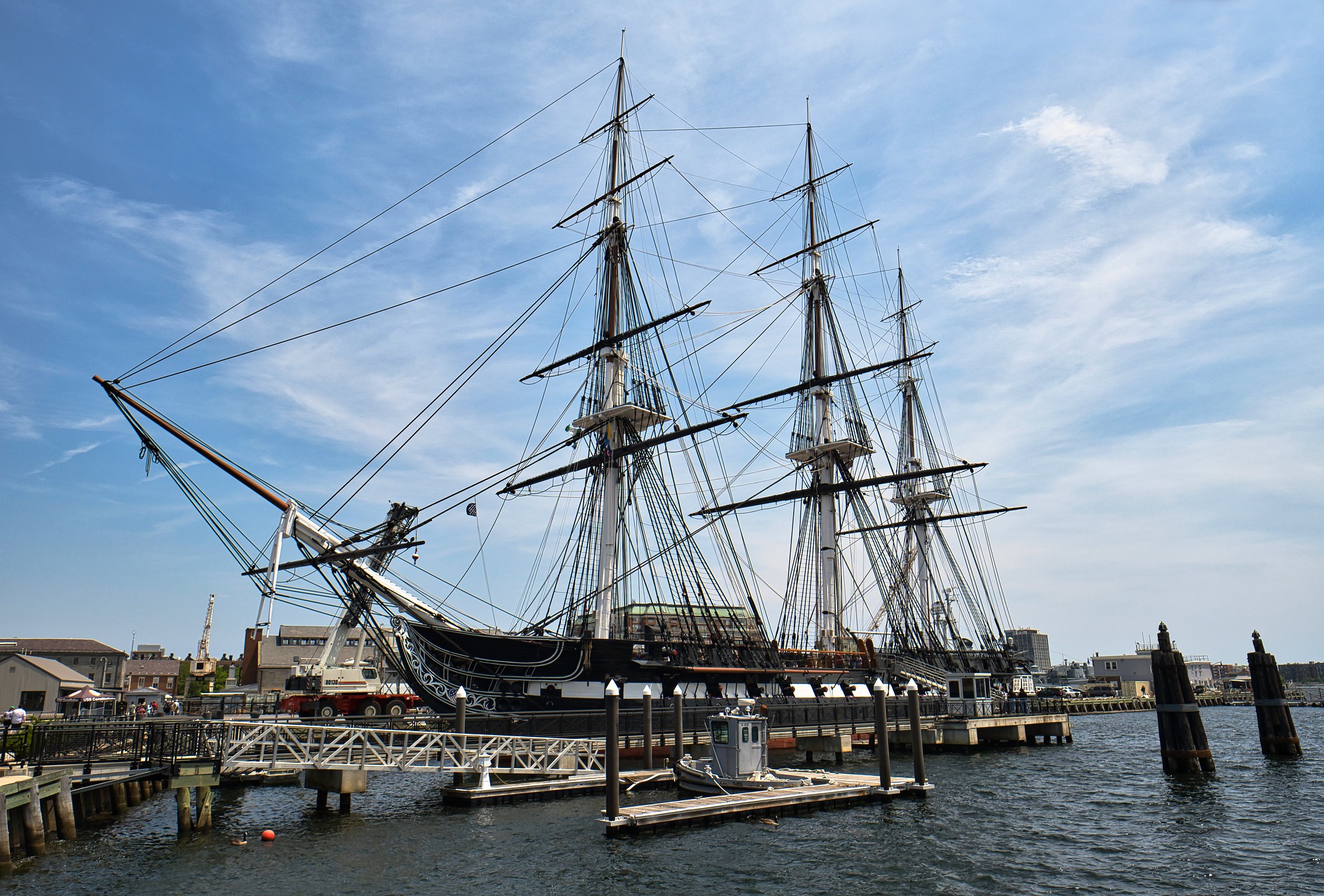
A historic U.S. Navy frigate and the oldest commissioned warship still afloat, famous for its victories in the War of 1812
Site Details
Pin location is approximate.
Building 22 Charlestown Navy Yard
Charlestown, MA 02129
Family Friendly?
Yes
Visitors Per Year
500,000
Guests tour the Visitors’ Center, museum, and USS Constitution at their own pace in a self-guided manner. Rangers, proctors, and sailors can answer questions at each stop. In the case of the USS Cassin Young, rangers do offer tours.
- The USS Constitution features three decks that include such attractions as the captain’s cabin, sailor hammocks, 32- and 24-pound cannon, and a majestic helmsman’s wheel. At once, it ranks as the main attraction in the Charlestown Navy Yard and the one that requires the least amount of time to absorb.
- The Charlestown Navy Yard sits in a safe, gentrified section of Boston in the inner harbor between the mouths of the Charles and the Mystic Rivers. It offers views of both Boston Harbor and the city itself and remains an active military installation. A visitor to any of the attractions within the Navy Yard may enter for free.
- The USS Constitution, a grand ship that has remained in operation during every presidency in the nation’s history, remains the draw. The site also includes the World War II-era destroyer USS Cassin Young, two museums, an impressive dry dock, and models of various naval ships. One could easily spend half a day here. Alternatively, a CliffsNotes version that involved a perusal of the USS Constitution Museum and a stroll along the three open decks of the USS Constitution might take little more than an hour.
The USS Constitution meets standards of accuracy and presents a thumbnail sketch of life on the ship. The cannon aboard the “44-gun frigate” are replicas, and the ship retains just a fraction of the original wood, given the periodic renovations over the years. What one sees, rather than what one reads, makes for the better part of the experience on the ship. The accompanying Charlestown Navy Yard Visitor Center obsesses over race and sex to the point that an uninformed visitor might imagine the significance of the long-dormant shipbuilding center, which constructed more than 300 vessels during the Second World War, as an anticipation (and validation) of the contemporary political concerns of progressives. The USS Constitution Museum, through films, games, and interactive exhibits, presents an array of interesting and relevant information that even small children can absorb.
The USS Constitution offers the ship in a straightforward experience with little in the way of the captions or displays that can frame history through an ideological lens. The USS Constitution Museum chronicles the story of an African American sailor who was falsely arrested as a fugitive slave in Alabama, the ship’s brief role in combatting the international slave trade, and the Navy’s use of slave labor to harvest timber for the vessel. All of this, as both true and relevant to the broader story told, seems unobjectionable.
The nearby Charlestown Navy Yard Visitor Center, on the other hand, presents heavy-handed displays that view the history of the navy and its yard bizarrely through the looking glass of race and sex. One display, undoubtedly playing to local ethnic allegiance, details a naval effort to alleviate suffering partly inflicted and largely ignored by the British during the Irish famine of 1847. A multi-panel exhibit explores segregation in the U.S. Navy during World War II. Another, on the Shipbuilding Women of the Navy (SWONS), describes how some men “harassed the women” in the naval yard, while other men threatened to quit because of their presence. An otherwise unobjectionable placard on both world wars notes, in obligatory fashion, that “the workforce included significant numbers of minorities and women.” A visitor unfamiliar with the U.S. Navy and its once-bustling yard would form the impression that their significance involved launching campaigns against segregation, breaking down employment barriers for women during wartime, and alleviating the hardship of oppressed minorities (the Irish) at the hands of powerful overlords (the English) overseas. Collectively, it all creates a distorted history of the Charlestown Navy Yard and the U.S. Navy, which seems significant for reasons greater than the ones fixated upon here. Ships built in the yard braved the aerial onslaught at Pearl Harbor, fell to the bottom of Charleston Harbor as the first submarine victim in the history of warfare, and rescued the crew of the SS Andrea Doria. Those and a thousand other stories capture the meaning of this place more than formulaic emphasis on grievance based on ethnicity, class, and other dividing lines of identity politics.
The disadvantage of the location involves its walking distance from Massachusetts Bay Transportation Authority stops. From the green line’s North Station, for instance, the USS Constitution requires almost a 20-minute walk (and much of it over the long and heavily trafficked Bill Russell Bridge). The locational advantage is its proximity to the Bunker Hill Monument, which memorializes one of the key battles of the Revolutionary War. Given the site’s location on the water in Charlestown, visitors may wish to plan trips for warmer months.
At 30 acres, the Charlestown Navy Yard, now identified as the Boston Navy Yard but not usually called that by locals, provides an unusual space within a congested city for children to energetically wander without fear of getting lost or bumping into strangers. The USS Constitution, with its steep steps leading to the two lower decks that are open to the public, and the USS Cassin Young, with its unforgiving steel structure, call for more parental supervision.
The USS Constitution Museum, especially, seems to have been curated with curious children in mind. A design-your-own-ship game allows youngsters to participate in a digital naval battle simulation with vessels of the length, width, and firepower of their choosing. Another game allows participants to select from 11 names proposed in the 1790s to see if their selections match those of the six frigates that were ultimately launched. A wall of 42 flip-signs imparts the daily tasks of the various ranks of sailors.
The USS Constitution allows service dogs on the top deck. Most of the complex, including the USS Cassin Young and the USS Constitution Museum, forbids pets.
The USS Constitution first set sail in 1797 as one of the six frigates authorized by the Naval Act of 1794. Its most heroic service came during the War of 1812, when it captured several enemy vessels, most notably the HMS Guerriere. Obsolescence proved weaker than nostalgia, which saved the vessel from the scrapyard. “Old Ironsides,” a poem written in resignation to the ship’s seeming demise by Oliver Wendell Holmes, Sr., ironically helped save it. The USS Constitution from that point forward continued in such roles as a training vessel, a goodwill ship, and, finally, as a floating museum. Active-duty sailors man the ship to this day.
The Charlestown Navy Yard, where the USS Constitution is docked, built hundreds of vessels for the U.S. Navy between 1801 and 1975, when it was decommissioned. It acted as the longtime site of the barracks for a Boston detachment of U.S. Marines. It currently houses a World War II-era Fletcher-class destroyer built elsewhere, the USS Cassin Young, which serves, like the USS Constitution, as an on-the-water artifact open to the public. A dry dock, in use in recent years for work on both the USS Constitution and the USS Cassin Young, still occasionally operates on the site.
Owned By: U.S. Navy (USS Constitution), The National Park Service (Charlestown Navy Yard), and USS Constitution Museum Foundation (USS Constitution Museum)
Operated By: U.S. Navy, The National Park Service, and the USS Constitution Museum Foundation
Government Funded: Yes
Did you know?
Orphan George Sirian joined the USS Constitution’s crew at the age of nine in 1827 and retired from the U.S. Navy in 1880.
Recommended Reading
- Ironsides! The Ship, the Men and the Wars of the USS Constitution by Charles E. Brodine Jr., Michael J. Crawford, and Christine F. Hughes
- The 44-Gun Frigate USS Constitution ‘Old Ironsides’ by Karl Heinz Marquardt
Reviewed By
Daniel J. Flynn
Visiting Fellow at the Hoover Institution, a Senior Editor for The American Spectator, and author of The Man Who Invented Conservatism: The Unlikely Life of Frank S. Meyer (Encounter Books/ISI Books, 2025)
The opinions expressed above are those of the Reviewer who is providing a good-faith historical assessment to educate the public. Reasonable opinions can vary, and the Reviewer’s opinion is not necessarily the opinion of The Heritage Foundation or its affiliates.