Tumacacori National Historical Park
Historic site in southern Arizona that preserves the ruins of a Spanish colonial mission founded in the late 17th century
Site Details
Pin location is approximate.
1891 I-19 Frontage Rd
Tumacacori, AZ 85640
Family Friendly?
Yes
Visitors Per Year
40,000
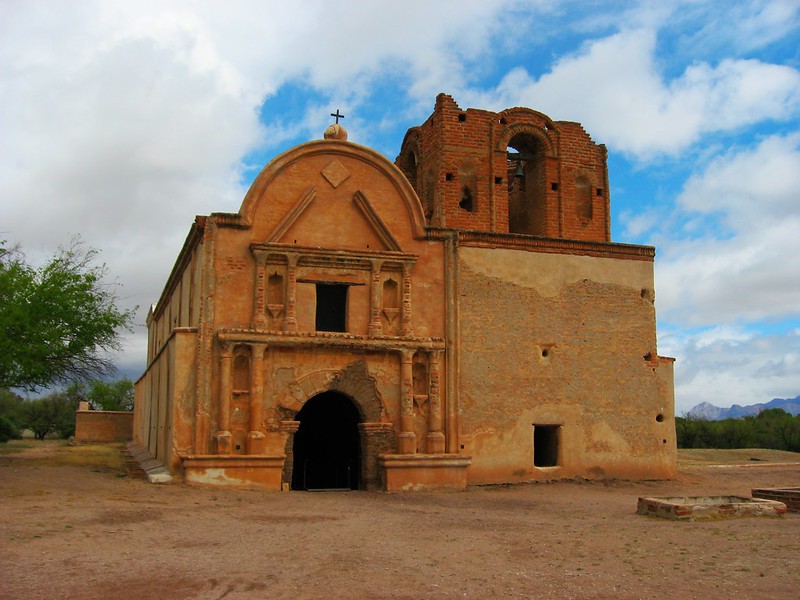
Tumacácori National Historical Park includes a three-story adobe mission church and grounds, a Visitors’ Center with a museum and gift shop, and an orchard with access to the Santa Cruz River and hiking trails. Visitors can explore the site themselves or go on a guided tour, which lasts approximately 45 minutes. A guided tour may be helpful, but is not necessary, as the brochures and museum exhibits are informative. Visitors should feel confident exploring as much as possible on their own.
The Visitors’ Center includes a 17-minute video entitled “Tumacácori: A Cultural Crossroads,” that focuses on the life of the O’odham people prior to and after the arrival of the Spanish missionaries. Although the videos on the website are generally quite good, the park introductory video is the weakest of the park videos, as it portrays the indigenous tribes as an idyllic people who kindly tolerate the intruding Spanish, rather than simply telling the story of the mission and church.
More worthy of a visitor’s time are the mission church itself and the excellent museum with various displays on the life of the mission church and history of the period. Exhibits include:
- The Santa Cruz Valley: The exhibit on the Santa Cruz Valley includes details on prehistoric life. This information is given fairly, without romanticizing or idolizing life before the arrival of the Spanish. Descriptions include classification of the prehistoric peoples based on their dwelling region, with explanations about what tasks were necessary for survival.
- Spiritual Life and Secular Life: These exhibits show details on church life at Tumacácori and the nearby mission churches—including Mass, baptisms, and weddings—as well as the various vocations among the residents, including farming, weaving, and animal husbandry. The description of the spirit and life of the community is done in a fair manner and does not presume or imply exploitation or cruelty. The exhibits do include information on a persistent pressure placed upon the community during Spanish rule, Mexican governance, and United States administration—namely, the role of the Apache and their frequent nighttime raids that resulted in plunder and murder.
- Allies and Enemies: These two exhibits fairly describe shifting allegiances before and after the Pima Revolt of 1751, including inter-tribal retribution especially upon the Yaquis.
- Saints Associated with the Mission Church: The exhibit includes information on the craftsmanship of the statues, in addition to details on the care for the statues of the mission church. The exhibit displaying the statues of the saints that stood in the church niches is done respectfully.
During the months of October to April, cultural demonstrators display their skills in wood carving, pottery, basket making, and jewelry. Tortilla demonstrations are especially popular, as the homemade corn or flour tortillas with refried beans are remarkably tasty.
The exhibits are notably accurate and comprehensive, so much so that visitors may choose to explore the site themselves, rather than opt for the guided tours.
Overall, the brochures and mission exhibits are well done and serve to tell a story without promoting a one-sided narrative of oppression or anti-colonialism. The website has a vast array of information, photographs, and videos that are informative without pushing a viewpoint. The bookstore offers a variety of publications that detail the history of the location and the region.
Families with older children may want to explore the orchard and hike the quarter-mile path to the river. For younger children, exploring the church, grounds, and museum might be a better option. Park grounds include picnic tables, but no food or drink is generally available on site.
The gift shop, run by the Western National Parks Association, offers appropriate toys and souvenirs. For those who participate in the National Park Service’s “Passport to Your National Parks” program, several cancellation stamps and ink pads are available, including the Juan Bautista de Anza National Historic Trail stamp. Regional craftwork and jewelry, and delicacies such as prickly pear candies are available for sale.
Tumacácori National Historical Park holds profound historical significance as a key site of Spanish colonial and indigenous interaction in the American Southwest. Founded in the late 17th century by Jesuit missionary Eusebio Francisco Kino, the mission at Tumacácori was a cornerstone of the Spanish mission system, aimed at spreading Christianity, fostering agricultural development, and integrating the indigenous O’odham people into colonial society. The mission’s establishment marked a critical moment in the cultural and religious transformation of the region, blending European and Native traditions through shared labor, trade, and religious practices. The mission church at Tumacácori is preserved as a “partially-restored ruin.”
Tumacácori’s role extended beyond spirituality, serving as a nexus for diplomacy and cultural exchange in a frontier region. The mission community faced tensions between Spanish authorities, missionaries, and indigenous communities, reflecting the complexities of colonial governance. The shift from Jesuit to Franciscan administration in the 1760s, followed by the mission’s decline and abandonment in the 19th century amid Mexican independence and Apache raids, mirrors the broader ebb of Spanish influence in the Southwest. Preserved as a National Historical Park, Tumacácori’s well-maintained mission church and archaeological remains illuminate the architectural, social, and cultural dynamics of the colonial era. The site stands as a vital historical record, highlighting the resilience of indigenous cultures, the impact of European colonization, and the multicultural roots of the American Southwest.
Owned By: United States Department of the Interior
Operated By: National Parks Service
Government Funded: Yes
Did you know?
Mass is held in the mission church once per year, during the La Fiesta de Tumacácori each December.
Recommended Reading
- Tumacacori National Historical Park by Susan Lamb
- The Tale of Tumacacori by Marshall Morgan
- The Pimeria Alta: Missions & More by James E. Officer, Bernard L. Fontana, and Mardith K. Schuetz-Miller
Reviewed By
Joe Giles
M.S.M., J.D., lives in Phoenix, Arizona
The opinions expressed above are those of the Reviewer who is providing a good-faith historical assessment to educate the public. Reasonable opinions can vary, and the Reviewer’s opinion is not necessarily the opinion of The Heritage Foundation or its affiliates.