Thomas Edison National Historical Park
Site preserving the American entrepreneur’s home and “Invention Factory,” where over half of his 1,093 patents were produced
Site Details
Pin location is approximate.
211 Main St
West Orange, NJ 07052
Family Friendly?
Yes
Visitors Per Year
50,000
The park is composed of two sites:
- Edison’s laboratory complex
- His residence, Glenmont Mansion
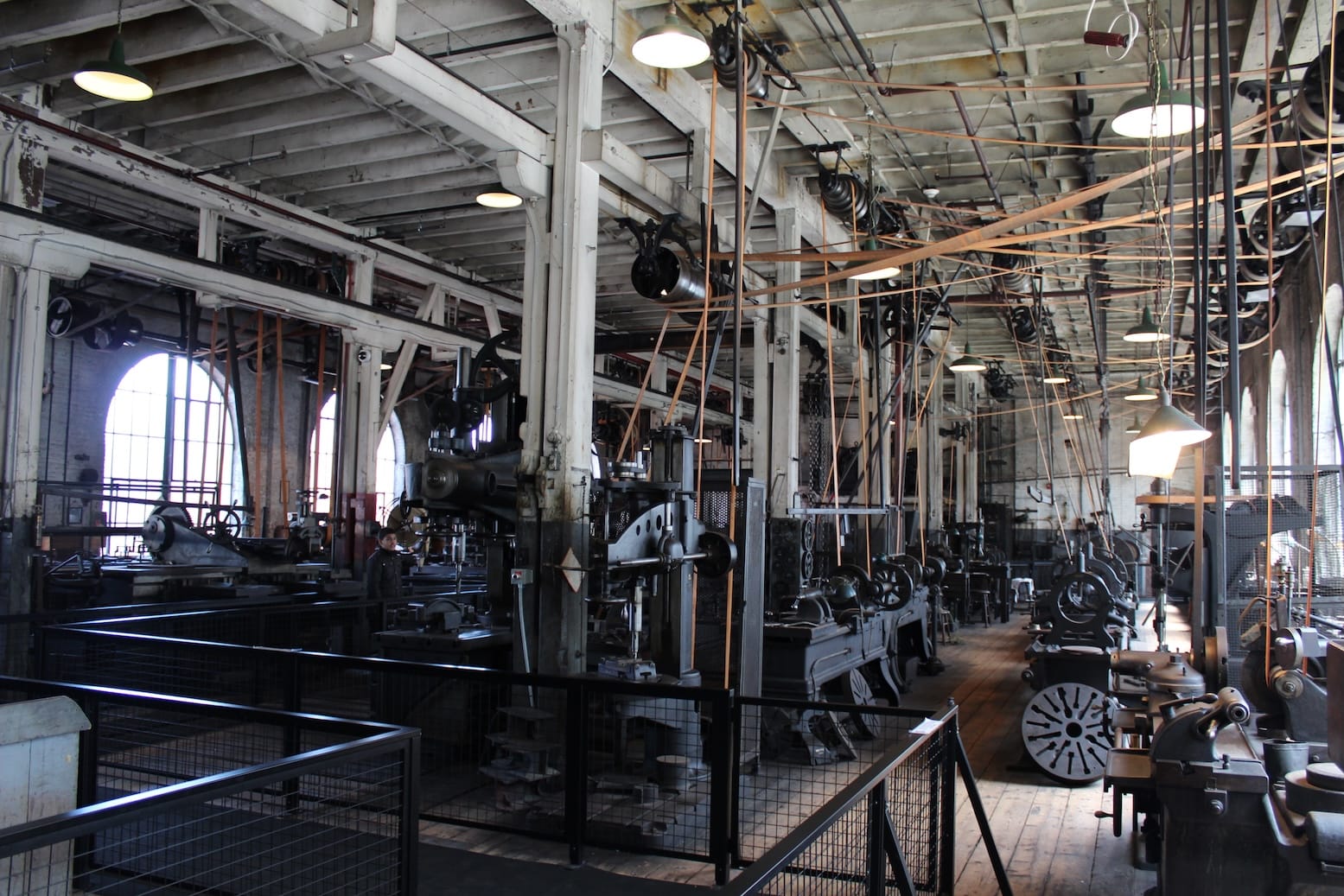
The complex consists of a Visitors’ Center, chemistry laboratory, smithy, early movie studio, machine shops, and the main factory building. The park’s Visitors’ Center introduces Edison’s biography and the site in a video lecture. Self-guided tours, accessible via QR code, are available throughout the complex. A series of short lectures by expert park rangers, including a phonography demonstration, chemistry lab tour, and Black Maria early movie-making tour, are available at times posted on a white board.
The Visitors’ Center at the main factory complex provides the parking passes needed to access the Glenmont Mansion, which is up the street from the factory complex and is open for self-guided tours of the interior and grounds.
Note: Thomas Edison National Historical Park in West Orange is distinct from Edison State Park in Edison, New Jersey. West Orange maintains a significant collection of historic buildings, artifacts, and exhibits, whereas Edison State Park is primarily a nature preserve, on the site where “Menlo Park,” the laboratory in which Edison invented the light bulb, formerly stood.
The Edison Complex meets scholarly standards of accuracy, though it lacks a certain imaginative quality. Plaques, accessible for all ages, provide interesting technical and biographical details, but sometimes lack context, inadequately imparting information about the significance of Edison and his inventions to American and world history. However, the volunteers who are present throughout the museum can generally be relied upon to fill in the gaps.
The exhibits tend to focus on the material and social aspects of factory life in the 19th century. Visitors learn basic information about machinery and invention, but the exhibits do not convey Edison’s unique contributions and historical significance. The relative weight exhibits place on details of secondary importance suggests some bias or imbalance in the museum’s approach to the subject, which focuses on the lives and experiences of ordinary people, rather than on the most noteworthy figures and events.
Children’s activities are found throughout, and plaques are intelligible for all reading ages. The museum, an industrial laboratory and factory full of machines, will be of greater interest to older students and those interested in science. The museum complex is compact, and all exhibits are accessible by stroller. The tours, especially the phonograph demonstration, are good for all ages, but more interesting for older children. Each factory floor offers an interactive exhibit for non-reading age children, such as machinist mold building blocks, to entertain younger visitors while adults read their way through the floor.
In his life and work, Thomas Edison exhibited the distinct virtues of American republicanism—intense curiosity, pragmatism, perseverance, and sincerity. Born in relative obscurity, he became a self-made inventor and industrialist by early middle age and devoted the rest of his life to science and letters. Edison was truly an American Renaissance man.
He produced technical and scientific breakthroughs, from acoustics and optics to energy storage and material science. In West Orange, he and his team produced the first motion picture camera, improved phonographs, sound recordings, and the nickel-iron alkaline electric storage battery. His most profitable invention was cement, but his most popular, the light bulb, made him the face of America at home and abroad for decades.
Edison built the West Orange factory site near his mansion, Glenmont, where he maintained a happy marriage and long residence. He welcomed visitors from across the globe to see the invention factory, which made the site a hotspot for social and commercial enterprise and placed him at the center of American civic life for decades. Edison, who passed away in 1931, left to his sons and benefactors a legacy of prosperity and innovation in what is today General Electric.
Owned By: National Park Service
Operated By: National Park Service
Government Funded: Yes
Did you know?
The “Wizard of Menlo Park” was the most recognized visage in the world for the first few decades of the 20th century. Edison put his name and image on nearly all his products and extensively documented his life and work using the new medium of photography.
Recommended Reading
- Edison by Edmund Morris
- Who was Thomas Edison? by Margaret Firth
Reviewed By
Louis Galarowicz
Research Fellow at the National Association of Scholars
The opinions expressed above are those of the Reviewer who is providing a good-faith historical assessment to educate the public. Reasonable opinions can vary, and the Reviewer’s opinion is not necessarily the opinion of The Heritage Foundation or its affiliates.