Taliesin Preservation
Historic estate in Spring Green, Wisconsin, that served as the home, studio, and architectural school of American architect Frank Lloyd Wright
Site Details
Pin location is approximate.
5481 County Rd C
Spring Green, WI 53588
Family Friendly?
Somewhat
Visitors Per Year
25,000
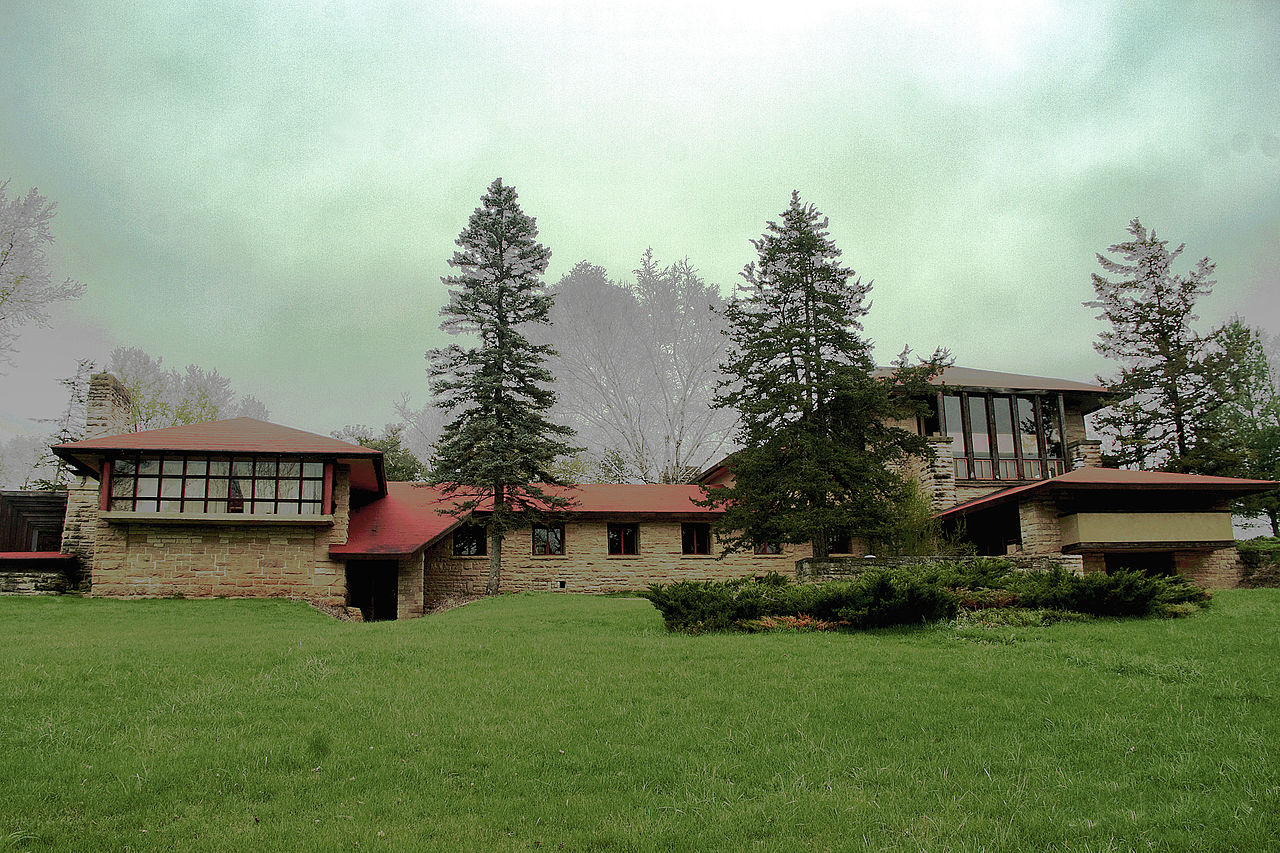
The entire estate of Frank Lloyd Wright includes the following structures:
- Taliesin, which was Wright’s private residence and professional studio with some student residences and agricultural spaces;
- Midway Barn, which housed the property’s dairy and other agricultural spaces;
- Hillside School and Theater, which was originally a school run by Wright’s aunts and became the school of architecture that Wright directed;
- Tan-y-Deri, which is the home Wright designed for his sister and which he later acquired in 1950; and the
- Romeo and Juliet Windmill, which pumped water to the Hillside School.
Regarding the tours:
- The Estate Tour lasts about four hours. This tour offers access to every major building of the property, an in-depth tour of Wright’s house, and the opportunity to take a 1.5-mile walk across the 800-acre estate.
- The Highlights Tour lasts approximately two-and-a-half hours and offers the most comprehensive overview of Wright’s home, estate, and school. The tour features visits to two iconic Wright-designed structures: Taliesin and Hillside. Along the way, visitors see Wright’s Romeo and Juliet Windmill and Midway Barn during a scenic shuttle ride through the property.
- The two-hour House Tour is a detailed review of the main house, Taliesin.
- A 60- to 90-minute self-guided tour gives visitors the opportunity to view the main house at their own pace and includes exclusive content such as historic footage and Wright’s personal reflections.
Taliesin tours typically focus on the property and buildings, rather than on archival material or exhibits. Tour guides are given in-depth training about the buildings and property, Frank Lloyd Wright’s design philosophy, his overall body of work, and his colorful and often fraught personal life. No script is provided, so some tour guides focus more on Wright’s personal life and others more on his architecture, but generally the tours offer a balanced and in-depth view of the man’s work and his life. While some of the particulars about Frank Lloyd Wright’s personal life, particularly relating to his mistress and a murder and arson at Taliesin, are shocking, these are stated matter-of-factly and do not form the core of the tours.
As a note to historic preservation enthusiasts, the biggest challenge for those restoring Taliesin is identifying the appropriate era as the “period of significance.” Taliesin was built and rebuilt over the long life of Frank Lloyd Wright and, even after his death in 1959, his third wife continued to make modifications. The main house of Taliesin was not intended to be a lasting monument, but rather a laboratory of architectural ideas, often built hastily by Wright’s students, meaning serious structural issues have arisen in the past several decades.
In the presentation of Frank Lloyd Wright’s life and work at Taliesin, the only apparent ideology that some might find questionable is rooted in his own life and writings. As the son of a Unitarian minister and a devotee of the Transcendental philosophers, Wright saw nature as the highest source of inspiration and viewed traditional Judeo-Christian values and Graeco-Roman architectural forms as largely irrelevant or opposed to his own views.
The only public access to Taliesin is through its tours, which are fairly long, and are for ages eight and up. The tours leave from the Visitors’ Center, which is down the road from the estate. As such, Taliesin is difficult to visit for those with small children. Some details about Wright’s personal life, which are touched on briefly in tours, may be inappropriate for younger children.
Frank Lloyd Wright was one of the most creative and influential architects in American history, designing over a thousand structures and mentoring hundreds of apprentices. Wright was an early and important contributor to the Prairie School design philosophy in architecture and later developed what he called “organic architecture”—one that sought harmony between man and nature through design.
Wright also experimented with architectural forms derived from Japanese art, and that utilized new construction techniques and materials, such as plywood. The horizontal qualities of the Prairie School, the open floor plans he pioneered, and the heavy usage of plywood cabinetry, which became influential in suburban home design through the 1950s and 1960s, are all on display at his house and laboratory, Taliesin. Finally, Wright’s vision for a new architecture—one which he felt was entirely American and democratic—rejected the older, European models. Ironically, this new direction in architecture was taken up by prominent European architects, who, in turn, rejected all ornamentation, even the minimal ornamentation that Wright had developed, leading to the minimalist aesthetic that has dominated architectural design for the past 75 years.
Owned By: The Frank Lloyd Wright Foundation
Operated By: Taliesin Preservation, Inc.
Government Funded: Yes
Did you know?
Frank Lloyd Wright designed over 1,100 buildings, of which 532 were built—more than any other American architect to this day.
Recommended Reading
- The Essential Frank Lloyd Wright edited by Bruce Brooks Pfeiffer
- Frank Lloyd Wright: The Houses by Alan Weintraub
- Many Masks: A Life of Frank Lloyd Wright by Brendan Gill
- Famous Buildings of Frank Lloyd Wright by Bruce LaFontaine
Reviewed By
Peter Budnik
Principal Architect at Domus Architecture
The opinions expressed above are those of the Reviewer who is providing a good-faith historical assessment to educate the public. Reasonable opinions can vary, and the Reviewer’s opinion is not necessarily the opinion of The Heritage Foundation or its affiliates.