National Susan B. Anthony Museum & House
Home of a leading social reformer and early women’s rights advocate from 1865 to 1906
Site Details
Pin location is approximate.
17 Madison St
Rochester, NY 14608
Family Friendly?
Yes
Visitors Per Year
10,000
- A guided tour of the home of American social reformer and activist Susan B. Anthony lasts between 60 and 90 minutes. Within the tour, the guide provides the only source of information, and the main source of focus of the tour is suffrage as central to Anthony’s work. Each docent is taught a script but is allowed the freedom to offer anecdotes and additional history surrounding various suffrage leaders apart from Susan B. Anthony. These other leaders include Anthony’s chief collaborator, Elizabeth Cady Stanton; American Red Cross founder, Clara Barton, a supporter of women’s suffrage who stayed with Anthony while working to strengthen the fledgling Red Cross; and other women’s advocates who visited and stayed in the guest room.
- The home is furnished in a manner that is true to the era. The guide points out which items and pieces of furniture are original to the home, notable among them: Susan’s alligator purse upon which the children’s jump rope rhyme is based, an embroidered wool coat that demonstrates her tall stature, a favorite custom-made black silk dress presented to Anthony as a gift of gratitude from suffragists in Utah, the double desk from which she worked in her attic, portraiture (oil paintings and photographs), and textiles (embroidery and quilts).
- Visitors are expected to move from room to room with the guide. There are no videos, plaques, signs, or brochures explaining the house, though there are primary written sources and photographs for perusal.
Staff members dress in the style of the time (long skirts and shawls), adding a touch of historical reenactment. Overall, there seems to be a desire to stay true to the era and to leave the home mostly untouched.
The tour guides are knowledgeable, anchoring presentations with dates and significant milestones, but are also often not able to answer specific questions outside the script.
Presentation of the social issues that motivated Anthony’s campaign for suffrage are accurate but sometimes incomplete. Guides correctly mention that Anthony was moved to act in defense of various groups of women who were treated unjustly: women who left abusive marriages who did not have custody of their children; married women who could not legally own property or enter contracts; and women who were generally condemned for speaking out publicly, even against slavery. But Anthony’s work for temperance is not considered, nor is her desire to empower mothers to responsibly care for their children emphasized.
Conspicuously absent was the fact that Anthony’s religious faith called her to action. Also, like other women’s advocates of her time, Anthony regarded abortion (akin to infanticide) as a symptom of poor treatment of women.
Anthony and Stanton are portrayed as the central leaders of the suffrage movement: Anthony is portrayed as the suffrage movement’s public face, who was free to engage the public on social reform, while Stanton, who organized the first Women’s Rights Convention at Seneca Falls in 1848, is described as the movement’s “philosopher,” who made her contribution to the movement while caring for small children at home. Other leaders of the early women’s movement who split with Anthony and Stanton over differences in philosophy or strategy are mentioned, but little attention is paid to the nature of the differences (e.g., whether suffrage should take precedence over other concerns and whether a state-by-state strategy should be preferred). Primarily, the house should focus on Anthony, but since the operators have chosen to also cover the suffrage movement as a whole, it would be appropriate to note these disagreements.
On key issues, the docents are balanced, for example, regarding the dispute between Anthony and Frederick Douglass over the passage of the 15th Amendment. While Anthony argued that the movement should insist on universal suffrage, Douglass and other women’s advocates thought enfranchisement of black men was too important to delay. Guides correctly do not equate Anthony’s views with racism but rather a difference of opinion over strategy. Details of Anthony and Douglass’ reconciliation and other accounts of Anthony’s defense of black Americans further demonstrate her opposition to racism.
The overall tone of tour guides is good and measured. Subtle bias is sometimes revealed when guides extrapolate about what Anthony would have been “thinking.” For example, guides sometimes describe Anthony as wishing to signal to the public that she was an “unmarried woman who had freedom because she was single and without children.”
The most flagrant ideological bias is on display in the House’s gift shop, which must be entered at the beginning of the tour. The curation contains some vulgarity, the worst form being stickers and imagery labeled “Feminist as F” and “Put the F in Feminism” (the full expletive is not stated). Other items include images of a uterus on posters (e.g., a chocolate bar shaped like a uterus); Ruth Bader Ginsburg posters; the use of Anthony’s portrait with the logo of feminism with a fist; Stacey Abrams notepads; and the book How to be an Anti-Racist, among other ideologically slanted titles. It is clear that the museum shop curators see the progressive feminist cause today as an outgrowth of Susan B. Anthony’s activism and are trying to inspire the museum’s visitors to reach the same conclusion, despite the fact that the museum tour doesn’t offer any convincing rationale to support that controversial idea.
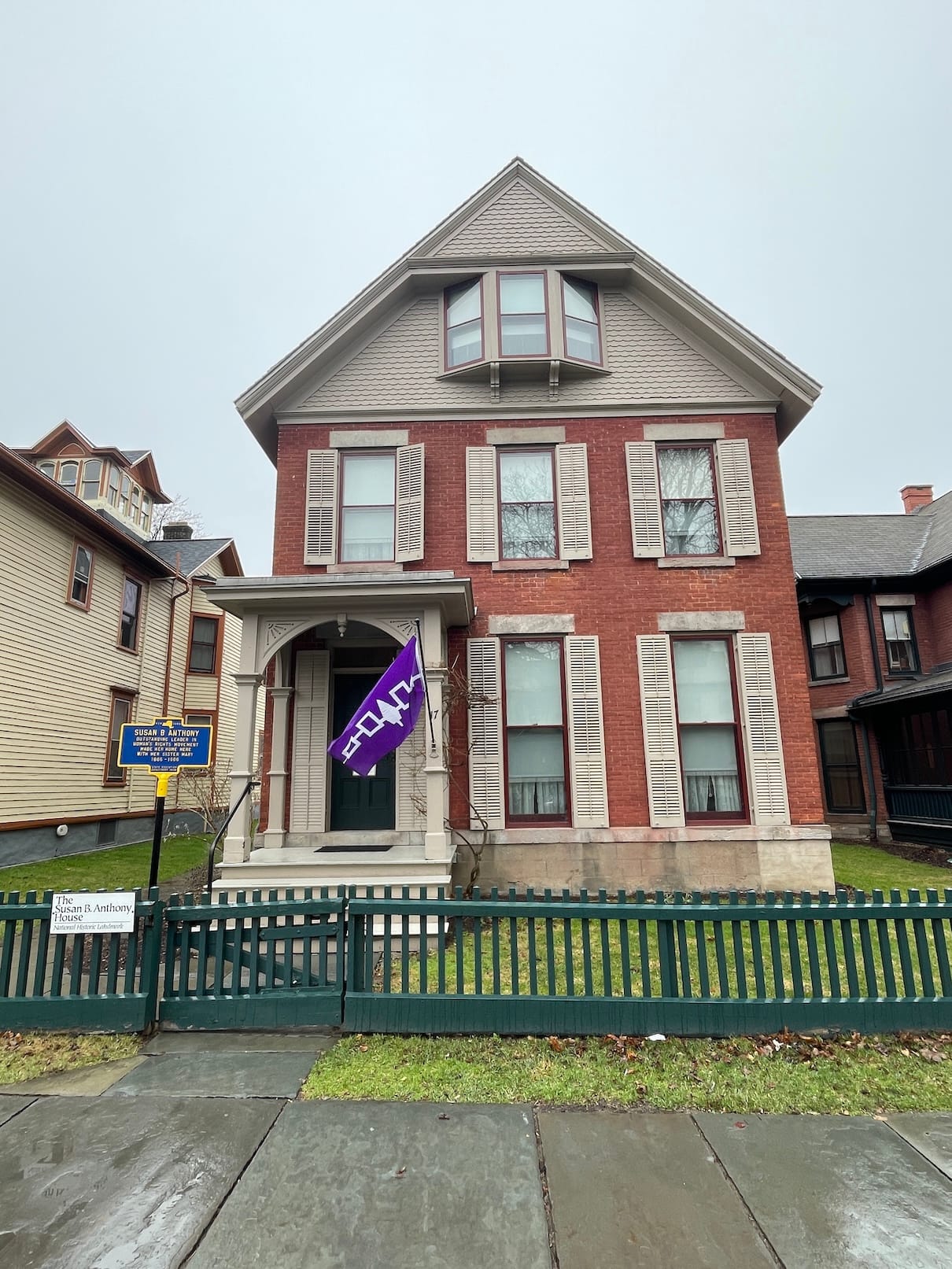
The home and grounds, though not expansive, are well maintained, as is the surrounding neighborhood, which includes homes built during the same era. A small park with a statue of Susan B. Anthony and Frederick Douglass is within walking distance. Details like original slate sidewalks and a stone platform for carriages have a transporting effect.
Due to the nature of the tour (confined space and the need to be able to hear the guide) and the restrictions of the house (visitors are not permitted to touch anything, including the walls), the tour is not suitable for young children. It is probably best for ages 8 and older, and the gift shop is not recommended for children.
The house was the home of Susan B. Anthony from 1865 until 1906. Susan B. Anthony was an American social reformer, activist, and leader in the movement for the cause of women’s suffrage. Anthony argued that, from a universal natural rights perspective, women are persons and citizens and as such entitled to certain inalienable rights. She sought to expand women’s moral influence beyond the domestic realm and into the civil and political realms of society.
The house was also the headquarters of the National American Women’s Suffrage Association while Anthony was president; the location of Anthony’s arrest for attempted voting in 1872; the place where she co-authored her biography; and the location of her death in 1906. Notable guests to the house included Clara Barton, Ida B. Wells, Anna Howard Shaw, Charlotte Perkins Gilman, Ida Husted Harper, and Carrie Chapman Catt.
Owned By: National Susan B. Anthony Museum and House
Operated By: National Susan B. Anthony Museum and House
Government Funded: Yes
Did you know?
Susan B. Anthony is the “lady with the alligator purse” in the famous children’s jump rope rhyme; the Susan B. Anthony House has Anthony’s faux alligator handbag on display.
Recommended Reading
- Pity for Evil: Suffrage, Abortion, and Women’s Empowerment in Reconstruction America by Madeleine McDowell and Monica Klem
Reviewed By
Erika Bachiochi
Fellow at the Ethics and Public Policy Center, Director of the Mercy Otis Warren Initiative for Women in Civic Life and Thought at Arizona State University’s School of Civic and Economic Thought and Leadership, and author of The Rights of Women: Reclaiming a Lost Vision
Cecelia Lester
President of Feminists Choosing Life of New York
The opinions expressed above are those of the Reviewer who is providing a good-faith historical assessment to educate the public. Reasonable opinions can vary, and the Reviewer’s opinion is not necessarily the opinion of The Heritage Foundation or its affiliates.