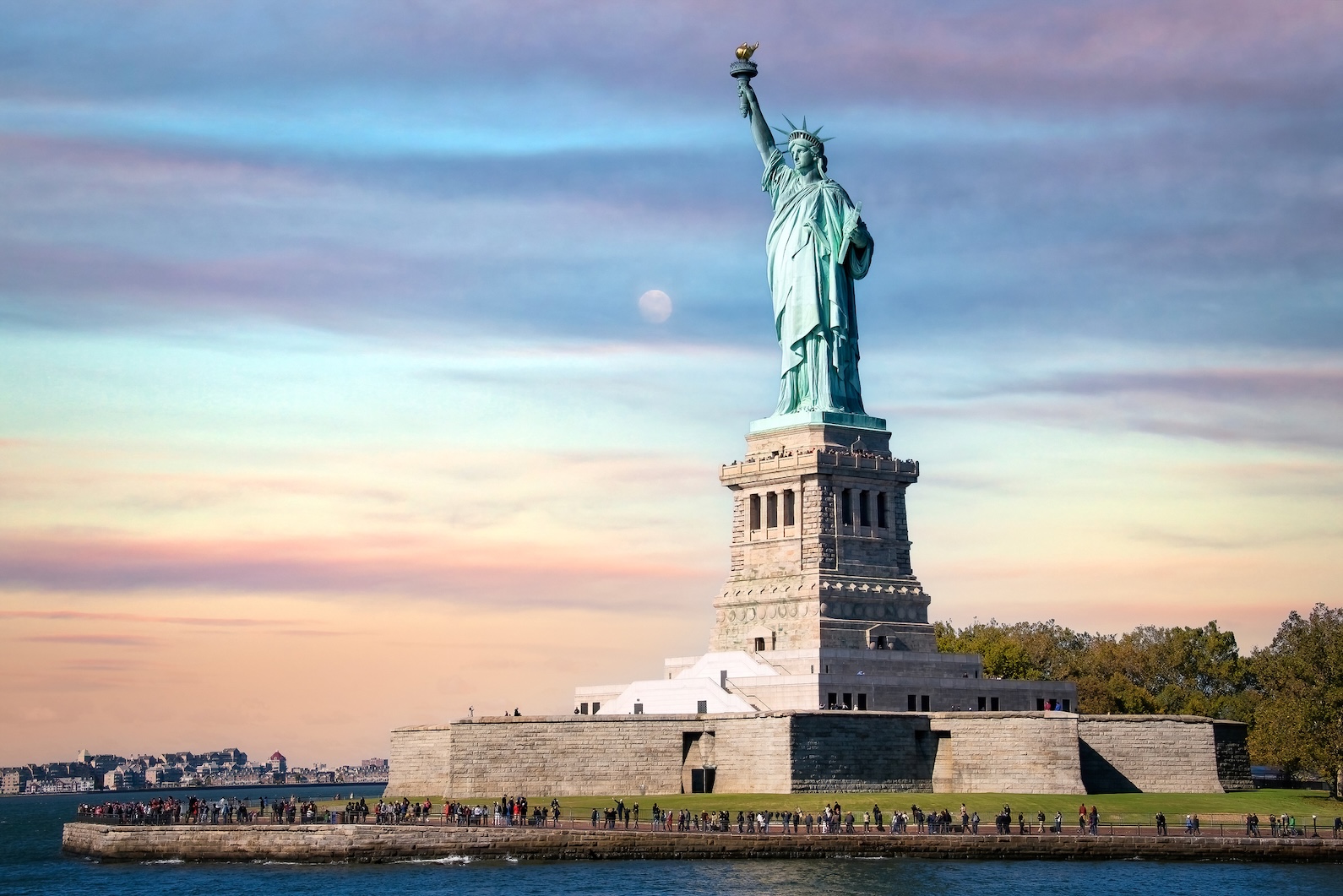
Statue of Liberty National Monument
A globally recognized symbol of freedom and democracy, and America’s main immigration processing center from 1892 to 1954
Site Details
Pin location is approximate.
Ferries from Battery Park, NYC and Liberty State Park, NJ
New York, NY 10004
Family Friendly?
Yes
Visitors Per Year
3,750,000
The only way to visit Liberty and Ellis Island is via Statue City Cruises. The cost of the ferry includes visits to Liberty and Ellis Island and the museums they house and can be purchased from New York (Battery Park) or New Jersey. Advance ticket reservations are strongly recommended, and are required weeks to months in advance for pedestal and/or crown access. To allow time to visit both islands, choose a morning ferry time. Airport-level security screening is required before boarding the ferry, and there is no place for luggage storage.
The Statue of Liberty:
- Liberty Island is the first of two stops on the ferry. The ferry ride alone offers excellent, close-up views of the Statue.
- Free audio tours are available immediately upon exiting the ferry, but they are not essential to the Liberty Island visit, especially for those who plan to visit the museum.
- Visitors can walk around the base of the statue or climb up to the top of the pedestal or the crown for panoramic views of Manhattan and the harbor. An elevator is available for the top of the pedestal, and only those with appropriate mobility and stamina should attempt to climb the additional 162 narrow steps spiraling up to the crown.
- The new Statue of Liberty Museum (2019) begins with three short, panoramic films outlining the design, engineering, and installation of the Statue.
- Additional exhibits highlight the history of the Statue from its conception, design, and manufacturing through its unveiling and reception in popular culture.
- Two highlights of the museum are seeing the restored original torch on display and getting to see a model of the Statue of Liberty’s toes.
- The museum’s grand finale consists of kiosks where visitors can take a group photo and share the freedoms that are most important to them. These photos are then posted on a large screen at the museum’s exit.
Ellis Island:
- The second stop on the ferry is Ellis Island.
- Visitors can get a free audio tour (highly recommended) at the kiosk inside the museum to the right.
- Highlights of the museum include the Baggage Room where new arrivals checked their belongings, the Registry Room where people recorded their names, rooms where immigrants were screened for various physical and mental health conditions, a re-created dormitory room, and other spaces that discuss new foods and clothing styles the immigrants would have been exposed to.
- One large exhibit houses a collection of treasured items from immigrants’ home countries that they brought with them.
- Other rooms (several closed and under renovation until late 2025) discuss the closure of Ellis Island and immigration in the late 20th and early 21st century.
- One room on the main floor allows visitors to search for records of their ancestors who entered the United States through Ellis Island.
Statue of Liberty: The museum exhibits feature comprehensive and accurate accounts of the creation of the Statue, including its installation and popular reception. All exhibits are supported with photographs, diagrams, historical artifacts, and testimonials.
Ellis Island: The main rooms that the audio tour takes visitors through paint a thorough picture of the first days of an immigrant once they had disembarked on Ellis Island. While most displays are in small rooms that have a narrow focus, every room had a clear purpose and features historical artifacts, photographs, and excerpts from newspaper articles to illustrate the significance of the display. Since many exhibits are currently being redeveloped, there is little to see beyond the main rooms; however, these main areas are the heart of the experience and are well worth the stop on Ellis Island.
Statue of Liberty: Minimal ideological bias is present. The museum celebrates the creation and legacy of one of the most iconic monuments in the United States. One display fairly recognizes that America has not always lived up to its ideal of liberty for all (such as with slavery, suffrage, and Japanese internment). The final display allows visitors to take a photo and select the freedoms that are most important to them. One choice among many is “Identity,” but there are a variety of images to choose from that broadly encompass cultural identities as a whole, ranging from faith traditions to sexual orientation to national ancestry.
Ellis Island: Minimal ideological bias is present. The exhibit entitled “New Eras of Immigration, 1945–Present” discusses how immigration policy in the United States developed from being relatively unregulated to its present, restricted stance. Some signage discusses what is meant by the terms “undocumented” or “illegal” immigrants, but all of these are described as “controversies” or “debates,” and information is communicated relatively objectively. This section is part of a larger exhibit that highlights citizenship and features communities of legal immigrants who have flourished in various areas of America. This area also points out the dangers of illegal immigration, placing people at risk of human trafficking or even death. Overall, the section on modern immigration allows for various viewpoints on a matter of public policy.
Ask at the front desk of the Statue of Liberty Museum and at the Ellis Island Immigration Museum for a “Be a Junior Ranger” worksheet. Children can complete a scavenger hunt on both Liberty and Ellis Island and return it to the front desk for a badge.
The Statue of Liberty is accessible to all up to the pedestal but requires mobility and stamina to climb to the crown. The new museum on Liberty Island makes learning about the Statue of Liberty enjoyable for all ages through a short introductory film on a panoramic screen and interactive exhibits, including a chance to sit on a replica of the Statue’s toes as well as kiosks for group pictures, which are then displayed on a giant screen along with quotes from historical figures about liberty.
The free audio tour offered by Ellis Island Museum makes navigating this museum easier. It comes with a children’s option for ages 5 and over, which shortens the description in each area and focuses on what a child immigrating to the United States might have gone through.
There is a café on each island, but visitors can bring their own food and water and eat outside at either location if they wish. Battery Park has a playground and a unique “Sea Glass Carrousel” that younger children will enjoy.
Statue of Liberty: French abolitionist Édouard de Laboulaye had the idea to build a statue representing liberty, as a gift to celebrate America’s centennial and the two countries’ friendship. Auguste Bartholdi, a French sculptor, designed the statue, titling it, “Liberty Enlightening the World.” Since its unveiling to great fanfare in 1886, the Statue of Liberty has been a global symbol of freedom, democracy, and welcome.
Ellis Island: Originally the site of Fort Gibson, Ellis Island is best known for serving as America’s primary point of immigration from 1892 to 1954. During that time, over 12 million people were processed at the Ellis Island station as they entered the country. After closing in 1954, Ellis Island ceased to be a port of immigration and fell into disrepair until the 1970s when the U.S. government decided to turn the buildings into a national monument. After years of planning and securing private funds, the Ellis Island Immigration Museum opened in 1990.
Owned By: United States Federal Government
Operated By: National Park Service
Government Funded: Yes
Did you know?
While the Statue of Liberty was given to the United States as a gift, the pedestal was paid for by American citizens through one of the nation’s first crowdfunding efforts after Joseph Pulitzer published a plea for Americans to donate to the statue’s foundation. On Ellis Island, there is a room in the museum with computer stations where you can search ship manifests for a record of your ancestors arriving at Ellis Island.
Recommended Reading
- Enlightening the World: The Creation of the Statue of Liberty by Yasmin Sabina Khan
- American Passage: The History of Ellis Island by Vincent J. Cannato
- Island of Hope, Island of Tears: The Story of Those Who Entered the New World Through Ellis Island—In Their Own Words by David M. Brownstone
Reviewed By
Elizabeth-Jane McGuire
Associate Teaching Professor in the Augustine and Culture Seminar Program at Villanova University
The opinions expressed above are those of the Reviewer who is providing a good-faith historical assessment to educate the public. Reasonable opinions can vary, and the Reviewer’s opinion is not necessarily the opinion of The Heritage Foundation or its affiliates.