Paul Revere House
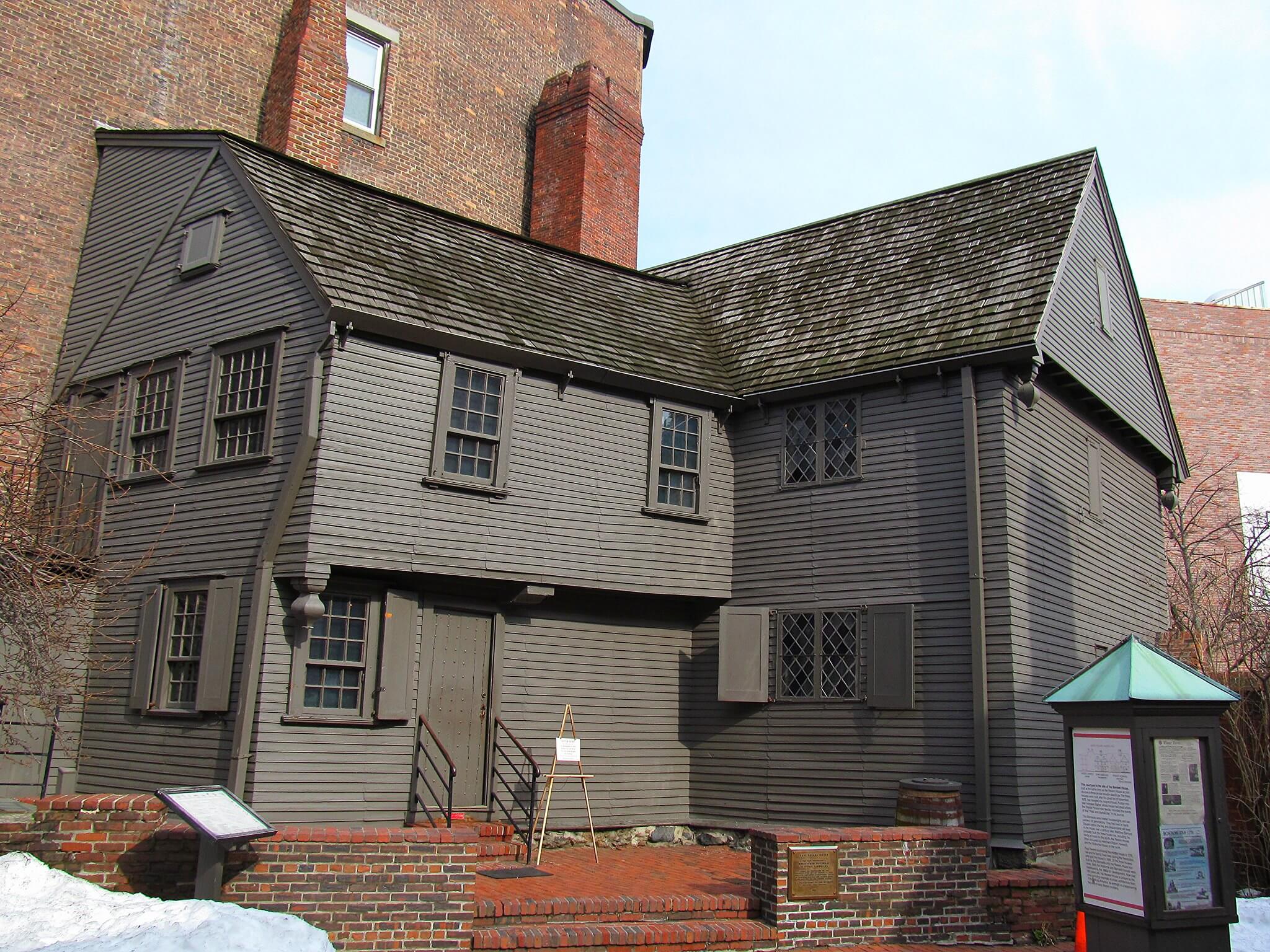
Boston home of the famous American patriot from 1770 to 1800, where he lived and worked during the Revolutionary era
Site Details
Pin location is approximate.
19 N Square
Boston, MA 02113
Family Friendly?
Yes
Visitors Per Year
250,000
- Within the actual house, guides speak about the various rooms and their purposes. A few paces from the house sits the museum, where there are more displays about Revere’s life, colonial Boston, and the American Revolution. Revere provided three accounts of his famous midnight ride, and the museum makes use of them to tell his story, a distilled and somewhat misleading version of which finds its way into Henry Wadsworth Longfellow’s famous poem. Therein, poetic license omits entirely the role of William Dawes, who also provided an alarm to the minutemen but, unlike Revere, eluded capture.
- The house itself, in which photography is prohibited, allows for a walk-through at the visitor’s own pace, with guides present to answer questions. The rooms depict how the Reveres lived. Although the house remains largely as it was, the contents now in it do not, for the most part, reflect what would have filled it 250 years ago.
- The museum includes specimens from Revere’s career in various creative fields. Those displayed include spoons, engravings, false teeth, and a church bell, all made by Paul Revere. Another exhibit details Paul Revere in pop culture, including the Marx Brothers spoof of his ride in the movie Duck Soup, the World War I–era song, “Paul Revere, Won’t You Ride for Us Again?” and, of course, Henry Wadsworth Longfellow’s classic poem, “Paul Revere’s Ride.”
The Paul Revere House meets scholarly standards of accuracy and provides a comprehensive overview of the property’s history. The home that stands matches in almost every way the home in which Paul Revere once lived. The furnishings in the interior provide visitors a sense of how the Reveres lived rather than anything approaching exactness. The material presented is accurate and easy to comprehend.
The site, including the textual displays in the house and the docents who answer questions, sticks to the history of the house and significance of its famous owner. The accompanying museum displays Revere’s craftwork, a timeline of his afterlife in pop culture, and his accounts of his famous ride, but nothing extraneous to push a current agenda.
The house features tight quarters, and the museum and the grounds, given its location in the North End of Boston, follow suit. The house and museum now boast full accessibility, though uneven floors and narrow doorways in the home present challenges. The text-heavy displays and 18th-century artifacts may fail to hold the attention of some youngsters. For those engaged, it provides an education.
The Paul Revere House is one of 16 sites on Boston’s 2.5-mile Freedom Trail, which includes the Old North Church, the Bunker Hill Monument, and the Granary Burial Ground, which is the resting place of Revere, John Hancock, Samuel Adams, Crispus Attucks, and James Otis. Some visitors, to economize time and effort, may wish to walk the trail to visit as many historic sites (most of which are free) as possible. The Paul Revere House sits in Boston’s North End, where the high concentration of restaurants makes it easy to pair the visit with a meal.
The Paul Revere House was owned by Paul Revere from 1770 to 1800. A member of the Sons of Liberty, Revere produced gunpowder for the revolutionary cause, served in the Massachusetts militia, printed local currency, and worked as a governmental courier. While in the house, he served as a silversmith, engraver, hardware store proprietor, husband, father, and much else. He lived in this home, not far from the Old North Church, when he made his famous “midnight ride” to warn the minutemen that the British were going to make their way by water, based on the two-lantern signal. His activities forced him to abandon his property during the occupation of Boston.
Owned By: Paul Revere Memorial Association
Operated By: Paul Revere Memorial Association
Government Funded: No
Did you know?
In addition to his work as a silversmith, Revere served as a dentist who manufactured false teeth and may have cleaned real teeth with the same pumice used to clean metal.
Recommended Reading
- Paul Revere and the World He Lived In by Esther Forbes
- “Paul Revere’s Ride,” by Henry Wadsworth Longfellow
- Paul Revere’s Ride by David Hackett Fischer
Reviewed By
Daniel Flynn
Visiting Fellow at the Hoover Institution, Senior Editor for The American Spectator, and Author of The Man Who Invented Conservatism: The Unlikely Life of Frank S. Meyer
The opinions expressed above are those of the Reviewer who is providing a good-faith historical assessment to educate the public. Reasonable opinions can vary, and the Reviewer’s opinion is not necessarily the opinion of The Heritage Foundation or its affiliates.