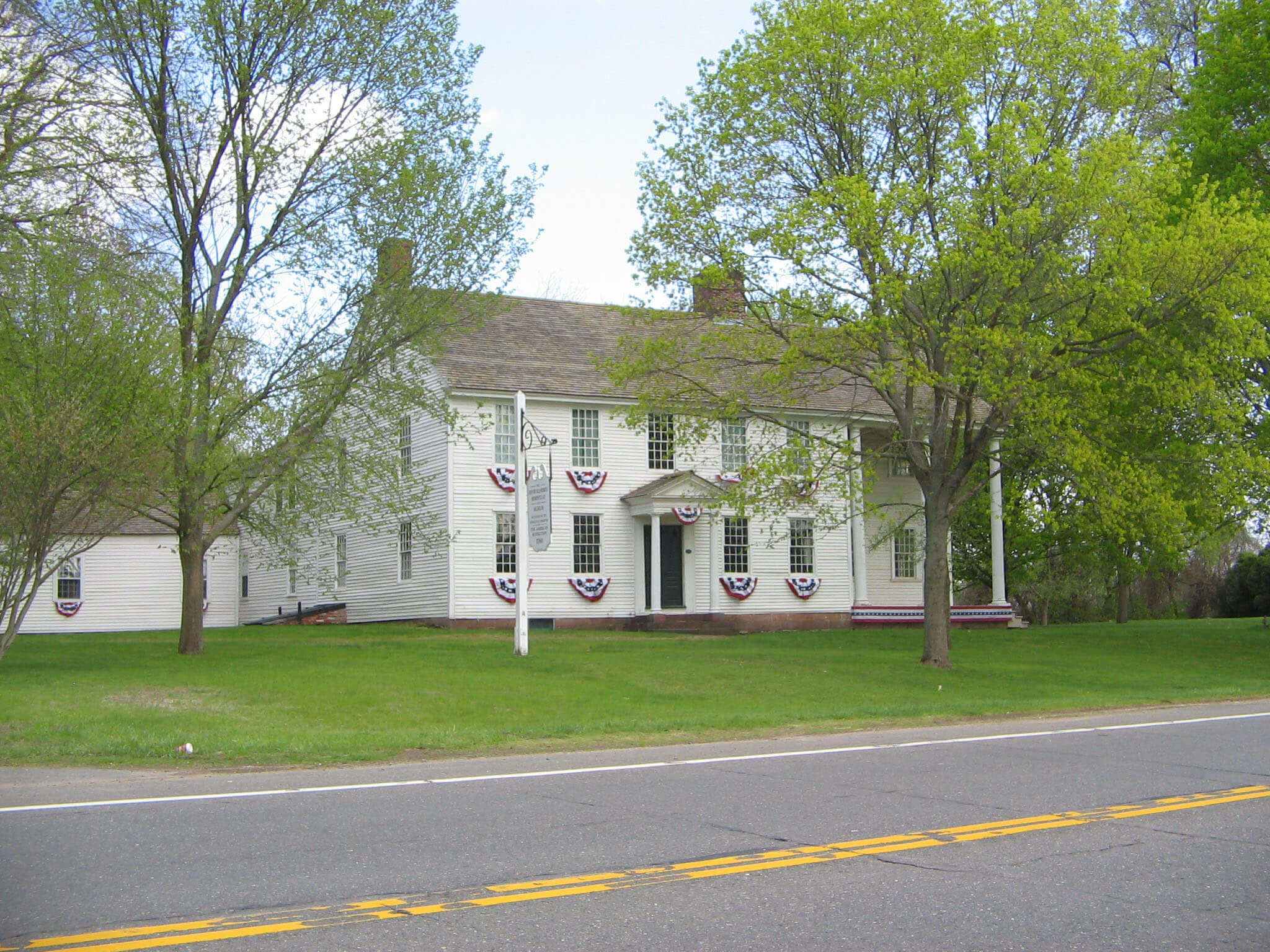
Oliver Ellsworth Homestead
Home of one of the most important Founders, both during the Philadelphia Convention and after, who became the third Chief Justice of the United States
Site Details
Pin location is approximate.
778 Palisado Ave
Windsor, CT 06095
Family Friendly?
Yes
Visitors Per Year
55,000
The Oliver Ellsworth Homestead is open on select days and seasonally. Tours of the mansion need to be arranged in advance. Touring the house gives the visitor a clear idea of Ellsworth’s centrality to his town’s life and the importance of his family to him. Besides that, the quite well-informed guides present interesting—albeit somewhat specialized or arcane—material clearly. This includes, for example, describing Ellsworth’s role in drafting Article III of the U.S. Constitution (the judicial article) and, as a senator, the Judiciary Act of 1789—which created the federal judiciary.
Apart from the mansion, there is an adjacent building that contains a half-dozen vertical displays about seven feet high—each a portrait with text below it—of non-Americans with some connection to the American Revolution. For example, one highlights Spanish Admiral Bernardo de Galvez, who, from his position of authority in the Caribbean, spirited various much-needed supplies to the Americans.
There is a display that details Ellsworth’s religious beliefs: He was a devout 18th-century Connecticut Calvinist. However, it is blocked by stacked chairs, and a DAR guide indicated that, “People say it’s old-fashioned. We’re thinking of getting rid of it.” Such a display helps visitors learn about Ellsworth, and his religious beliefs were important, so the removal of that exhibit seems ill-advised.
The displays in the outbuilding behind the mansion seem out of place primarily because they are not directly related to the house or to the life of Oliver Ellsworth.
The tours are outstanding, and the guides are particularly knowledgeable. No issues with ideological bias are present with the tour itself.
While the place is certainly family friendly, there are no activities specifically for small kids.
Oliver Ellsworth was a chief ally of fellow Connecticut delegate Roger Sherman in the Philadelphia Convention at which the U.S. Constitution was written. In that role, he pushed for Sherman’s Connecticut Compromise—which gave us population apportionment of the House of Representatives and state equality in the Senate. He also joined Sherman in advocating for the Commerce and Slave Trade Compromise, which allowed Congress to pass navigation and tariff acts with a simple majority in exchange for substantial constitutional protections for slavery. In addition, Ellsworth and New Jersey’s William Paterson were the delegates most responsible for the language of Article III of the Constitution, which provides for a federal judiciary, and the two of them joined in the U.S. Senate in writing the Judiciary Act of 1789—creating the structure of the Federal Judiciary that we still have today. Too, Ellsworth played a prominent part in securing ratification of the U.S. Constitution in Connecticut. His service as the third chief justice of the United States, though not very significant in itself, is best understood as a kind of cherry on top of his momentous career—as a reward from President Washington and the U.S. Senate in recognition of his important career of service to Connecticut and the United States generally.
Owned By: Connecticut Daughters of the American Revolution
Operated By: Connecticut Daughters of the American Revolution
Government Funded: Yes
Did you know?
During the Connecticut Ratification Convention of 1788, Oliver Ellsworth assured skeptical delegates that, “If the United States go beyond their powers, if they make a law which the Constitution does not authorize, it is void and the judicial power…will declare it to be void.”
Recommended Reading
- Founding Federalist: The Life of Oliver Ellsworth by Michael Toth
Reviewed By
Kevin R. C. Gutzman
Professor of History at Western Connecticut State University
The opinions expressed above are those of the Reviewer who is providing a good-faith historical assessment to educate the public. Reasonable opinions can vary, and the Reviewer’s opinion is not necessarily the opinion of The Heritage Foundation or its affiliates.