Noah Webster House
Birthplace and childhood home of the “schoolmaster of the American Revolution,” who created the American dictionary
Site Details
Pin location is approximate.
227 S Main St
West Hartford, CT 06107
Family Friendly?
Yes
Visitors Per Year
10,000
The house tour is self-guided with an easy-to-use computer tablet. The tour can take up to an hour depending upon the scope and depth of the tourist’s interests. In each room, the tablet offers a curated story, biographical details about Webster and his family, a recorded actor-interpretation of Webster in his own words commenting on ideas and events of his day, various presentations by historians and archeologists about early American culture and artifacts, and a “Kid’s Corner” presentation for children by children in period costumes talking about the life and times of Noah Webster. Private tours for groups of 10 or more can be arranged in advance.
Visitors are encouraged to watch a short introductory video about Noah Webster as an orientation to the house tour. The film acknowledges that today Webster is best known for the dictionary that bears his name but details a more comprehensive presentation of his life and contribution to American history. Viewers learn that Webster was the bookish son of Connecticut farmers who mortgaged their farm to send him to Yale College, that Webster was a schoolmaster, prolific author of newspaper articles, political essays, textbooks, and even a translator of the Bible. His aim was to shape a national people and cultural identity through language, story, and religious, educational, political and legal institutions.
A modest exhibit area supplements the house tour with information about Webster’s Dictionary, his “Blue Backed speller” (a grammar and spelling book for children), and other textbooks. Other displays include information about Webster’s family and their farm and its history, the house’s New England-style architecture, and the socio-economic development of the local area during the colonial period and early republic. Artifacts include original editions of Webster’s A Grammatical Institute of the English Language (1783), A Compendium of the American Language (1806), and An American Dictionary of the English Language (1828).
Manicured gardens surround the house with plantings native to an 18th and 19th century New England farm.
Noah Webster House is meticulously and beautifully maintained and presents a charmingly attractive view on 227 South Main Street in West Hartford, Connecticut. Visitors may want to budget one to two hours for a visit.
Noah Webster House meets the scholarly standards of accuracy and comprehensiveness expected of a public history museum. Its curated story even includes elements of religion and spirituality. In an increasingly secularized region and era, the Noah Webster House is a refreshingly notable exception to other religiously sanitized museums. Inclusion of its religious narrative includes, for example:
- Multiple references to Noah Webster’s father, who was a deacon and active member of the local Congregationalist church.
- An exhibit about Webster’s family life revealing that the tragic death of Noah’s adult daughter was followed by his own “religious awakening.”
- The museum’s introductory video informing the viewer that Webster’s dictionary definition of love includes the love of God, “The love of God is the first duty of men and this springs from just views of his attributes or excellencies of character, which afford the highest delight to the sanctified heart.”
- The self-guided tour’s computer tablet featuring an actor who interprets Webster “in his own words” quoting from Webster’s introduction to his Common Version: “The Bible is the chief moral cause of all that is good, and the best corrector of all that is evil in human society; the best book for regulating the temporal concerns of men, and the only book that can serve as an infallible guide to future felicity.”
There are no apparent issues with ideological bias. For example, slavery, race, the roles of women and men in early American society are discussed in the curation with accuracy and in appropriate proportion in a manner that is balanced and fair. Webster’s advocacy for the abolition of slavery is highlighted.
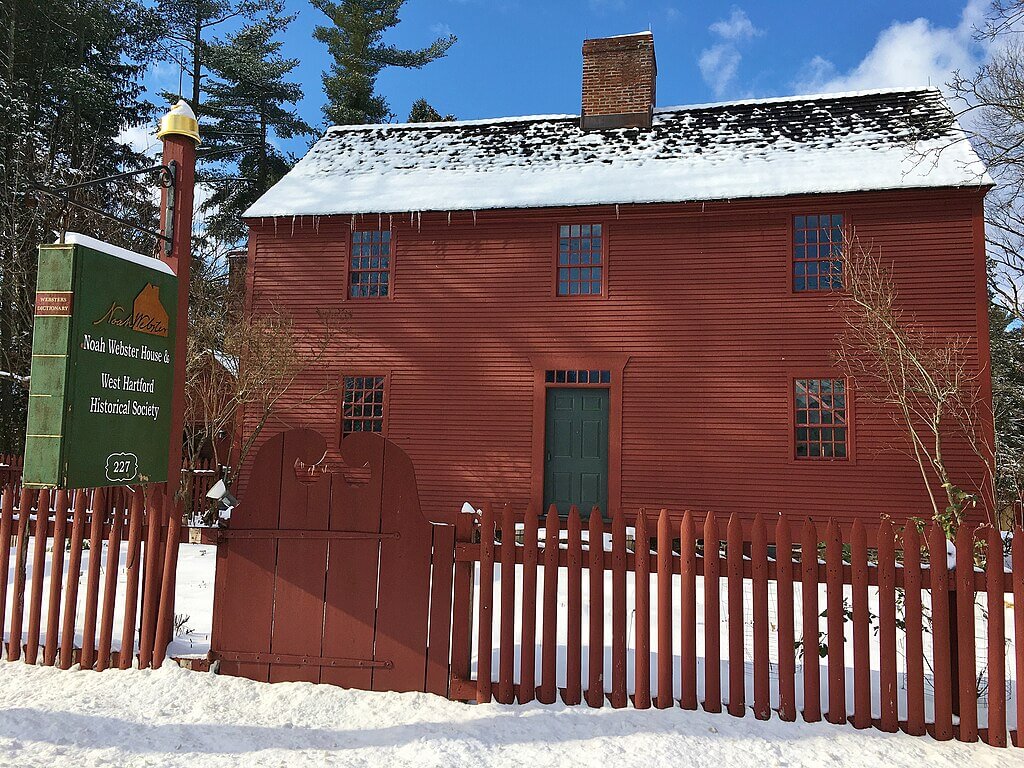
Most visitors are school children. Noah Webster House is an 18th century, two-and-one-half story wood-frame and clapboard-sided structure with a large central brick chimney and center entrance. It is furnished to portray domestic home and farm life in New England circa 1774, the year Webster departed for studies at Yale College. The house and site are especially family friendly. Because most of its annual visitors are school children, the grounds, house tour, and exhibit area are tailored to children’s interest, engagement, and education. Special programs and activities for children are offered periodically throughout the year. A modest museum and gift shop on site offers books and educational materials for both adults and children. Ample restaurants are within a mile of the Noah Webster House at the center of West Hartford.
One often thinks of the American Revolution in terms of ideas, politics, and war. Noah Webster’s story reminds us that, in the aftermath of the war for independence and the framing of the new republic’s constitution, there yet remained a significant cultural and civilizational task: to make a great people and nation. Webster was called and committed to that task. At the center of this undertaking was language. The curse of builders of biblical Babel was a confusion of language, but in building the new American nation, Webster was resolved to avoid their fate. Today, he is acclaimed as a lexicographer and for the dictionary that made his name famous, but that project was only a piece of a larger national project designed to make America great.
Webster was a prolific author of newspaper articles, political essays, and textbooks whose aim was to shape a national people and cultural identity through language, story, and religious, educational, and political institutions. His Grammatical Institute of the English Language is a work consisting of the famed “Blue Backed speller” (1783), a grammar (1784), and a reader (1785). These textbooks and others included moral and religious precepts scattered throughout. Webster’s American Dictionary of the English Language (1828) emphasized the virtues of regulating human passions and individualism, submission to authority, and fear of God; they were necessary for the making and maintenance of the new American order. But Webster believed that the most important and crowning achievement of his life’s work was a modernized American translation of the Bible—the Common Version (1833). Webster’s revision of the King James Bible was his capstone in giving the fledgling United States a body of literature for deriving correct language. The Bible gave Americans Scripture—sacred story—for daily reading, which had the effect of reforming common speech and helping to form a common identity. It would, he believed, order souls in the new republic. In his words, “The Bible is the chief moral cause of all that is good and the best corrector of all that is evil in human society; the best book for regulating the temporal concerns of men.” Language and story— especially sacred story—are centrally important to cultural and political revolutions.
This is no less true of the American Revolution. Therefore, it can be reasonably argued that Noah Webster was the schoolmaster of the American Revolution. The Noah Webster House is significant as the birthplace and childhood home of America’s schoolmaster. It is the place of his family upbringing, early community, and church life. It is the farmhouse on the very land that was mortgaged to educate a 16-year-old precocious and bookish boy at Yale College who later went on to multiple and great labors in cultivating a distinctively American culture and civilization.
Owned By: Town of West Hartford, Connecticut
Operated By: West Hartford Historical Society
Government Funded: Yes
Did you know?
In addition to publishing the first American dictionary, Noah Webster published the Common Version, the first modernized American revision of the King James Bible.
Recommended Reading
- The Forgotten Founding Father: Noah Webster’s Obsession and the Creation of an American Culture by Joshua Kendall
- “Noah Webster: The Connecticut Yankee as Nationalist,” in After the Revolution by Joseph Ellis
- The Life and Times of Noah Webster An American Patriot by Harlow Giles Unger
Reviewed By
Reverend Alan R. Crippen II
Executive Director and Chaplain of the Hillsdale College Blake Center for Faith & Freedom in Somers, Connecticut
The opinions expressed above are those of the Reviewer who is providing a good-faith historical assessment to educate the public. Reasonable opinions can vary, and the Reviewer’s opinion is not necessarily the opinion of The Heritage Foundation or its affiliates.