Nevada State Capitol
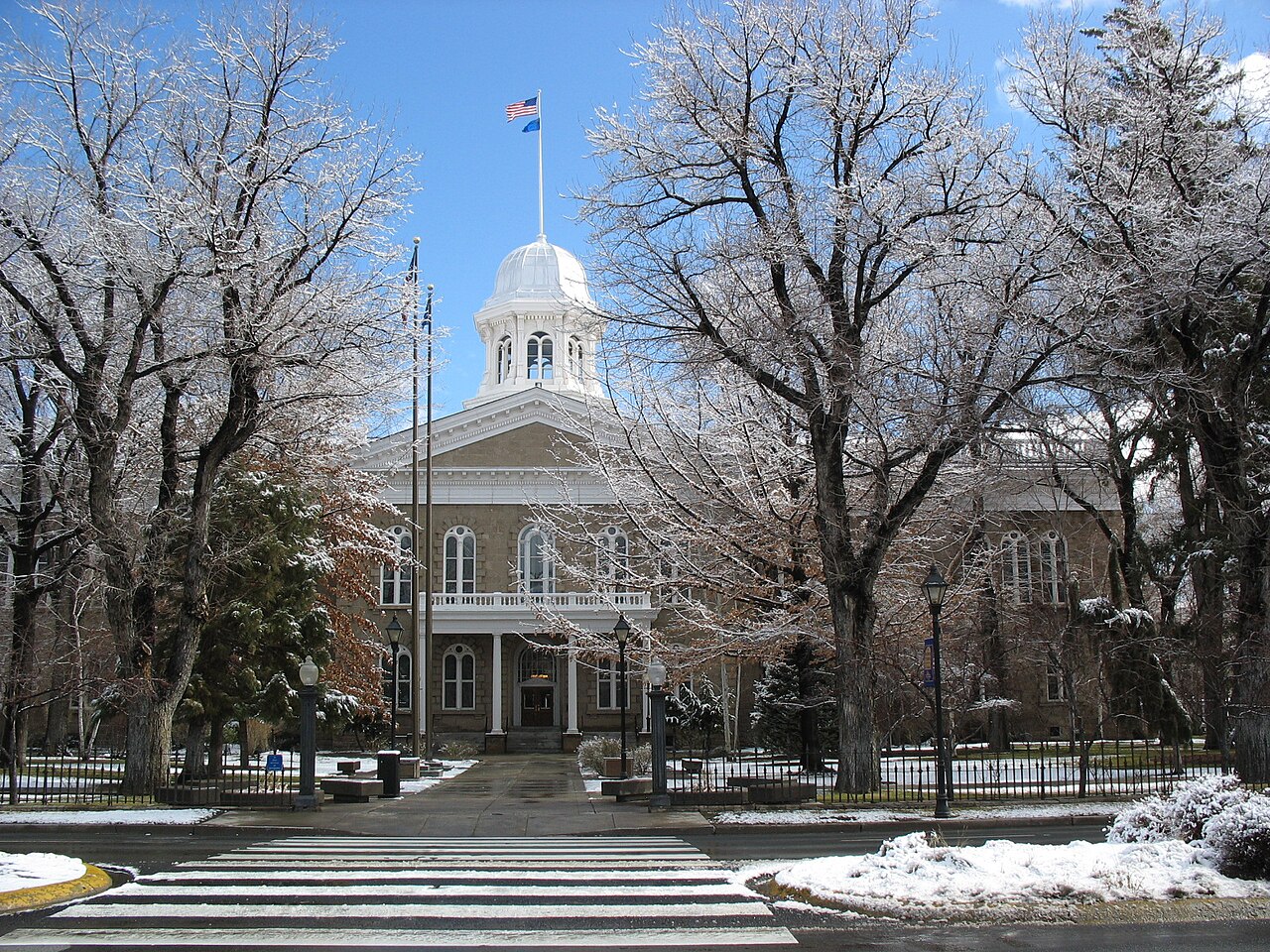
Capitol of the “Battle Born” state, built in 1870–1871
Site Details
Pin location is approximate.
101 N Carson St
Carson City, NV 89701
Family Friendly?
Somewhat
Visitors Per Year
Unknown
Self-guided tours may be taken of the capitol building and its grounds on Mondays through Fridays from 8:00 a.m. to 5:00 p.m., and on Saturdays from 10:00 a.m. to 3:00 p.m. The capitol is closed on Sundays. Groups, including schools, may make an appointment for a guided tour that lasts about 90 minutes.
In addition to being the Nevada State Capitol building, the interior, not including the governmental offices, is devoted to depicting the state’s history from before statehood to present day.
- In the building, visitors may walk into the old State Senate and Assembly chambers, the Nevada Supreme Courtroom, the Sesquicentennial Exhibit, and the Women’s Exhibit Hall.
- On the first floor in the center of the hallways, tourists can view the Sarah Winnemucca statue, a replica of the figure displayed in Statuary Hall in the U.S. Capitol.
- The photographs of Nevada’s 31 past governors hang in the hallways on the first and second floors. A photograph of the current governor, Joe Lombardo, hangs in his reception room and can be seen by visitors from the first-floor hallway.
- At the time the State Capitol was built, the Nevada Supreme Court courtroom was on the second floor. Visitors may enter this room to observe the three-judge bench, counsel table, and chairs, and photographs of some of the early justices.
Visitors can tour the Sesquicentennial Exhibit in the old Nevada State Senate Chambers, which was created for the state’s 150th anniversary in 2014. Upon entering the hall, visitors will see a gigantic map of the state that details the names and locations of Nevada’s 17 counties and the state’s historic places, monuments, and museums. The exhibits contain numerous artifacts and photographs of the state’s history.
These exhibits begin with prehistoric times when Native American tribes lived in the area and continue chronologically through the state’s history up to Nevada’s Sesquicentennial Anniversary in 2014. One of the exhibits is a copy of the Emancipation Proclamation, signed by President Abraham Lincoln in January 1863. The original document was displayed in the Nevada Museum of Art in Reno in 2014.
Visitors can also view the Women’s Exhibit Hall on the second floor of the Capitol, which contains select artifacts and numerous photographs of women who contributed to Nevada’s history.
The Capitol offers an accurate and comprehensive presentation of the history of Nevada, from prehistoric days to the present. Its exhibits provide educational resources, artifacts, and displays that inform visitors about the state’s history. Additionally, the state’s industries of mining, agriculture, gaming, and tourism are represented in unique displays in the Sesquicentennial Exhibit. This exhibit shows not only Nevada’s interesting history, but the state’s contribution to the development of the United States of America.
No ideological bias is apparent.
A stairway leads to the front door of the Capitol building, but a ramp is available in the back of the building, and an elevator provides easy access to the exhibits and photographs on the second floor. The labels by each governor’s portrait are in small print and located high up on the walls, making them difficult to read. Additionally, more than a few signs on the exhibits are quite lengthy and require a lot of time to read in full.
The Sesquicentennial Exhibit, which will be of interest to children and adults alike, is much more accessible. Many of the exhibits are interactive and are located at a level that children can reach and operate for better understanding of the information presented. Adults can interact with these exhibits too.
Nevada joined the Union in 1864. President Abraham Lincoln needed two more votes in the U.S. Senate to support his position on the Thirteenth Amendment to abolish slavery. At the time, Nevada was a territory with a small population of mostly single men searching for gold.
Territorial officials held a constitutional convention in Carson City to draft a state constitution pursuant to the Enabling Act to become a state. On July 4, 1864, the voters rejected this proposed constitution because of the method of taxation on the mines. On July 27, 1864, the delegates to the second convention adopted the Enabling Act and new constitution. In September, the voters approved the documents because the proposed method of taxation on the mines would be on net proceeds, not on the land of the mine.
Copies of the constitution were sent to Washington, D.C.—one by overland mail and one by sea. Neither copy arrived in time to admit Nevada to the Union before the presidential election in November 1864. Consequently, Territorial Governor James Nye authorized the sending of a telegram to Washington, D.C. The message was the longest telegram sent to that date. The transmission took days and cost $4,303.27. When President Abraham Lincoln received the message, he signed the Proclamation on October 31, 1864, admitting Nevada to the Union. Nevada became a state in time for the General Election in 1864. In the Sesquicentennial Exhibit Hall, visitors will find a display on this historical telegram.
Architect Joseph Gosling designed the building following the Neoclassical-Italianate style. Contractor Peter Cavanaugh built the structure using sandstone mined at the Nevada State Prison.
Located behind the Capitol, though easy to miss, is a tree with a plaque that states that the local Daughters of the American Revolution (DAR) planted and dedicated the tree to America’s first President, George Washington, in 1932. The plaque on the tree states:
Washington first took command of the American Army under the grandparent of this Elm at Cambridge Mass. July 3, 1775. Tree raised and given by Maryland DAR. Marked by the Nevada DAR. Tree is planted as part of the two hundredth anniversary of the birth of George Washington. 1732–1932.
Owned By: State of Nevada
Operated By: State of Nevada
Government Funded: Yes
Did you know?
In 1864, during the Civil War, Nevada became the 36th state to join the Union. Thus, Nevada chose the motto “All for Our Country” for its state seal and “Battle Born” for its state flag.
Recommended Reading
- A Short History of Carson City by Richard Moreno
- Buildings of Nevada by Julie Nicoletta
Reviewed By
Patricia D. Cafferata
Esq., Nevada Historian
The opinions expressed above are those of the Reviewer who is providing a good-faith historical assessment to educate the public. Reasonable opinions can vary, and the Reviewer’s opinion is not necessarily the opinion of The Heritage Foundation or its affiliates.