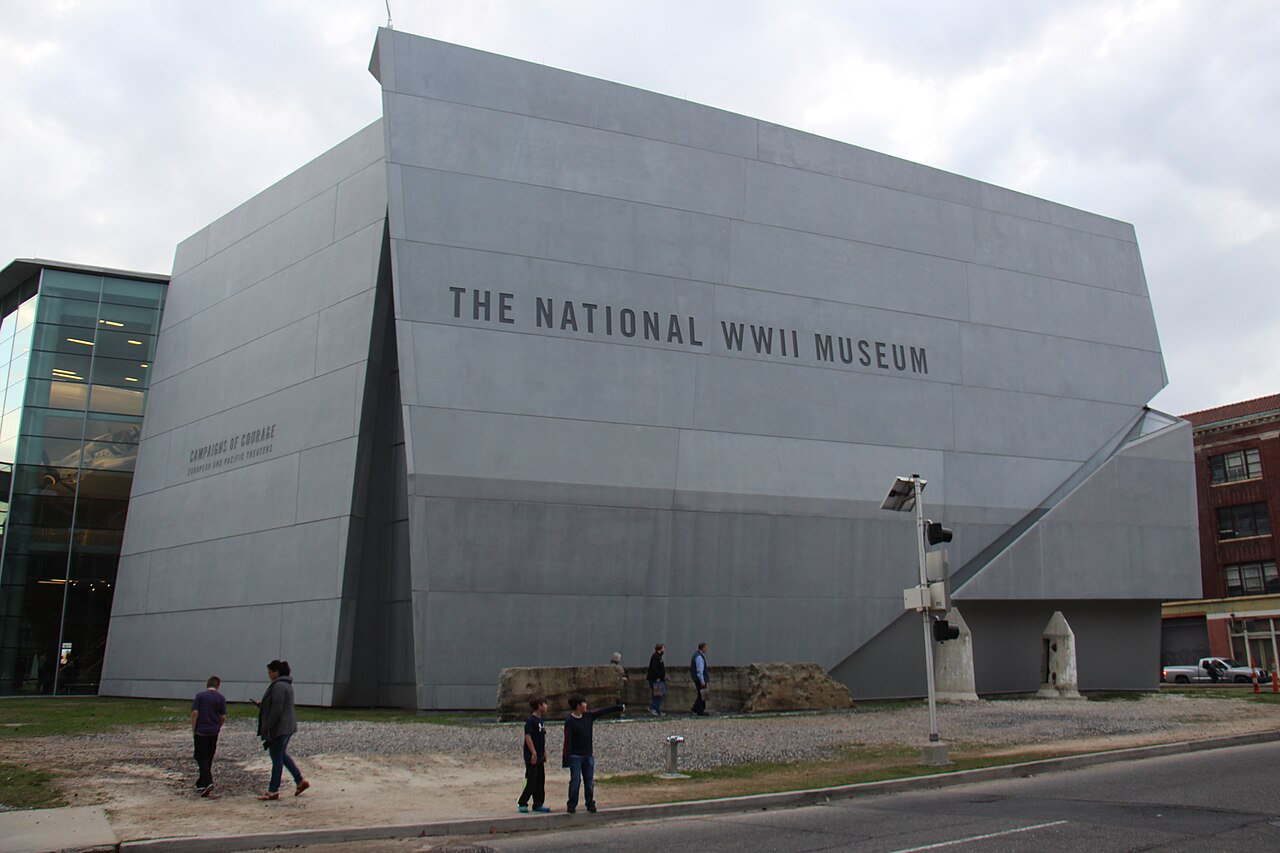
National World War II Museum
Congressionally designated museum in New Orleans that documents the American experience in World War II
Site Details
Pin location is approximate.
945 Magazine St
New Orleans, LA 70130
Family Friendly?
Somewhat
Visitors Per Year
700,000
The National World War II Museum is quite extensive, with several permanent exhibits and rotating exhibits. Visitors could easily spend an afternoon or even a whole day exploring the museum.
- Exhibits include The Road to Tokyo, The Road to Berlin, The Arsenal of Democracy, Final Mission: the USS Tang Submarine Experience, The D-Day Invasion of Normandy, Bayou to Battlefield, The US Merchant Marine Gallery, The Priddy Family Foundation Theater, the Beyond All Boundaries cinematic experience, and Forces of Freedom at Home and Abroad (1945–Present).
- The US Merchant Marine Gallery highlights the important and often overlooked contributions of the U.S. Merchant Marine, a service whose role is just as important as it was in the 1940s, given the return of great-power competition in the Indo-Pacific. Visitors learn about the civilian merchant mariners who risked their lives delivering troops and military equipment overseas, facing German U-boats and the Japanese fleet to do so.
- There are guided tours available, including the Europe & Pacific Guided Tour and the Home Front Guided Tour. The Home Front tour “highlights the sacrifices, difficulties, and triumphs of everyday Americans in the war effort, especially women, African Americans, and Japanese Americans.”
The Road to Tokyo, The Road to Berlin, The USS Tang Submarine Experience, and the US Merchant Marine Gallery are especially good, with impressively high-quality and well-designed exhibits (some of them interactive) and videos throughout that focus on the experience of American service members fighting in the Atlantic and Pacific theaters of World War II. These exhibits are largely free of politicized language or diversity, equity, and inclusion ideology and would serve as an excellent introduction to the history of World War II for families.
The museum has provocative and misleading exhibit titles throughout that have little to do with World War II and more to do with a historical narrative attacking the United States as a hypocritical and oppressive country. For example:
- “Second Class Citizens.” Despite acknowledging that Hispanics and Native Americans served in racially integrated units alongside white soldiers, an exhibit refers to them as “Second Class Citizens.”
- “United but Unequal.” This exhibit attacks America as hypocritical for fighting enemies that “promoted policies of racial superiority and genocide” while being oppressive at home.
Some discussion of segregated units and the internment of Japanese Americans is warranted, but the museum goes beyond what would be a reasonable way to discuss these issues and places them at the heart of the narrative in a way that is divisive. More emphasis on the impressive contributions of African Americans and Japanese Americans, and less focus on accusing America of crimes, would be a better approach.
- Most egregious is the Forces of Freedom at Home and Abroad (1945–Present), which is entirely out of place in a museum ostensibly about World War II. This exhibit is primarily about the feminist movement, gay rights movement, and the civil rights movement from the 1950s to the 1970s, and features figures like Gloria Steinem. These exhibits continue the narrative that America was and is a deeply flawed country and undermine the allegedly unifying message of the museum. Among other things, this exhibit features a Ku Klux Klan hood on display. The space containing the exhibits dedicated to DEI could be better used highlighting another battle or Medal of Honor recipient.
The museum consistently presents an ahistorical reading of World War II as primarily an ideological struggle against “racial superiority” and repeatedly highlights discrimination within the United States as American hypocrisy during this ideological struggle. This narrative ignores the great–power politics of the day and the very real fact that America was primarily fighting because Japan attacked it and then Germany declared war on it, and further ignores the large role played by the totalitarian Soviet Union in the Allied victory.
Families should spend their time exploring the exhibits about the experience of U.S. service members fighting for their country. The Road to Berlin and The Road to Tokyo are very well done and very educational. The exhibits and videos are engaging, and children interested in the military will thoroughly enjoy them. For children who would enjoy a more interactive exhibit, the US Merchant Marine Gallery and USS Tang Submarine Experience allow visitors to see what it was like to be on a U.S. warship at sea.
Families might want to skip Forces of Freedom at Home and Abroad (1945–Present), which has nothing to do with World War II.
The National World War II Museum should be about World War II and the role the United States played in it, presenting a unifying message of a nation that was “suddenly and deliberately attacked” by Japan and then Germany and Italy and fought to defeat the Axis powers decisively. In the face of aggression by the Axis powers, Americans came together, built an extraordinary military, and fought all over the world to defeat the aggressors.
The United States, faced with a two-front war, was forced to fight concurrently in the Atlantic and the Pacific. As the U.S. entered the war, the Axis powers controlled much of Europe and Asia, and the United Kingdom and Soviet Union had faced catastrophic defeats in both theaters. Americans reacted to the attack on Pearl Harbor by volunteering in huge numbers as the United States used its massive civilian industry to build a defense industrial base and churn out the ships, planes, and tanks needed to fight and win this two-front war.
Learning this history helps Americans understand the world that American victory in World War II built, with structures that persist to this day. Some of the biggest U.S. military bases abroad are still in Germany, Japan, and Italy, for example, and the United Nations Security Council is composed of the victors of World War II: the United States, Russia, the United Kingdom, China, and France.
The National World War II Museum should expand on these themes by focusing on the history of American troops fighting in World War II, with more exhibits like The Road to Tokyo, The Road to Berlin, The USS Tang Submarine Experience, and the US Merchant Marine Gallery.
The National World War II Museum is mostly a great experience, and the military-focused exhibits are exceptionally well done. Families will enjoy visiting the museum, with the likely exception being the non-military, politically divisive exhibits.
Owned By: The National WWII Museum, Inc.
Operated By: The National WWII Museum, Inc.
Government Funded: Yes
Did you know?
Congress designated the museum in New Orleans as the official World War II museum of the United States.
Recommended Reading
- Band of Brothers by Stephen E. Ambrose
- The Longest Day by Cornelius Ryan
- With the Old Breed by Eugene Sledge
Reviewed By
Wilson Beaver
Senior Policy Advisor for Defense Budgeting and NATO Policy in the Douglas and Sarah Allison Center for National Security at The Heritage Foundation
The opinions expressed above are those of the Reviewer who is providing a good-faith historical assessment to educate the public. Reasonable opinions can vary, and the Reviewer’s opinion is not necessarily the opinion of The Heritage Foundation or its affiliates.