National Portrait Gallery
The museum displays an extraordinary range of portraits of historical figures on display, with considerable variation in artistic quality, which can itself be instructive. Gilbert Stuart’s “Lansdowne” portrait of George Washington (1796) is the nation’s most important painting of an American President.
Site Details
Pin location is approximate.
8th St NW & G St NW
Washington, DC 20001
Family Friendly?
Somewhat
Visitors Per Year
1,000,000
The National Portrait Gallery is home to thousands of portraits and includes both permanent and temporary exhibits. The gallery offers “Highlights” tours led by volunteer docents at 12:00 p.m. and 2:30 p.m. daily. No reservations are needed, but last-minute cancellations may occur due to docent unavailability. Exhibits include:
- “Out of Many: Portraits from 1600 to 1900,” occupying a first-floor wing of the Patent Office Building, which is now the Donald M. Reynolds Center for American Art and Portraiture. Galleries comprising the exhibit are mostly devoted to historical periods and associated themes such as “Exploration and Colonization,” “Cultural Identity,” and “Invention and Industry.” The Civil War receives extensive coverage. The fault lines of gender, race, and class are emphasized in the exhibit’s introduction: “Portraiture—particularly before the advent of photography in 1839—reflects the reality of unequal economic and social structures.… [Y]ou will find that the portraits of wealthy, powerful people greatly outnumber those without such status. There are more images of men than of women, and more pictures of people of European descent than those of other backgrounds.” The fact remains that many interesting portraits are on view here—of well-known and more obscure personages alike. Sometimes, more important Americans receive more impressive artistic treatment. But not always.
- The “America’s Presidents” exhibit on the second floor, which is the only venue, apart from the White House, in which portraits of all past Presidents are on view. The portraits reflect divergent modes of artistic representation—traditional, realist, impressionistic, photo-realistic, and even surrealistic—but these are scarcely addressed in the accompanying texts. The progressive political slant in the textual commentary is less pronounced than elsewhere in the gallery, though it is by no means absent.
- “The Struggle for Justice” exhibit, in the room adjacent to the presidential display, which is currently centered on a multi-screened installation displaying photos of “drag king” Stormé DeLarverie and “other queer activists of color,” along with clips pertaining to the 1969 Stonewall Inn brawl between homosexuals and New York City police. The exhibit also includes numerous portraits of black men and women, including Betsy Graves Reyneau’s realistic paintings of George Washington Carver, the famed instructor and researcher in agriculture at Alabama’s Tuskegee Institute; pioneering fighter pilot William Campbell; educator Mary McCleod Bethune; and the singer Marian Anderson, memorably posed in front of the Lincoln Memorial colonnade in her elegant mink coat. In addition, there is a photograph of the Black Panther leaders H. Rap Brown and Stokely Carmichael, both armed and smiling.
- Galleries on the third floor include portraits—paintings, drawings, sculptures, and photographs—of 20th- and 21st-century figures: military commanders, actors, writers, scientists, labor leaders, social reformers, preachers, and artists. The portrait gallery began collecting likenesses of living subjects in 2001, and in 2008, redefined portraiture to include video and film. Aside from these questionable decisions, some selections of personages reflect the parochial interests of gallery curators rather than the public at large, as with the inclusion of “influential literary scholar” Lauren Berlant (1957–2021). For the record, “they” are known in academic circles for “their” work on “affect theory, politics, and sexuality.” And few visitors will be edified by a starkly realistic charcoal drawing of Berlant with a red line running down her exposed abdomen—a reference to a surgical procedure that identified cancerous tumors.
- Eighteen portraits of Native Americans by the great George Catlin, who ventured as far west as North Dakota during the 1830s, hang in a stairwell leading up to the second floor from the “Out of Many” exhibit. The many paintings of Indians, by Catlin and others, are one of the great strengths of the portrait gallery and the SMAA alike.
The text accompanying Gilbert Stuart’s celebrated portrait of Thomas Jefferson states as a fact that Jefferson sired several children by Sally Hemings when, in fact, Jefferson’s paternity is possible but uncertain.
In the “Out of Many” exhibit, curatorial commentary contends that Senator John C. Calhoun of South Carolina took up the doctrine of nullification with a view to protecting slavery, of which he was a fervent defender, but makes no mention of the fact that he was motivated by opposition to tariffs, which were promoted by Northern industrialists and bitterly opposed by Southern planters.
In the same exhibit, the gallery devoted to the Civil War displays portraits of Ulysses S. Grant, William Tecumseh Sherman, George B. McClellan, Julia Ward Howe, and a number of other distinguished Northerners; the South is represented by a small, printed image of Jefferson Davis, president of the Confederacy, and three photographs from 1863 of the same escaped slave’s horribly whipping-scarred back. Absent entirely are Robert E. Lee, Stonewall Jackson, and Nathan Bedford Forrest—the latter a larger-than-life figure, for better and for worse, and possibly the most brilliant cavalry tactician the nation ever produced.
In the “Out of Many” exhibit, the havoc wrought on Native American tribes by European settlement and expansion and the evils of slavery are not merely elucidated, but relentlessly reiterated. Slaveowners are now “enslavers”—a historically questionable term insofar as slaves were typically born into a state of bondage, not reduced to that state by their owners. And given the absence of historical scrutiny of native cultures, the value of the creation of a new national civilization of world-historical significance is never weighed in the balance against what it supplanted. The text accompanying a painting of General Philip Sheridan galloping to the rescue of Union fortunes at the Battle of Cedar Creek, Virginia, in 1864 denounces his later “pivotal role” in the realization of “federal imperial ambitions” and “[t]he resultant genocidal dispossession of nomadic Native American societies of the Great Plains.” Commentary in the “Cultural Identity” gallery, which is focused on 19th-century artistic and literary trends, makes condescending reference to “the popular myth of American exceptionalism.”
The portrait gallery’s postmodern curators are focused on providing a historically unbalanced, guilt-laden, and multiculturally balkanizing portrayal of the nation and its history. “The Struggle for Justice” elevates LGBTQ+ rights to the same plane as civil rights for black Americans, a premise with which many Americans would disagree.
There is an interactive play space on the ground floor, adjoining the “Out of Many” exhibit, where children up to eight years old can express their reactions to what they’ve seen. Also, the adjoining indoor Kogod Courtyard, with its glass canopy, wide-open space, and café, is a welcome retreat from the bustle of the city for families to eat and relax. There are also a number of excellent restaurants in the immediate vicinity.
The gallery has art history lessons to offer. In the “America’s Presidents” exhibit, the Lansdowne portrait of Washington places him in an architecturally monumental, symbolically rich setting, with a rainbow in the background signifying a new constitutional covenant. It emulates the great tradition in European portraiture. But the finest likeness of the Founding Father on display here is the superb plaster bust by the French sculptor Jean-Antoine Houdon, who spent two weeks at Mount Vernon in 1785. Also noteworthy is the French painter Joseph-Siffred Duplessis’ brilliant ca. 1785 painting of Benjamin Franklin in the “Out of Many” exhibit. In this work, as in Houdon’s, the supple modeling is grounded in a deep grasp of classical form.
Visitors who carefully study the presidential portraits will notice the changes in artistic style over time: From the latter half of the 19th century, they become more impressionistic in style, and after that, become more photographic in style. Paintings of Presidents Harry S. Truman, Dwight D. Eisenhower, Richard Nixon (by Norman Rockwell), Gerald Ford, and George H.W. Bush (father) and George W. Bush (son) all resemble touched-up photographs. The modernist Elaine de Kooning’s portrait of John F. Kennedy, in contrast, is a slapdash expressionistic evocation. Chuck Close’s portrait head of Bill Clinton amounts to a supersized, clownishly pixelated photograph. Barack Obama, as portrayed by Kehinde Wiley, is a photo-realistic figure seated on an elegant chair and surrealistically situated amidst an abundance of foliage.
The first photographed subject in the presidential display is Alexander Gardner’s Abraham Lincoln, showing him weeks before the Civil War’s end. It is a disturbing image, as the viewer confronts a countenance terribly worn by exhaustion and anguish. Down a nearby SMAA corridor, a far more dignified likeness can be found: Augustus Saint-Gaudens’ portrait bust, with Lincoln’s head tilted down in a gesture of pathos.
Visitors with an interest in the visual arts should be attentive to the influence photography has had on later presidential portraits. And because the portrait gallery includes many photographic images, they should be mindful of the difference between the creative evocation of a personage in a traditional portrait and a photograph’s mechanical or electronic recording of a personage.
Owned By: Smithsonian Institution
Operated By: Smithsonian Institution
Government Funded: Yes
Did you know?
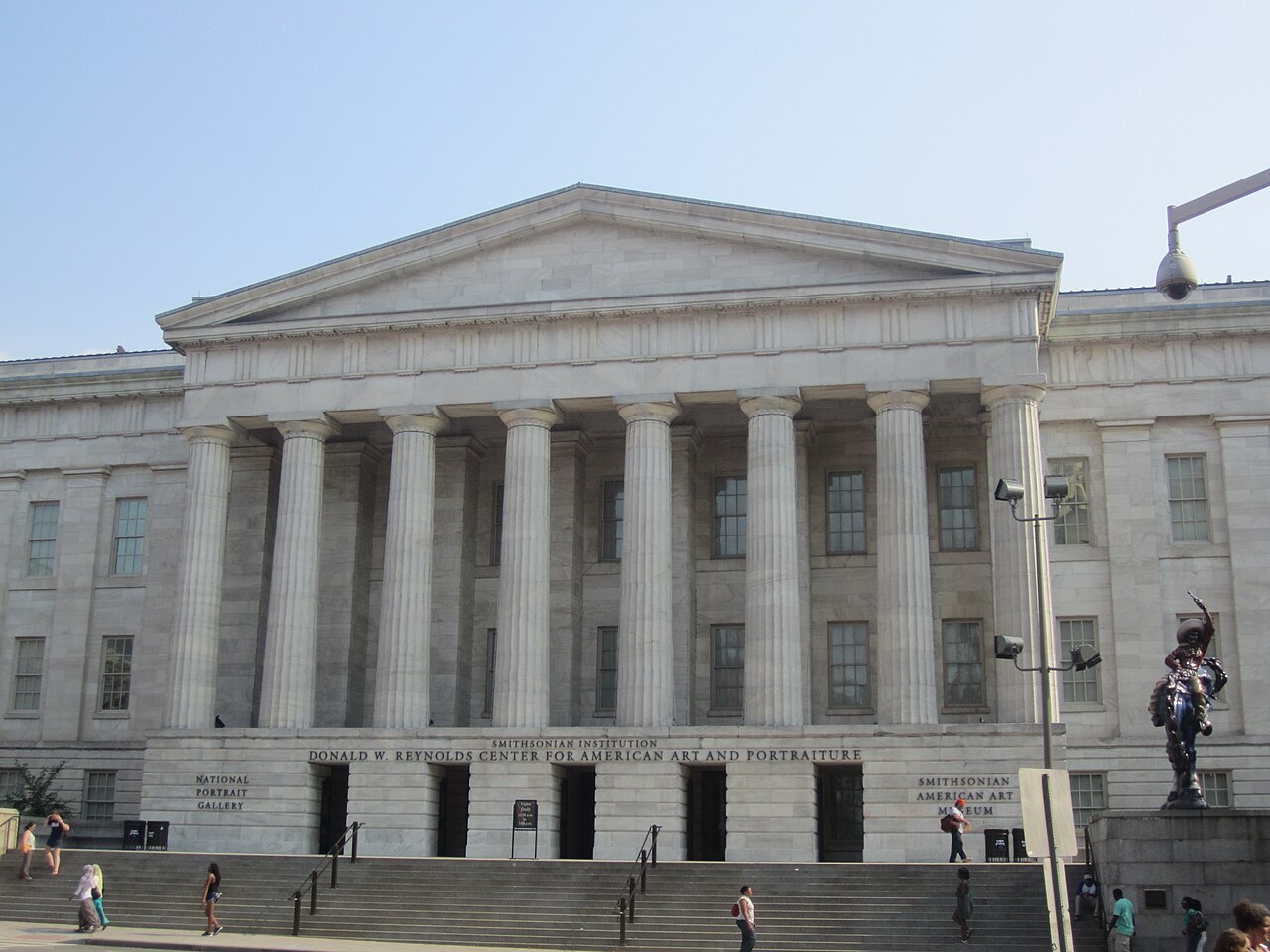
The National Portrait Gallery and the Smithsonian Museum of American Art (SMAA) are both housed in the Old Patent Office Building, a 19th-century Greek Revival landmark that occupies a full block in downtown Washington, D.C.
Recommended Reading
Reviewed By
Catesby Leigh
Art and Architecture Critic and Past Chair and Research Fellow of the National Civic Art Society
The opinions expressed above are those of the Reviewer who is providing a good-faith historical assessment to educate the public. Reasonable opinions can vary, and the Reviewer’s opinion is not necessarily the opinion of The Heritage Foundation or its affiliates.