National Museum of the United States Air Force
The museum is near a major U.S. airbase, Wright-Patterson Air Force Base, and boasts the most comprehensive overview of U.S. military aviation.
Site Details
Pin location is approximate.
1100 Spaatz Street
Wright-Patterson AFB, OH 45433
Family Friendly?
Somewhat
Visitors Per Year
800,000
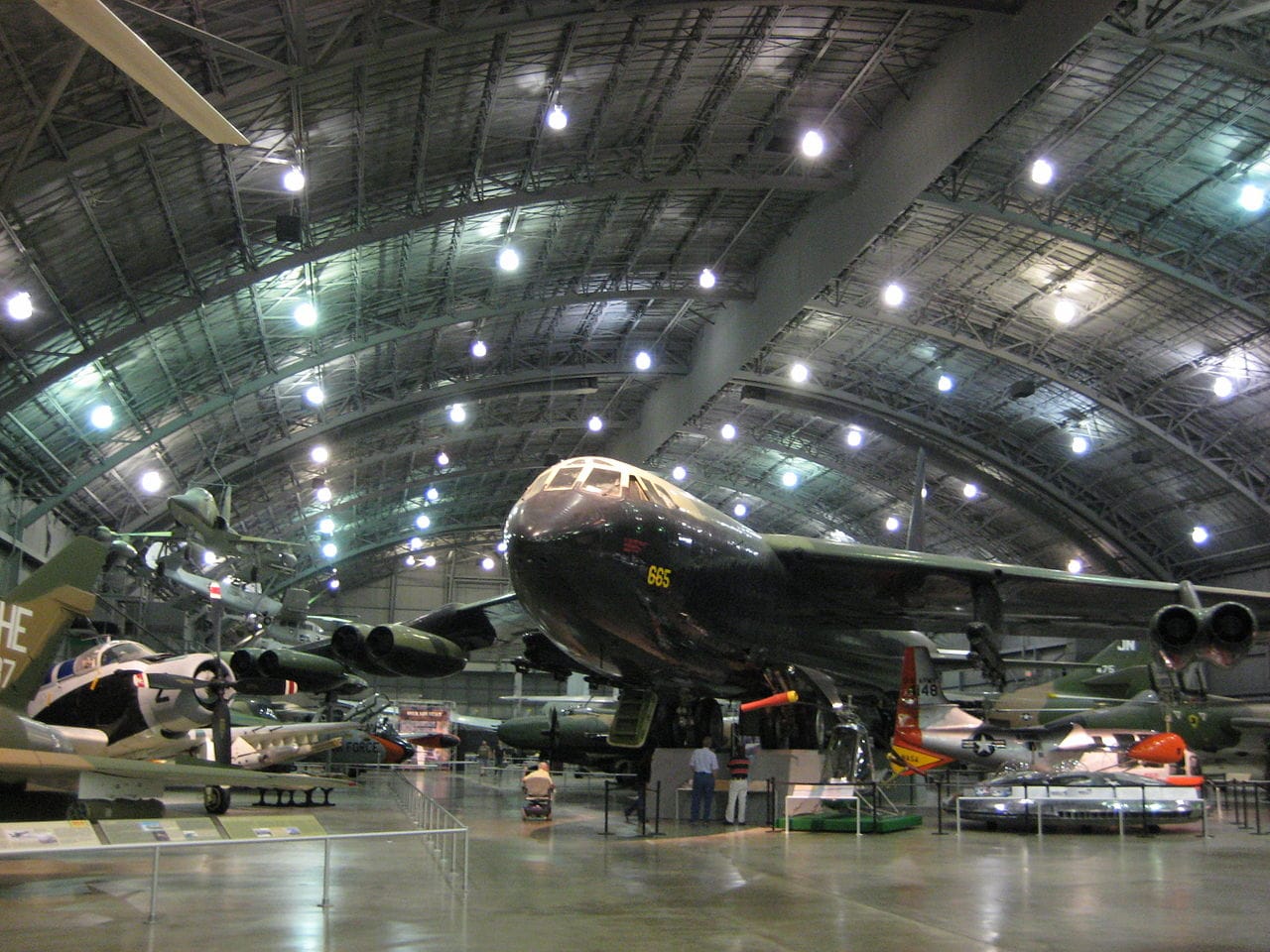
The main museum consists of four large hangars with numerous airplanes from different eras on display. Highlights include such historically significant aircraft as Bockscar, the plane that dropped the second atomic bomb, ending World War II, on Nagasaki, Japan and the iconic SAM 26000, a Boeing plane that acted as Air Force One or a backup for eight Presidents, from Lyndon B. Johnson to Bill Clinton. This specific plane was involved in major U.S. events, such as returning President Kennedy’s body from Dallas after his assassination (and consequently Lyndon B. Johnson’s swearing-in following the assassination), President Nixon’s famous trip to China, and carrying former Presidents Nixon, Ford, and Carter to the funeral of the assassinated leader of Egypt, Anwar Sadat, in 1981. Guests can board the plane and walk its entire length, which has excellent signage indicating the location of key events.
Over 350 airplanes, aircraft engines, space vehicles, satellites, and various missiles, along with thousands of individual artifacts, including critical equipment, flight jackets, and astronaut suits, cover 20 acres. Numerous planes, including those used for troop movement, and a space shuttle, are open for walk-through. There are several planes open for walk-through that allow visitors to observe bomb bays.
Various flight simulators are in the museum, especially in the hangar devoted to the Korean and Vietnam Wars. While there is an extra charge, these simulations provide a family-friendly, exceptionally child-friendly experience and a brief introduction to some of the skills required to be a pilot serving in the U.S. Air Force.
Tours are available with trained volunteers. Each tour lasts a little over one hour and typically focuses on one central exhibit area, such as the early days of aviation, the world wars, or the Presidential gallery.
The museum also includes an approximately 400-seat theater with an 80-foot screen that features a rotating set of movies devoted to aviation, space exploration, and military history. The movies usually last 40–50 minutes, and there is a charge for tickets.
This museum has a great deal of content. For those deeply interested in aviation and military history, allowing a full day (and a minimum of four hours) would be advisable for going through all of the exhibits.
Experts might find some of the material a bit superficial. However, for anyone looking for an introduction and broad overview of American aviation and post-Civil War military history, the museum does an excellent job of providing enough information that a visitor will go away with a solid understanding of the basic history of the Air Force and of basic technological concepts that underpin modern aircraft.
For the most part, the museum does not engage in political activism. Several extensive exhibits deal with race relations. However, these are generally grounded in historical events, and politically loaded terminology is not overtly utilized. For example, there is a wall-length exhibit dedicated to the Tuskegee Airmen. The exhibit is one of three panels of varying sizes that reflect ongoing developments throughout the 20th century as the Air Force expanded can be found in each significant museum section. It is well done and details their recruitment and associated missions during World War II. There are discussions of segregation within several individual wall panels, but the focus is tight and generally avoids loaded terminology.
Numerous exhibits on the role of women in the Air Force are on display. There is somewhat more emphasis on gender and racial equity than is probably needed, given that it is woven through multiple exhibits rather than being in a single location. However, it is broadly fact-based and focuses on integrating women and minorities within the Armed Services.
Overall, this is a very child-friendly museum, especially older children. While the scope of the exhibits might overwhelm small children, those ages 10 and above (especially boys) will likely be enthralled by the number of planes, hands-on learning, including a STEM room which focuses on the science of aerodynamics, and a hall of fame for Americans involved in space exploration. The flight simulators are also popular with children, illustrated by the steady stream of families waiting in line to climb into one. They are located halfway through the museum, offering a good break opportunity for children who need more physical activity and stimulation.
From the Wright Brothers’ first flight in 1903, aviation has defined America’s technological prowess and been a constant reminder of its military strength and global influence.
Air power became increasingly important in warfare during the 20th century. While it was not decisive in World War I, by World War II, the most devastating war in all of human history, air power had become indispensable, and the main way to limit the war-making power of battlefield opponents was through aerial bombardment. This culminated in the atomic bombings of Hiroshima and Nagasaki—events that not only ended the war but reshaped global politics. Mastery of the skies and the ability to merge air and ground tactics have since been central to U.S. grand strategy, from Korea and Vietnam to the Gulf War and the War on Terror. Meanwhile, the rise of stealth, radar-hiding aircraft has become important to both the collection of intelligence, enabling the United States to better understand actual and potential adversaries, and the ability to rapidly penetrate the defenses of adversaries. Finally, intercontinental ballistic missiles provided a tense equilibrium, but one that has also appeared to keep a lid on major power conflicts that could potentially escalate to World War II-levels of destruction. This is another example of how control of the skies has become a foundational component of how we experience the world.
Today, the ability to assert air superiority enables rapid deployment, precision strikes, and deterrence against adversaries of all sizes.
Though it began in 1923 as a small technical collection of World War I planes at McCook Field near Dayton, Ohio, the National Museum of the United States Air Force has grown to become the world’s oldest and largest military aviation museum, providing unparalleled detail about the role aviation has played in U.S. history.
Owned By: U.S. Air Force
Operated By: U.S. Air Force
Government Funded: Yes
Did you know?
While it is common knowledge that the Wright Brothers are from Dayton, Ohio, it is not as well known that the first cargo flight was between Dayton and Columbus, Ohio, in 1910, using a Wright Model plane and carrying 10 bolts of fabric.
Recommended Reading
- A Concise History of the U.S. Air Force by Stephen L. McFarland
- Flight of the Enola Gay by Paul W. Tibbets
- Air Force One: A History of the Presidents and Their Planes by Kenneth T. Walsh
Reviewed By
Greg R. Lawson
Research Fellow at the Buckeye Institute
The opinions expressed above are those of the Reviewer who is providing a good-faith historical assessment to educate the public. Reasonable opinions can vary, and the Reviewer’s opinion is not necessarily the opinion of The Heritage Foundation or its affiliates.