National Civil Rights Museum
Museum chronicling the history of the American Civil Rights Movement, built around the Lorraine Motel in Memphis, Dr. Martin Luther King Jr. was assassinated in 1968
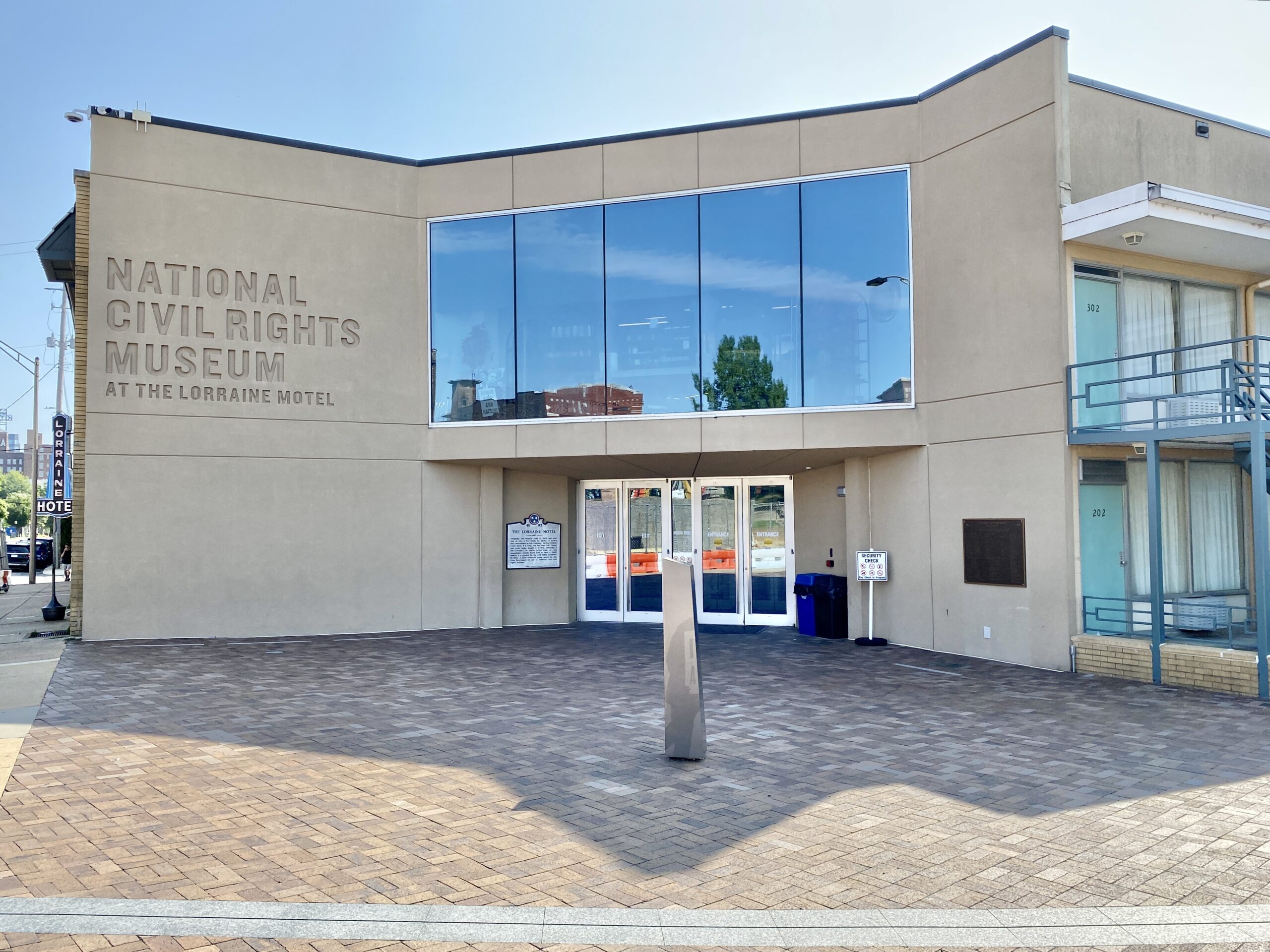
Site Details
Pin location is approximate.
450 Mulberry St
Memphis, TN 38103
Family Friendly?
Yes
Visitors Per Year
300,000
Visitors are encouraged to begin their tour with the museum’s rotating exhibition, which changes about every six months. These exhibits tend to emphasize specific figures or themes related to the Civil Rights Movement.
Guests are then directed toward the permanent exhibit titled “A Culture of Resistance: Slavery in America 1619–1861.” This rotunda provides a brief and thoughtfully organized history of pre-colonial African history, the Atlantic slave trade, and the tension between slavery and freedom in early America. The exhibit largely eschews heavy-handed textual narrative and instead emphasizes visual storytelling through statistical data, maps, and material culture. In so doing, the exhibit offers a nuanced and panoramic context for the rise of slavery in the United States.
Visitors are then ushered into a theater for an 18-minute video that explores the African American journey from slavery to freedom. This video examines the century between the nation’s Founding and the end of Reconstruction. Organized around the constitutional principle of “created equal,” this video places an emphasis on African American agency and faith in the nation’s legal and political institutions. The history is accurate and reflects the academic consensus on the 19th-century black freedom struggle. The video features young people as narrators to make the material engaging for a general audience.
When the video is over, visitors exit into the museum’s main exhibition hall where they encounter the museum’s remaining permanent exhibitions. The self-guided tour proceeds chronologically from the Jim Crow era to the end of the 1960s. It takes about an hour to finish the rest of the tour. Visits may require more time on Martin Luther King Jr. Day, April 4 (the anniversary of his assassination), and Juneteenth due to higher attendance.
The post-video permanent exhibits are immersive and make the history engaging and accessible. Each room has some sort of multimedia component that uses video and audio material from the mid-20th century United States. The museum also has some truly remarkable material items in its collection, including the Montgomery bus on which Rosa Parks refused to give up her seat and the Woolworth’s lunch counter where the 1960 Greensboro sit-ins took place.
The tour concludes by having visitors view room 306 and the adjoining balcony, the site where Martin Luther King Jr. was assassinated. The room has been preserved as a solemn shrine to King.
Once visitors complete their viewing of the Lorraine Motel balcony, they exit through the museum’s gift shop. The tour normally continues across the street with a larger exhibit on King’s assassination and the search for his assassin, James Earl Ray. Visitors can view the the bathroom window of the Legacy Building from which Ray fired the fatal shot. The building is currently closed for renovation.
The National Civil Rights Museum embodies a generational high–water mark of the Civil Rights Movement’s public history. It emphasizes and centers the role that black Americans played in making the nation’s constitutional principles and deepest values of equality and freedom real and tangible. While the museum is carefully curated to avoid academic elitism and intellectual pretension, its exhibits reflect a deep engagement with more than 30 years of historical scholarship. Curatorial choices have been made to deemphasize familiar and famous figures in favor of local leaders and the larger spirit of a movement-oriented story. In some ways, this story could have been made even more “national”—including more stories of the movement in places in the North, Midwest, and West—but the decision to focus on the southern phase of the Civil Rights Movement is one that feels appropriate for a Memphis-based museum catering to the local audience and travelers who are likely seeking a series of southern experiences.
The National Civil Rights Museum clearly strives to provide an even-handed and nonpartisan account of the Civil Rights Movement. While there is a tendency for some Civil Rights Museums to explicitly connect the movement’s history to current political struggles, the National Civil Rights Museum largely remains grounded in the past and uses the voices of those involved in the movement to guide the historical story it is telling. The museum does not shy away from hard histories but examines the Civil Rights Movement in a clear-eyed and sober manner.
In some ways, the museum provides a slightly conservative portrait of the movement’s history. Where some historians argue that an earlier more radically left-wing vision of the Civil Rights Movement had to be jettisoned with the rise of the Red Scare and the anticommunist era of the 1950s and 1960s, others argue that the Civil Rights Movement should be more properly understood as a more centrist quest for political and legal equality—and that the more anti-capitalist and anti-imperialist movements before and after the “classic” phase of the Montgomery-to-Memphis movement should be categorized as different struggles. The National Civil Rights Museum largely takes the side of the latter, saying little about earlier radical social movements that preceded the Civil Rights Movement and deemphasizing the political demands of the black liberation movements that succeeded the southern struggle.
Some of the material in the museum grapples with sensitive and difficult subjects. Exhibits include images of chained human beings, photographs of lynchings, and audio and text of people being called racial slurs. The museum’s exhibits largely emphasize the agency and courage of movement participants, but they also highlight the violence and danger that those who joined the movement faced. The museum does provide materials for families to help discuss some of its more difficult subjects with children, and many of its exhibits are immersive and interactive in ways that allow young people to gain a meaningful and age-appropriate understanding of the Civil Rights Movement.
The Civil Rights Movement serves as one of the most important historical chapters of the modern United States. At the height of the Cold War, the Soviet Union challenged the promise of the “American Way of Life” by repeatedly highlighting the persistence of racial inequality in its rival superpower. Those who participated in the Civil Rights Movement took the nation’s Founding creeds seriously and risked their lives to ensure that civic and political equality would be guaranteed to all the nation’s citizens. The National Civil Rights Museum understands this constitutional story at a deep level and frames the movement that began in Montgomery as a struggle that brought the principles of the Founding into the American century. Through this lens, the movement generation reminded the nation that freedom was not simply an abstract ideal, but a profound set of democratic practices that revitalized the promise of the Republic.
Owned By: State of Tennessee
Operated By: National Civil Rights Museum Foundation
Government Funded: Yes
Did you know?
In 1965, soul singer Wilson Pickett wrote his hit single “In the Midnight Hour” while staying at the motel.
Recommended Reading
- The Movement: The African American Struggle for Civil Rights by Thomas C. Holt
- Going Down Jericho Road: The Memphis Strike, Martin Luther King’s Last Campaign by Michael K. Honey
- Ella Baker and the Black Freedom Movement: A Radical Democratic Vision by Barbara Ransby
Reviewed By
Robert Bland
Assistant Professor of History and Africana Studies at the University of Tennessee, Knoxville, and Author of Requiem for Reconstruction
The opinions expressed above are those of the Reviewer who is providing a good-faith historical assessment to educate the public. Reasonable opinions can vary, and the Reviewer’s opinion is not necessarily the opinion of The Heritage Foundation or its affiliates.