Mount Rushmore National Memorial
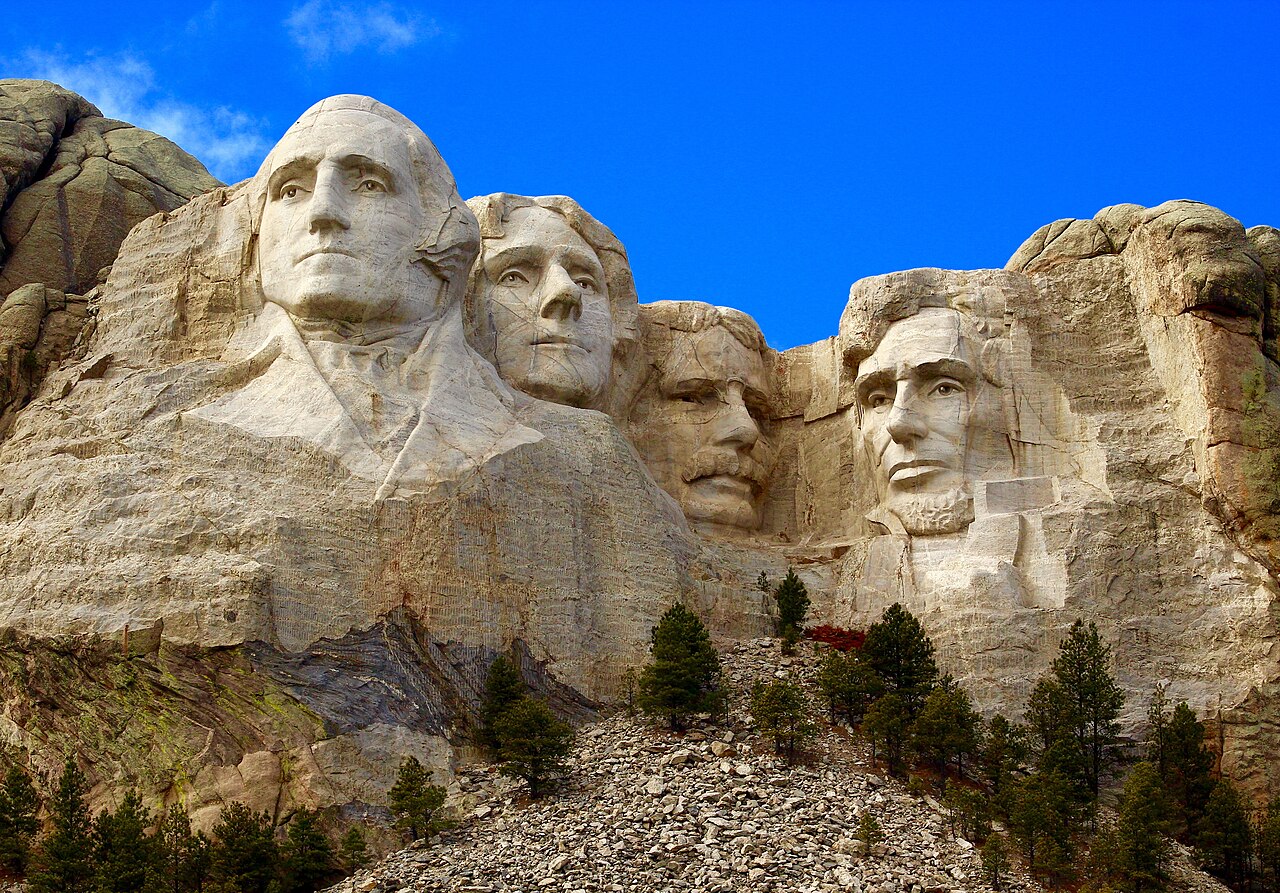
Monumental sculpture of Presidents Washington, Jefferson, Roosevelt, and Lincoln carved into the granite of South Dakota’s Black Hills
Site Details
Pin location is approximate.
13000 SD-244
Keystone, SD 57751
Family Friendly?
Yes
Visitors Per Year
2,400,000
Mount Rushmore gives visitors four basic experiences:
- The primary experience is, of course, the mountain itself. One approaches Mount Rushmore via the Avenue of the States. This is a promenade lined with the flags of all 50 states and the territories. Each flag has a nameplate with the name of the state, its date of admission, and the order of its admission (for example, Minnesota, admitted in 1858, the 32nd state).
One then arrives at the Grand Terrace. The Terrace provides the classic view of the mountain. There are coin-operated viewers that provide a “close up,” but these are low quality. Those wishing for a telescopic view of the mountain should bring their own binoculars.
One can then take the “Presidential Trail” loop, which is a part boardwalk, part stone walking path, that allows for a closer look at the mountain than is available from the Grand Terrace. The Presidential Trail has check points for a Junior Ranger challenge for kids as well as one display for each of the four Presidents on Mount Rushmore. These displays give basic biographical detail on each President as well as significant events of his lifetime and presidency. Finally, the Presidential Trail allows appreciation of the beauty of the terrain on which the sculpture is set.
- A second experience is the Visitors’ Center. This center has museum-type exhibits laying out the history of the shaping of the monument. Great emphasis is placed here on the monument’s lead sculptor and visionary, Gutzon Borglum. There is also a larger display chronicling the history of America from 1775 to the Theodore Roosevelt presidency. A historical timeline gives greater detail than one gets from the smaller histories on the Presidential Trail. The Visitors’ Center also has a theater in which one can watch a short film on the sculpture’s creation. The Visitors’ Center contains a bookstore.
- The third experience is the “Sculptor’s Studio.” This exhibit is open only from Memorial Day through September. It contains more exhibits about the men and tools that sculpted the monument. Periodically, there is a ranger talk on this subject.
- Finally, also only during the summer months, there is a lighting ceremony at dusk. At the memorial’s amphitheater, a park ranger gives an introduction extolling the virtues of the four Presidents. That is followed by a short film doing the same while presenting a history of America, again from the Revolution through the Roosevelt presidency. The film ends with a patriotic exhortation. The ranger calls all veterans in attendance to the stage for appreciation of their service. These veterans then take part in the ceremonial flag lowering for the day.
Mount Rushmore is a remarkably accurate and respectful depiction of American history. Its mission is to inspire patriotism in visitors. It is successful in that goal. If anything, parts of the site experience border on excess. The clearest example of that is a large plaque entitled “The Entablature.” Located at the end or beginning of the presidential walk (depending on which way one starts the loop), the plaque recounts out the history of America up to 1904. It is reverent, even pious, in tone, extolling America’s mission to spread “civilization and Christianity.”
The ranger talk and film at the lighting ceremony honor American history and contain no obvious inaccuracies. The treatment of Theodore Roosevelt, with its emphasis on robber barons, political bosses, and Roosevelt’s statism, might be perceived as anti-free market. Still, such a theme is not explicit.
The site’s shortcomings are largely sins of omission rather than outright errors. The Presidential Trail displays are cursory, and their content choices can feel arbitrary. For instance, each President is represented by a single quotation: Washington is given an obscure line from his Farewell Address rather than his better-known statements on foreign alliances or religion’s role in public life. The Lincoln timeline notes his suspension of habeas corpus but omits the Homestead Act, the Morrill Act, and the Gettysburg Address; his featured quotation is a mild line from his First Inaugural.
These gaps are partially remedied in the Visitors’ Center, where larger plaques feature more appropriate and iconic texts—Lincoln’s Gettysburg Address and Jefferson’s “We hold these truths” passage, among others. The story of each President is more comprehensively addressed there.
The site includes three bookstores, though the selection of serious histories and biographies is limited. Edmund Morris’s two-volume Roosevelt biography is a welcome exception, but comprehensive works on Lincoln or Washington are absent; major Lincoln biographies by Guelzo, Burlingame, and Donald are missing, as are collections of Lincoln’s speeches. Still, the children’s book offerings are extensive and well chosen.
Bias at Mount Rushmore is virtually non-existent. Controversial issues—slavery, race, and the treatment of Native Americans—are acknowledged briefly and factually, without inappropriate emphasis. A small Native American exhibit off the Grand Terrace feels proportional to the site, and Native American materials appear in bookstores and the gift shop. Slavery is noted in the broader historical narrative, but Washington’s and Jefferson’s slaveholding is not addressed directly (for instance, a painting of Washington with enslaved people on the Presidential Trail appears without comment). The Visitors’ Center’s timeline offers a straightforward, traditional textbook-style overview of American history, mentioning events like the Trail of Tears, slavery, and Jim Crow in an informational rather than interpretive tone.
Overall, Mount Rushmore’s presentation is strongly patriotic. The evening lighting ceremony in particular embodies this spirit. Exhibits and programs are reverential yet generally avoid aggressive nationalism. The one clear interpretive misstep appears in the Entablature, whose uncritically admiring tone leads it to describe the Mexican-American War as “inevitable” and the land acquisition as the product of “mutual concession,” both unreasonably generous interpretations of those events.
The site is very family friendly. The gift shop has many kid–friendly choices. There is a café and ice cream shop on site. The Presidential Trail is relatively easy to traverse, with the caveat that loop includes many stairs—descending first, then climbing back up. This presents an obstacle to strollers and for those with difficulty walking. There is plenty to do and see without taking this walk, however. Younger children may find the largely text-based Visitors’ Center museum a bit dry, though the 14-minute film on the memorial’s creation—shown every 20 minutes—is very accessible. More broadly, the Black Hills region offers numerous attractions, and the overall atmosphere is welcoming to families. The region is an outstanding family-friendly, affordable vacation choice.
As noted above, the mission of Mount Rushmore is to educate visitors on the greatness of the American project via the stories of the four Presidents portrayed on the mountainside. Unlike most other historical sites, Mount Rushmore does not commemorate a particular person, place, or event naturally related to the place, but was an intentional creation by Gutzon Borglum and the United States government to arouse patriotic feelings. The significance of the site is in its honoring of the American experiment as well as the ingenuity and grit of the people who carved the inspiring sculptures. The site successfully raises Washington, Jefferson, Lincoln, and Roosevelt to hero status, presenting them as model Americans, whom all Americans can admire.
No pets other than service animals are allowed at Mount Rushmore.
When visiting in the summer, prepare for extensive traffic; the roads around Mount Rushmore travel are winding, mountain-style routes that do not handle large amounts of traffic well.
Entrance to Mount Rushmore is free, but there is a parking fee.
Owned By: National Park Service
Operated By: National Park Service and Mount Rushmore Society
Government Funded: Yes
Did you know?
The original plan was for full–body sculptures of the four Presidents. Funding restrictions resulted in just the faces being sculpted, with only George Washington having any detail below the face.
Recommended Reading
- The Great White Fathers: The Story of the Obsessive Quest to Create Mount Rushmore by John Taliaferro
- Founding Father by Richard Brookhiser
- Thomas Jefferson and the New Nation by Merill D. Peterson
- Abraham Lincoln: Redeemer President by Allen Guelzo
- The Rise of Theodore Roosevelt by Edmund Morris
Reviewed By
Jon D. Schaff
Professor of Political Science at Northern State University
The opinions expressed above are those of the Reviewer who is providing a good-faith historical assessment to educate the public. Reasonable opinions can vary, and the Reviewer’s opinion is not necessarily the opinion of The Heritage Foundation or its affiliates.