Montpelier
Home of James Madison
Site Details
Pin location is approximate.
11350 Constitution Highway
Montpelier Station, VA 22957
Family Friendly?
Yes
Visitors Per Year
125,000
The main house tour lasts about an hour. Guides discuss the contents of the house, the entertaining of guests, provide some Madison family biographical information, touch on James Madison’s role in shaping the Constitution, address the contradiction of slavery, and often tell the story of enslaved valet and author Paul Jennings. James Madison is only really afforded attention in the last room of the house.
Another hour-long tour offered regularly focuses on slavery, and guides detail individual stories of those who were enslaved at Montpelier as well as what life was typically like for those who were enslaved.
There are two short videos shown in the visitors’ center: an introductory 20-minute video provides an overview of the exhibits on the property and the significance of Montpelier itself, and an eight-minute video discusses Madison’s “Big Ideas”—extending the sphere, federalism, and protecting the rights of the minority—and labels the Constitution racist. Another video shown in the basement of the house seeks to connect “the history of slavery to many of the racial and cultural issues we still contend with today.”
Apart from a small archeology exhibit and one about the DuPont family in the visitor’s center, all exhibits at Montpelier are focused on slavery, race, and Jim Crow. The exhibit on the Constitution paints it as a pro-slavery document, and the exhibit for children encourages parents to have conversations with their children about race.
The exhibit on the Constitution gives the impression that slavery was the central animating force behind the Constitution. Panels contend that the clauses pertaining to domestic violence and insurrection were primarily about slave revolts, but most of the revolts listed took place after the Constitution was drafted. All evidence indicates that the Founders had in mind incidents like Shays’ Rebellion, which occurred a few months prior to the Convention and during which 1,500 people in Massachusetts seized control of the roadways. As Madison put it, Shays’ Rebellion showed “new proofs of the necessity of such a vigour in the Genl. Govt. as will be able to restore health to any diseased part of the federal body.”
Many of the panels directly contradict Madison’s own views and statements. One exhibit panel draws attention to the fact that the Constitution does not include the words “slave” or “slavery,” but fails to give Madison’s own account of that fact: that the delegates to the Constitutional Convention “thought it wrong to admit in the Constitution the idea that there could be property in men.”
A display composed of pictures of the first 18 Presidents with blurbs about their relationships with slavery mentions that Madison never freed a single person but omits mentioning that George Washington did in his will. The display notes that while John Adams never owned slaves, “some of his legal clients did.”
Another panel contends that the economy of slavery permeated every state and lists the percentage of the population enslaved in various states in 1790. New Hampshire is shown as having 11 percent of its population enslaved, while the actual figure was 0.11%. This error was identified in 2022 and remains uncorrected.
The Mere Distinction of Colour exhibit in Madison’s basement features an 11-minute film on slavery’s enduring legacy that seeks to connect “the history of slavery to many of the racial and cultural issues we still contend with today.” It shows protesters carrying signs saying, “stop police brutality,” “I can’t breathe,” and “Black Lives Matter” and others waving Confederate flags. Professor Hasan Kwame Jeffries, host of the Southern Poverty Law Center podcast “Teaching Hard History,” and Chairman of the Montpelier Foundation board, claims in the video that, “There are probably more defeats in the pursuit of justice and fairness and equality in American history than there are moments of triumph.”
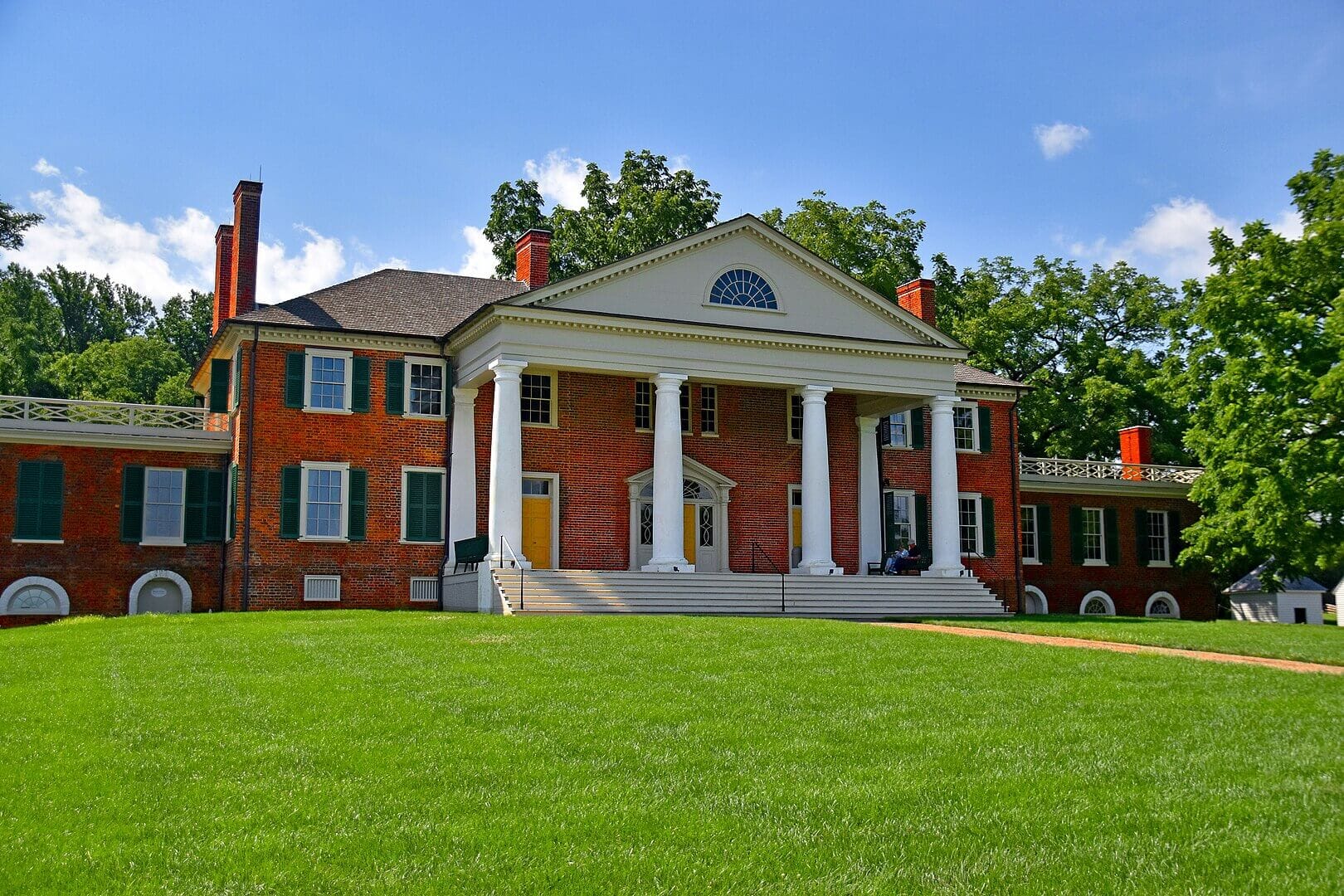
Montpelier is a large two-story brick building with four grand white columns spanning the front, looking toward vast, rolling green farmlands and distant mountains. The site itself is beautiful and lends itself to families, as there are extensive grounds, gardens, and walking trails. But as noted, much of the material at Montpelier seems more suited to prompting children to political activism than to educate them. All the books in the children’s exhibit are ones recommended by the Southern Poverty Law Center.
From Slave Ship to Freedom Road by Julius Lester and Rod Brown asks children to “[i]magine not the victim, but the aggressor. We may think that we would never whip someone until their flesh cried blood.” But “[e]vil is as mesmerizing as a snake’s eyes. Though difficult, we must imagine our capacity for evil. Unless and until we do, unseen shadows of hung men will blot the walls of our homes.” This text is accompanied by illustrations of an enslaved man hanging from a rope, his back raw and bloodied by lashes from a whip, and the silhouette of a hanged man.
James Madison has been called the Father of the Constitution. With the dedication of a scholar, he pored over ancient and modern texts about republican government, which prepared him to draft the Virginia Plan that laid the groundwork for the debates at the Constitutional Convention. He advocated for the separation of powers, checks and balances, bicameralism, and federalism; authored many of The Federalist Papers, which helped ensure the passage of the Constitution; drafted the Bill of Rights; and staunchly defended freedom of conscience.
Madison held numerous political offices, serving in the Virginia State House, in the House of Representatives, as Secretary of State, and as America’s fourth President. Along with his close friend, Thomas Jefferson, Madison founded the first American political party as well as the University of Virginia. In his last years, Madison defended his views and principles against the secessionist theories of John C. Calhoun.
In 2018, the Montpelier Foundation, in partnership with the National Trust for Historic Preservation’s African American Cultural Heritage Action Fund, produced a set of guidelines (a “rubric”) for engaging descendants of slaves and presenting slavery at historical sites that provides insight into the foundation’s ideology. These guidelines recommend:
- Approaching American history through the lens of “restorative justice” and contend that “[f]or institutions that interpret slavery, it is not enough simply to discuss the humanity and contributions of the enslaved. It is imperative that these institutions also unpack and interrogate white privilege and supremacy and systemic racism.”
- Having staff undergo “significant and ongoing anti-racist training (which includes interpreting difficult history, deconstructing and interrogating white privilege, white supremacy, and systemic racism, and engaging visitors on these subjects).”
The guidelines have been adopted by other organizations, including John Dickinson’s plantation, a descendants’ council for James Monroe’s Highlands and the Bray School Lab at Colonial Williamsburg, indicating an effort by the Montpelier Foundation to spread its ideology.
Owned By: National Trust for Historic Preservation
Operated By: Montpelier Foundation
Government Funded: Yes
Did you know?
James Madison has been deemed the Father of the Constitution.
Recommended Reading
- James Madison: A Biography by Ralph Ketcham
- The Federalist Papers by Publius
- Notes of Debates in the Federal Convention of 1787 by James Madison
Reviewed By
Brenda Hafera
Assistant Director and Senior Policy Analyst in the B. Kenneth Simon Center for American Studies at The Heritage Foundation
The opinions expressed above are those of the Reviewer who is providing a good-faith historical assessment to educate the public. Reasonable opinions can vary, and the Reviewer’s opinion is not necessarily the opinion of The Heritage Foundation or its affiliates.