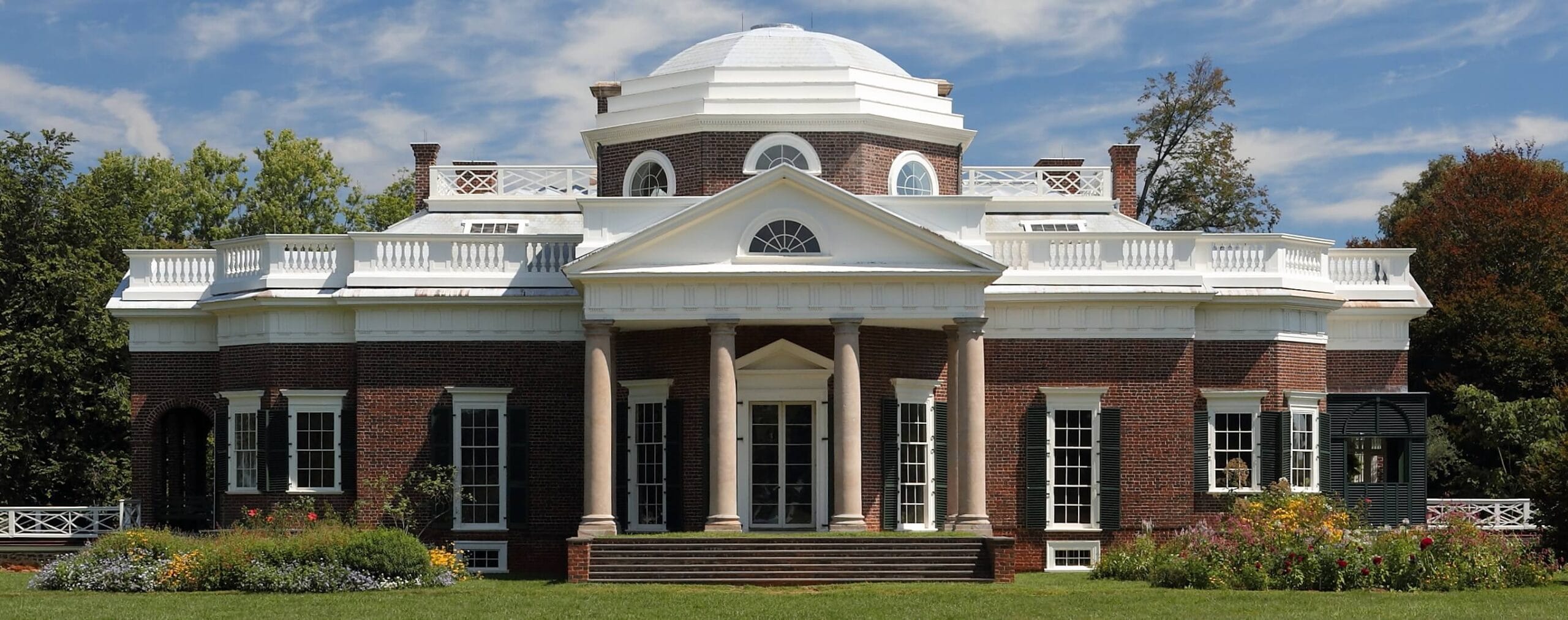
Monticello
Home of Thomas Jefferson
Site Details
Pin location is approximate.
1050 Monticello Loop
Charlottesville, VA 22902
Family Friendly?
Yes
Visitors Per Year
500,000
Most visitors will spend the majority of their time at the top of the mountain, where the mansion is located.
- The house tour lasts 45 minutes and focuses on the contents of Monticello (the various inventions, paintings, etc.), Jefferson’s biography and accomplishments, and the story of Sally Hemings and the contradiction between slavery and the principle of human freedom.
- Another 45-minute tour offered regularly takes visitors along Mulberry Row, the reconstructed slave quarters, and features guides telling the history of slavery, what life was like at Monticello, and some of the individual stories of those who were enslaved.
The cellars of the mansion are filled with exhibits and artifacts that detail the purpose of each room and give information about the enslaved families, including the Hemings family and Jefferson’s alleged relationship with Sally Hemings.
Additionally, guests are welcome to roam the grounds and gardens, and Monticello regularly offers specialty tours and events, such as presentations by a Jefferson impersonator, scavenger hunts, VIP tours, and a 2.5 hour From Slavery to Freedom Tour. As they journey down the mountain, visitors can stop at Jefferson’s tombstone, which is inscribed with his proudest accomplishments: “Author of the Declaration of American Independence[,] of the Statute of Virginia for Religious Freedom and Father of the University of Virginia.”
The David M. Rubenstein Center at the base of the mountain includes two short videos on Jefferson’s accomplishments, the Enlightenment, slavery, and the construction of Monticello and contents of the house (one video seems to be an expanded version of the other) as well as smaller exhibits on Jefferson as an architect and scientist, the building of Monticello, and information on the enslaved and free individuals who lived at Monticello. A recent exhibit on the Declaration of Independence has been added; it is quite lackluster, with framed paintings, a quote on the wall, a few bits of trivia, and a reading of the Declaration coming through the loudspeakers.
The exhibits and tours at Monticello are mostly accurate but fall short of being comprehensive. Insufficient time and space are afforded to Jefferson’s political accomplishments, the main source of his significance. While it is appropriate to discuss slavery, Monticello also needs to give Jefferson the political thinker and politician his due.
Most disappointing is that the Declaration of Independence exhibit fails to detail the meaning and significance of the Declaration, which lays out America’s founding principles. Sadly, tour guides often contend that “all men are created equal” applied only to white, property-owning men. In fact, Jefferson himself would have said that these words universally mean that no person has been born to rule over others absent their consent; as he famously echoed, “the mass of mankind has not been born with saddles on their backs, nor a favored few booted and spurred, ready to ride them legitimately, by the grace of god.”
Over the years, Monticello has changed the way it details the story of Sally Hemings through its exhibits, tours, and website. Visitors are left with the impression that DNA evidence verified the paternity of Hemings’ children and that the relationship between Hemings and Jefferson is firmly established. This goes too far. The DNA evidence proved the paternity of a male Jefferson, but not that the male in question was Thomas Jefferson. In 2000, the Thomas Jefferson Heritage Society launched a year-long investigation into these questions, engaging a number of well-respected scholars. With the exception of one scholar, conclusions ranged from “serious skepticism about the charge to a conviction that it is almost certainly false.” It would be more appropriate to present complete and accurate information and allow visitors to the site to form their own opinion.
Overall, the exhibits and tours at Monticello are restrained in tone. However, Monticello has shifted its focus over the years, and that shift seems to be building momentum.
- Tour guides sometimes make political claims like, “diversity is our strength.”
- The website and pages addressing Sally Hemings and slavery have evolved. In 2018 and 2019, the pages on slavery and Sally Hemings were expanded and reimagined, and the qualifiers were eliminated.
- In honor of Juneteenth in 2022, Monticello commissioned a painting housed for a time in Jefferson’s music room. It depicted a figure whose “hands and face of featureless tar” represent “the faceless lives of all who served in bondage, witnessing but never recognized,” an identifying card explained.
Of course, recalibrations of the telling of history are sometimes appropriate (it is necessary to tell the history of slavery and admirable to highlight individual stories), but some of Monticello’s changes have a political tinge.
Monticello is a wonderful destination for families. The grounds and gardens are extensive and beautiful, there are tours led by a Jefferson impersonator, and scavenger hunts for children. If conditions are just right, visitors can see a reflection of the back of the house (etched into our nickel) in the estate’s fishpond. The staff are generally very knowledgeable and dedicated to making the experience pleasant and educational.
Parents may want to use some discretion regarding the tours and exhibits focused on slavery. The accurate details of slavery are inherently brutal and tragic. The exhibits in the cellars on the Jefferson-Hemings controversy ask if the relationship was consensual or rape.
Tickets for the standard house tour are $42 for adults, $13 for those 12–18, and $4 for children ages 5–11, which is quite expensive compared to other sites.
Thomas Jefferson was one of the Founding era’s leading thinkers, advocating strongly for government by the people, and placed supreme value on freedom of inquiry and freedom of the mind, authoring Notes on the State of Virginia, the Virginia Bill for Religious Freedom, and, of course, the Declaration of Independence. He was one of the era’s foremost champions of public education; the University of Virginia was established under his influence. He held numerous state and federal political roles, including representing Virginia in the Continental Congress, during which time he was asked to assist in drafting the Declaration of Independence. He later served as a Virginia legislator and governor, Minister to France, Secretary of State, Vice President, and President.
Along with his close friend, James Madison, Jefferson founded the Republican party, which opposed the commercial policies of Alexander Hamilton and the Federalists. The two also teamed up to write the Kentucky and Virginia Resolutions against the Alien and Sedition Acts that threatened freedom of speech. As President, Jefferson secured the Louisiana Purchase, which doubled the size of the United States.
Owned By: Thomas Jefferson Foundation
Operated By: Thomas Jefferson Foundation
Government Funded: Yes
Did you know?
Monticello means “little mountain.”
Recommended Reading
- The Essential Jefferson, edited by Jean Yarbrough
- The Constitutional Thought of Thomas Jefferson by David N. Mayer
- American Founders: Leaders at the Creation of the Republic, edited by Colleen Sheehan
Reviewed By
Brenda Hafera
Assistant Director and Senior Policy Analyst in the B. Kenneth Simon Center for American Studies at The Heritage Foundation
The opinions expressed above are those of the Reviewer who is providing a good-faith historical assessment to educate the public. Reasonable opinions can vary, and the Reviewer’s opinion is not necessarily the opinion of The Heritage Foundation or its affiliates.