Manhattan Project National Historical Park
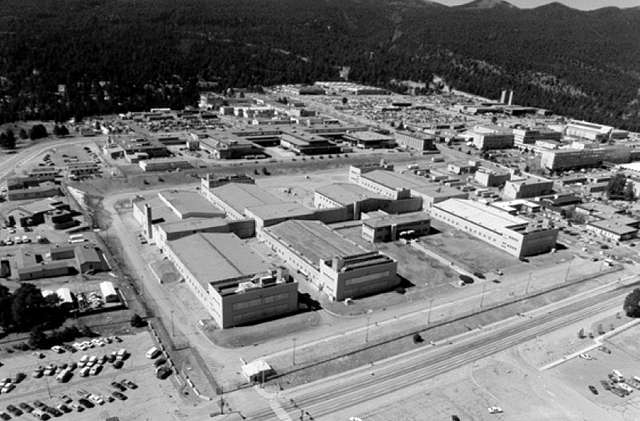
This is the location of the Manhattan Project, where the first atomic bombs were developed.
Site Details
Pin location is approximate.
475 20th St
Los Alamos, NM 87544
Family Friendly?
Yes
Visitors Per Year
25,000 - 30,000
The park offers a walking tour of the original Manhattan Project site, around which the town of Los Alamos grew. The best place to begin is the Visitors’ Center, where helpful guides can provide a map and orientation to the site. The park offers 90-minute guided tours once or twice per day.
Near the Visitors’ Center is a small introductory museum overlooking Ashley Pond, a centerpiece of the original Manhattan Project. From there, the roughly one-mile tour begins at a locally famous statue of Dr. J. Robert Oppenheimer and General Leslie Groves, the scientific and military leaders of the Manhattan Project. Visitors can then check out Fuller Lodge, a ranch school dining hall that was acquired for use by the Manhattan Project and used as a community center for lab employees, followed by the first of two main attractions, The Los Alamos History Museum.
Though small, the museum is very informative regarding the history of the area and the project. Exhibits are careful not to “take sides” on the issue of nuclear weapons and whether their use in WWII was justified, with one key panel being simply titled, “The Decision.” Another is called “In Their Own Words: The Decision to Drop the Bomb,” and quotes conflicting views among Manhattan Project scientists, Secretary of War Henry Stimson, and President Harry Truman. Nearby, visitors are invited to comment for themselves via clipboards on the wall that say, “We all continue to live with the legacy of the Manhattan Project. Please share your reflections and contribute your voice. What responsibility do scientists have for how their work is used?”
The tour continues to the home of Nobel Prize winner Hans Bethe with a multi-room exhibit about the Cold War, then past the home of Dr. Oppenheimer (which is currently closed pending renovations, but visitors can peek in the windows). The pleasant walk continues past an old Women’s Army Corps (WAC) dormitory and a WWII-era cafeteria, and ends at the second main attraction, The Bradbury Science Museum.
This museum is a treasure trove of scientific exploration, touching on not only nuclear science but also the evolving discoveries being explored at the nearby national labs. It packs more than 60 interactive exhibits into a somewhat small footprint and includes two video presentations: one on the history of the Manhattan Project and one on the future of science titled, “Beyond Nuclear Weapons.” Anyone with a scientific bent, including teens or pre-teens interested in science, could spend hours there.
The park overall presents a comprehensive and balanced history of the Manhattan Project and the events that led up to and flowed from it. The general impression given is that the development of, and decision to use, nuclear weapons was justified, but there is no shying away from the ongoing debate, and the exhibits are careful not to take an official position.
A few of the panels throughout the park focus on the displacement of locals to build the labs, including Native Americans, Hispanic homesteaders, and The Los Alamos Ranch School, but the topic is presented fairly and appropriately.
There is one questionable interactive video exhibit at the Bradbury Science Center called “Climate Perspectives: Change in the Terrestrial Arctic,” which delves into how “[r]ising temperatures are rapidly reshaping the terrestrial arctic: permafrost is thawing, coastlines are eroding, and habitats are shifting.” The specific content presented is straightforward and fact-based, but it seems like the intent of the exhibit is to further climate change alarm.
There are certain to be some staff and volunteers who have strong opinions one way or the other, which they may telegraph to visitors. But overall, the park presents a difficult, complex period of history well. While there is no overt patriotism, a visitor to the site cannot help but come away impressed by what was accomplished in such a short period of time by so many smart, dedicated patriots (infiltrated by a handful of spies) on behalf of America and the war effort.
The overall sense a visitor gets is that the people who live and work in Los Alamos and at the historic site are proud of their community and the role that it played in history. Perhaps this is due to the degree to which Los Alamos is a “company town,” whose economy is significantly driven by Los Alamos National Labs. It may also be because the park’s docents tend to be retired laboratory employees, who are instructed not to take sides either for or against the decision to bomb Hiroshima and Nagasaki but simply to present the events that led to history’s unfolding.
It is important to distinguish the park itself from Los Alamos’ annual Oppenheimer Festival, a citywide event that “transforms Los Alamos into a two-week celebration of film, history, and immersive storytelling.” While the scope of this review does not include that independent festival, it seems to invite more of an ideological take on the events of the past 80 years and should be evaluated accordingly.
The walking tour is easy enough for families, on flat ground with much of it shaded by beautiful evergreen trees. There’s also no need to walk the full length, as the two anchor museums sit just two blocks from one another, and between them is a small shopping center with a handful of coffee and dining options. While the park and its exhibits can be enjoyed reasonably well in a good half-day, those who like to linger may want to take longer, and the surrounding area has additional attractions that can easily fill up the rest of the day (or two).
If the trip includes a visit to Santa Fe, look for a kitschy courtyard just off the plaza that features a plaque commemorating 109 E. Palace Avenue, the address at which scientists and staff arrived after a long, dusty train ride, only to find that it was merely a checkpoint on the way to Los Alamos’ top-secret location. There’s a cute coffee shop in the courtyard called Oppy’s Coffee, for those in the know.
The park’s content itself is probably not ideal for young children, who would not be able to understand it. But pre-teens and teenagers who are interested in history and science, or both, may find it a wonderful learning experience. There are no troubling images of death and destruction, and the Bradbury Science Center has many interactive exhibits that may help inspire young people to careers in science.
Everyone knows about the atomic bomb and how its use brought an end to World War II, and many people now have a passing familiarity with Oppenheimer due to the popular 2023 film of the same name that won several Academy Awards, including Best Picture (for which the park served as a shooting location and about which there is a separate film tour).
Few Americans, however, understand just how significant an accomplishment the Manhattan Project was, the complexity Oppenheimer and Groves faced in keeping its military and scientific operations (and personalities) working together, and how complicated it was to build a remote community of the world’s leading scientists almost overnight.
The Manhattan Project was so named because its first headquarters were located in New York City. But the government soon realized that a project this consequential was going to require the utmost secrecy, and in 1943, the first ramshackle buildings of a secret laboratory were erected atop a remote mesa in Northern New Mexico. While the original plan called for the project to have fewer than 1,000 employees, by the end of the war there were more than 8,000 people living in temporary quarters, driving on unpaved roads, and joking about the town’s two seasons: dust and mud. After the war, the government recognized the need for continued nuclear research and formally established Los Alamos National Labs, which today employs some 10,000 people. Los Alamos now has a population of 18,000 and, in addition to its scenic beauty and historical significance, is known for having the most PhDs per capita in the United States.
The Manhattan Project National Historic Park is a testament to American ingenuity, inspiring visitors not only by the project’s unprecedented scientific achievements, but also by the vital questions it raises about the continuing role of both nuclear weapons and science writ large in our society.
Owned By: Department of Energy
Operated By: A partnership between the Department of Energy, National Park Service, Los Alamos County, and local private landowners.
Government Funded: Yes
Did you know?
The site was originally expected to house just a few hundred scientists and staff, but by 1945, it had grown to some 8,200 people.
Recommended Reading
- 109 East Palace by Jennet Conant
Reviewed By
Steve McKee
Visiting Fellow at The Heritage Foundation
The opinions expressed above are those of the Reviewer who is providing a good-faith historical assessment to educate the public. Reasonable opinions can vary, and the Reviewer’s opinion is not necessarily the opinion of The Heritage Foundation or its affiliates.