James A. Garfield National Historic Site
Home of the 20th President, where he conducted the nation’s first successful front porch campaign in 1880, and site of the first presidential memorial library, established by his widow after his assassination
Site Details
Pin location is approximate.
8095 Mentor Avenue
Mentor, OH 44060
Family Friendly?
Yes
Visitors Per Year
Unknown
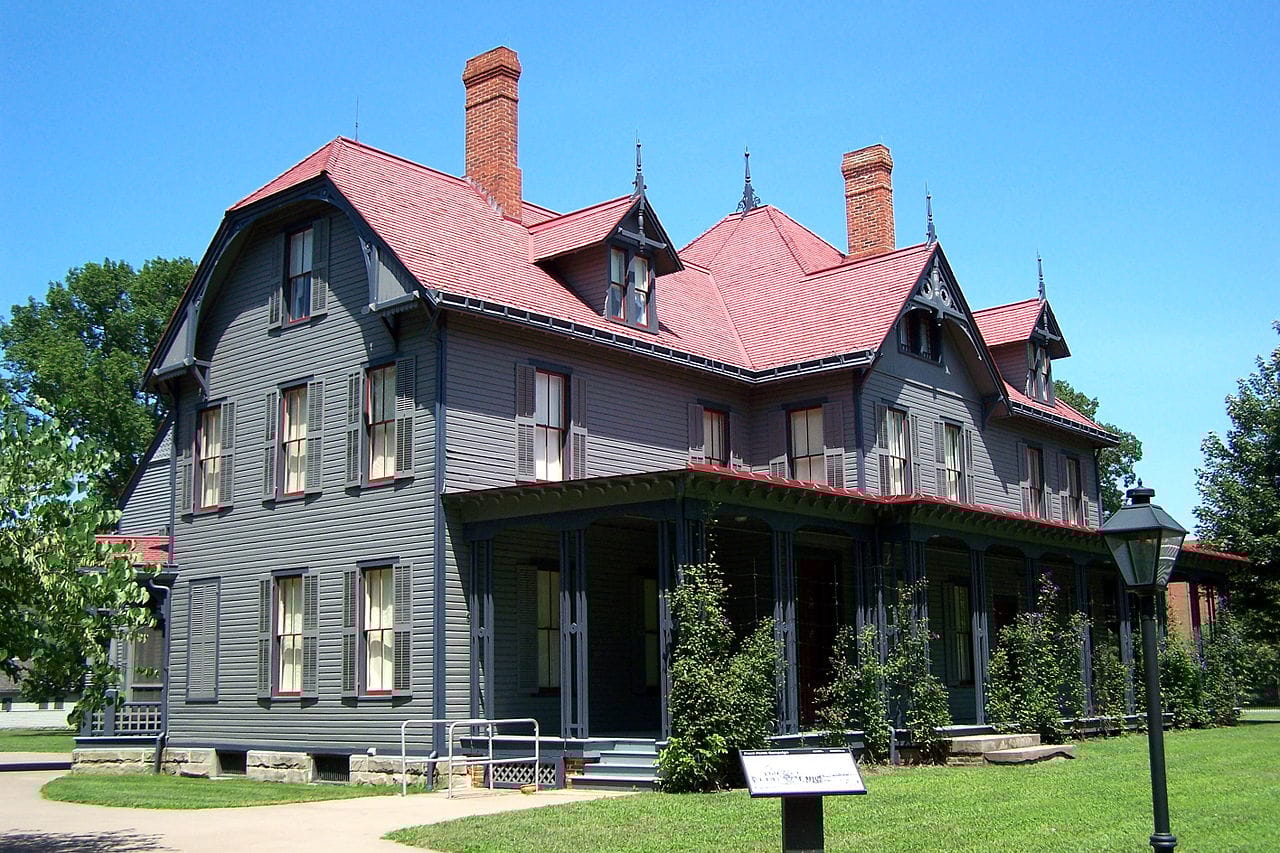
The site offers a tour of the Garfield house that lasts approximately 45 minutes. The site, including the home, contains an impressive number of original artifacts (around 85 percent) as well as a careful recreation of other elements. This part of the tour also highlights Garfield inaugurating the “front-porch campaign” that would recur in American politics for decades. Rather than traveling across the country, this form of campaigning had citizens and reporters come to the candidate, who would make speeches usually from the front porch of his residence. The tour does not follow a strict script but is guided by comprehensive interpretive notes.
The site also includes a museum separate from the Garfield home. Exhibits are chronological and cover the many phases of Garfield’s life: his childhood, education, roles as a teacher and as a preacher, his Civil War service, time in Congress, presidential run and term, up to his assassination and the response to his death.
Within the museum is a room in which a short video is played on Garfield’s life. This video makes use of photographs, letters, and other documents to tell his life story. The production is of solid quality and straightforward in its perspective.
The exhibits cover a great deal of ground in a small amount of space. The information is accurate and helpful overall. The exhibits are well presented in a professional fashion that is pleasing to view and utilizes a combination of text, pictures, artifacts, and audio aids to help tell Garfield’s story. The tour and site give helpful additional context about Garfield’s assassin, Charles Guiteau, that often gets left out of descriptions of the man and the event. The tour is careful to note which elements of the home are original and which have been recreated. It also notes in detail which artifacts and parts of the house were contemporary to the time that James Garfield lived there (as opposed to subsequent additions made by the Garfield family).
However, given the breadth of experience Garfield had, the discussion of his life in the panels at times lacks depth:
- The site and the tour could have explained in a clearer fashion the nature of the divisions within the Republican Party at the time, especially between the so-called “Stalwarts” and the “Half-Breeds.” Understanding Garfield’s position as a compromise candidate between them would make more sense.
- More detail could be given about Garfield’s time in Congress in relation to major political developments of the time. This includes how his push for civil service reform led to the subsequent evolution of the bureaucracy into the 20th century. Nevertheless, the tour provides a helpful outline for deeper study outside the site.
- The site could make a better distinction between the closeness of the 1880 presidential election as a matter of popular votes compared to electoral college votes. The popular vote was extremely close. However, the Electoral College count was a comfortable victory for Garfield.
The site displays no overt ideological bias or attempts to make partisan political points for today. In the Visitors’ Center, there is a section in which visitors can hear a stylized discussion between Garfield and a friend on topics that include slavery, women’s suffrage, creationism versus evolution, theology, and education. In these discussions, Garfield’s views generally receive a fair and even sympathetic rendering even on those issues where his views might not align with prevailing contemporary viewpoints. Much also is made of Garfield’s opposition to slavery and advocacy for civil service reform. These descriptions tend to be straightforward in their wording rather than engaging in any advocacy.
The site is family friendly. Parking is free and provides easy access to the site. The exhibits are very reasonable for families to navigate. The tour is workable for children as well. In addition, employees offer a kid-friendly workbook and give prizes to those who complete it. The workbook focuses children on finding certain objects and asking certain questions that help to focus a child’s observation. While dealing with some intense topics related to Garfield’s life, the presentation is appropriate for all ages.
James A. Garfield was the 20th President of the United States. He lived an accomplished life prior to winning the nation’s highest elected office, one that positioned him well for success. Garfield was a minister in the Disciples of Christ Church; he was an academic, having taught classical languages (among other subjects) and served as principal of what would become Hiram College. He served with distinction in the Union Army early in the Civil War before accepting a seat from Ohio in the U.S. House of Representatives. In the House, he was an important part of his party’s efforts in that chamber, including efforts on behalf of protecting the civil rights of African Americans. In early 1880, he was chosen by the Ohio legislature to serve in the U.S. Senate. That same year, he was a compromise candidate at the Republican National Convention for the presidency. Garfield, the first presidential candidate to campaign regularly from his front porch, won by the closest popular vote margin in U.S. history. He sought to reform government employment toward a civil service system and advocated for the natural and political rights of African Americans. He was shot by a troubled and disgruntled Republican Party activist on July 2, 1881, less than four months after taking office and died from resulting infections on September 19, 1881.
Owned By: National Park Service
Operated By: National Park Service
Government Funded: Yes
Did you know?
James A. Garfield was the last President born in a log cabin.
Recommended Reading
- President Garfield: From Radical to Unifier by C.W. Goodyear
- James A. Garfield and the Civil War by Daniel J. Vermilya
Reviewed By
Adam M. Carrington
Associate Professor of Political Science at Ashland University and Co-Director of the Ashbrook Scholar Program
The opinions expressed above are those of the Reviewer who is providing a good-faith historical assessment to educate the public. Reasonable opinions can vary, and the Reviewer’s opinion is not necessarily the opinion of The Heritage Foundation or its affiliates.