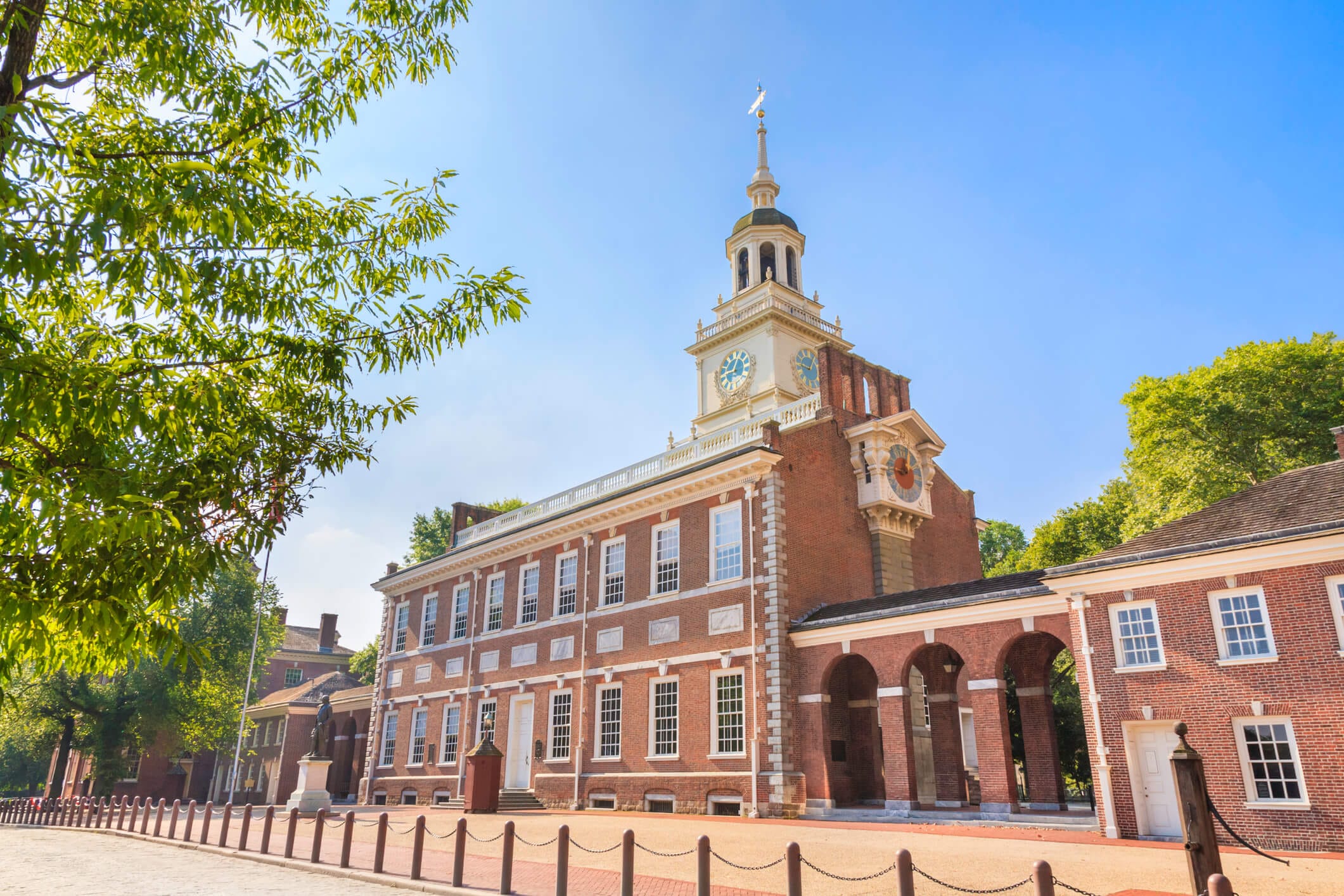
Independence Hall
Site of the signing of the Declaration of Independence, the Articles of Confederation, and the Constitution
Site Details
Pin location is approximate.
520 Chestnut Street
Philadelphia, PA 19106
Family Friendly?
Yes
Visitors Per Year
625,000
- Typical 20-minute tours include the two rooms on the first floor of Independence Hall (the courtroom and the signing room), while the 40-minute tours include more detail about the first floor, as well as a brief tour of the second floor, which had various uses over the years, including as a museum, a ballroom, and a prison. The rooms are staged with an eye to historical accuracy and include furniture from the period, such as the Rising Sun chair in which sat John Hancock and George Washington. The tours focus on the history of the building, including notable original or historically accurate design elements and other features of the rooms such as the woodwork, painting, and objects, as well as significant events that occurred there, including the conventions that produced the Founding documents of the United States.
- Another small room in a separate part of the building exhibits early printings of the Declaration of Independence, the Articles of Confederation, and the Constitution with some explanatory materials and other items.
- The Visitors’ Center has amenities, exhibits, and information for families eager to experience Independence Hall as part of a broader exploration of historic Philadelphia:
- A small theater shows on loop a film about Independence Hall and surrounding landmarks, which serves as a good introduction that will enhance the experience before embarking on a tour of the site itself.
- A small exhibit provides further historical information and helps to situate Independence Hall in the context of the wider mélange of important sites.
- Another large screen in an adjacent room advertises additional options for tourists in the surrounding area.
Signage in Independence Hall is very limited, leaving visitors to learn on their own or ask questions of the park rangers, keeping Independence Hall largely free of any narrative that slants the experience one way or another. There is no set script for guides, so each park ranger brings his or her own framing, which can vary widely, of the events that occurred there. The tours are short, so even the best guide will only scratch the surface of the rich history and significance surrounding the site.
The tours are very brief and superficial (presentations tend to be factual, and time constraints leave little time for editorializing) and written displays are quite limited, so the experience of Independence Hall is not really ideological. Sometimes there are regrettable stray remarks by park rangers who lead the tours, which may be more for effect than indicative of bias, but ideology does not seem to be systematically woven into the presentations. Explanations by guides sometimes convey salutary civic education; for example, one guide mentioned the way that legal principles in the courtroom derived from British common law and the way that the “Georgian” architecture (in the preferred style of King George II) of the building reflected the colonists’ desire during those years to express their British identity.
While not particularly geared toward children, guided tours somewhat cater to younger visitors, and the relative lack of mature themes in the exhibits and presentations make the site suitable for families. Independence Hall is not an “entertaining” site. There is not much there that is visually appealing or otherwise engaging for young children not yet of an age to appreciate the history of the place.
The tours are short and cover very little distance, so there is barely any walking to do, and children only have to be patient for brief stretches. The second floor is only accessible by stairs and is therefore not suitable for wheelchairs, strollers, and the like. Independence Hall can be visited as part of a collection of important or noteworthy sites, including the Liberty Bell, which is in the immediate vicinity, as well as the National Constitution Center, which is just across Independence Mall.
The historical significance of Independence Hall is beyond compare. The building housed both the state and federal governments for a time. It is there that the Founders of the nation and the Framers of the Constitution convened to embark on their experiment in ordered liberty. As the birthplace of the Declaration of Independence, the Articles of Confederation, and the Constitution, Independence Hall witnessed the debate and adoption of some of the most consequential political documents of all time and certainly the most important in American history. Among the original pieces of furniture is the famous “Rising Sun” chair in which sat John Hancock and George Washington as they presided over the assembled delegates.
The second floor of the building has a colorful history, having been used by the British as a prison during the Revolutionary War, a museum in the early 1800s, and a fugitive slave court in the mid-1850s. The second floor also has old, historic maps and other pieces that convey the period appropriately. Visitors with an appreciation for the momentous events that occurred in and around the building will recognize that Independence Hall is just about as close as one can get to sacred ground in America’s political history.
Owned By: City of Philadelphia
Operated By: The National Park Service
Government Funded: Yes
Did you know?
Abraham Lincoln raised a flag at Independence Hall in 1861 on his way to his first inauguration, and his body lay in state there for 20 hours in 1865 following his assassination.
Recommended Reading
- Notes of Debates in the Federal Convention of 1787 by James Madison
- Independence Hall in American Memory by Charlene Mires
- A New Birth of Freedom by Harry Jaffa
- 1776 (1972 film adaptation of the musical), set chiefly in Independence Hall
Reviewed By
Daniel Mark
Associate Professor in the Department of Political Science at Villanova University
The opinions expressed above are those of the Reviewer who is providing a good-faith historical assessment to educate the public. Reasonable opinions can vary, and the Reviewer’s opinion is not necessarily the opinion of The Heritage Foundation or its affiliates.