Hubbardton Battlefield State Historic Site
Site of a significant Revolutionary War battle that enabled the American retreat from Fort Ticonderoga and foreshadowed later victories and the best-preserved Revolutionary War Battlefield
Site Details
Pin location is approximate.
5696 Monument Hill Rd
Castleton, VT 05735
Family Friendly?
Yes
Visitors Per Year
10,000
The Hubbardton Battlefield State Historic Site includes a Visitors’ Center, exhibits, a riveting diorama of the battle that uses small colored lights to track the movement of troops on both sides, an 18th century cabin that stood at the edge of the battlefield, and the preserved battlefield itself, with paths and benches for visitors. The video, maps, and dioramas make the sequence of Revolutionary events crystal clear.
- While there are no tour guides, the Visitors’ Center is staffed by a single person who orients visitors in a friendly way and gets them started with a 20-minute video, “The Voices of Hubbardton.” The video, which includes scenes of military re-enactors from both sides, establishes both the context of the battle and its historical significance. The modern visitor learns that the Revolution was won not just in the clash of great armies, but through the courage of farmers and tradesmen willing to put their lives on the line against well-trained professional soldiers. The Americans technically lost the 1777 Revolutionary battle, as about 150 were killed and 230 were captured on the American side, while only 60 were killed on the British side. But the battlefield loss was a strategic victory, as British General John Burgoyne never regained his military momentum thereafter.
- The rest of the exhibits can probably be absorbed in 20 minutes. One exhibit contains the personal relics of an American soldier, Private Aaron Oliver, age 25, who fought at Bunker Hill, was captured at Hubbardton, and died 20 months later of starvation just after the British let him go. The exhibit mentions he was “a black farmer from Temple, New Hampshire.” The keepers of the Hubbardton Battlefield quietly allow this fact to sink in; the American Revolution was fought by men of all races.
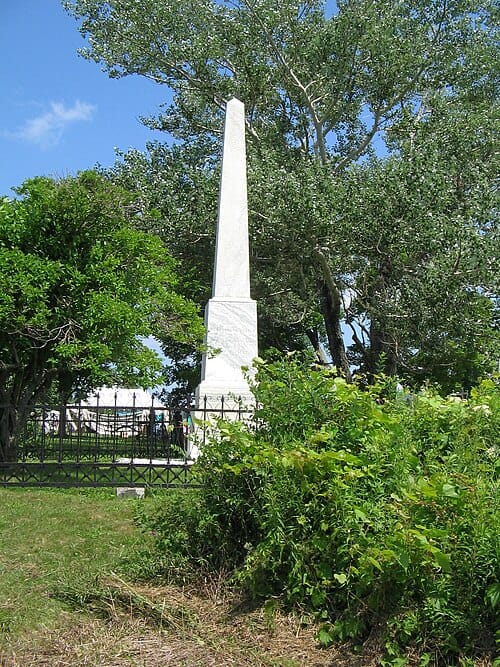
- Outside the Visitors’ Center there is a monument erected in 1859 by the residents of Hubbardton. Eighty-two years after the battle, there were no living veterans, but the townspeople remembered and kept the battlefield sacred and untouched. It remains the best-preserved Revolutionary War site in the United States.
- Each year on the anniversary of the battle, military re-enactors depict the key events of the day, the high point of the historic site’s season and when the greatest number of visitors come.
The Vermont historians at the Hubbardton Battlefield State Historic Site have done exceptional work in preserving the site and depicting the events that occurred at Hubbardton. They have traced the names and fates of many of the participants; recovered the faint archeological traces of that day; and made sure that the events that took place there in 1777 are situated in their historical context. The visitor in search of authenticity will find nothing amiss.
There is not so much as a whisper of bias in the presentation of Hubbardton’s history, neither through the over-glorification of the patriots or the demeaning of the British. The Visitors’ Center displays half a dozen historical American flags, and the Hubbardton Battlefield is treated as an appropriate source of American pride.
The exhibits are easily understood and nothing that would disturb young children is displayed. Hubbardton, to this day, is off the beaten track. It is not hard to get to, but no one is likely just to wander by. Families that seek it out may relax afterward at one of the lakeside cafes along nearby Lake Bomoseen, which is a miniature finger lake on the western edge of the Green Mountains. The site draws more than 80 percent of its visitors from Vermont. While it is small and relatively undiscovered, it is a treasure.
Parking is easy at the battlefield itself. The Visitors’ Center offers a small selection of refreshments. The battlefield is walkable, and families with strollers face no obstacles, though the battlefield itself is on a hill that is steep enough to pose some difficulty for those who have difficulty walking.
Hubbardton Battlefield represents the opening phase of a major campaign by the British in the third year of the Revolutionary War. A large British force under General Burgoyne swept down from Canada, hoping to gain control of the Hudson River and thus cut off New England from the rest of the colonies. Had he succeeded, the Revolution would almost certainly have failed.
Burgoyne’s first step was to capture Fort Ticonderoga on the western shore of Lake Champlain. Outnumbered and outgunned, the American commander, Major-General Arthur St. Clair, escaped with his troops across the lake and fled to the south. St. Clair knew the British would pursue. He created a rearguard under the command of Seth Warner to cover the retreat of his main force.
The British troops caught up with Warner’s detachment the next day, 20 miles south of Ticonderoga at Hubbardton. The American forces stood and fought long enough at Hubbardton to enable the main American forces to escape, setting the stage for the major American military victories that followed at the Battle of Bennington in August and the Battle of Saratoga in September and October.
Burgoyne’s plan was thwarted, and Hubbardton was where things began to go wrong for the British.
Owned By: State of Vermont
Operated By: Vermont Division for Historic Preservation
Government Funded: Yes
Did you know?
Hubbardton was the only Revolutionary War battle fought entirely in Vermont.
Recommended Reading
- Saratoga: Turning Point of America’s Revolutionary War by Richard M. Ketchum
- With Musket and Tomahawk: The Saratoga Campaign and the Wilderness War of 1777 by Michael O. Logusz
- The Turning Point of the Revolution by Hoffman Nickerson
Reviewed By
Peter Wood
President of the National Association of Scholars
The opinions expressed above are those of the Reviewer who is providing a good-faith historical assessment to educate the public. Reasonable opinions can vary, and the Reviewer’s opinion is not necessarily the opinion of The Heritage Foundation or its affiliates.