Hagley Museum and Library
Original powder mill of the du Pont family, now home to the largest library of American business history
Site Details
Pin location is approximate.
200 Hagley Creek Rd
Wilmington, DE 19807
Family Friendly?
Yes
Visitors Per Year
70,000
The Hagley Museum is a hidden gem in the often overlooked state of Delaware. Located in Wilmington, this museum uses the story of the du Pont family to take the visitor through the history of 19th century American innovation.
The welcome center is primarily dedicated to an exhibition on the “Nation of Inventors,” which features a unique collection of 19th century patent models and interactive activities. The exhibit on the useful arts spans several rooms over two floors and focuses on examples of American innovation and entrepreneurship with emphasis on the role of the inventors who shaped modern America. Some of the patents featured include an early dishwasher, mason jar, prosthetics, and a J.H. and J.B. Beam whiskey still.
On the top floor of the welcome center is the DuPont Discovery Loft, a science center geared toward children. This hands-on learning space takes visitors through science experiments but must be booked in advance.
After leaving the welcome center, a shuttle takes visitors to attraction areas around the expansive museum grounds. One of the first stops is the worker’s hill area, where there is a schoolhouse. The longest shuttle ride takes visitors to the historic home and gardens, which has a garage filled with antique vehicles and a barn filled with historic working items such as wagons. Before entering the house, be sure to stop by an outbuilding that served as the original DuPont Company headquarters.
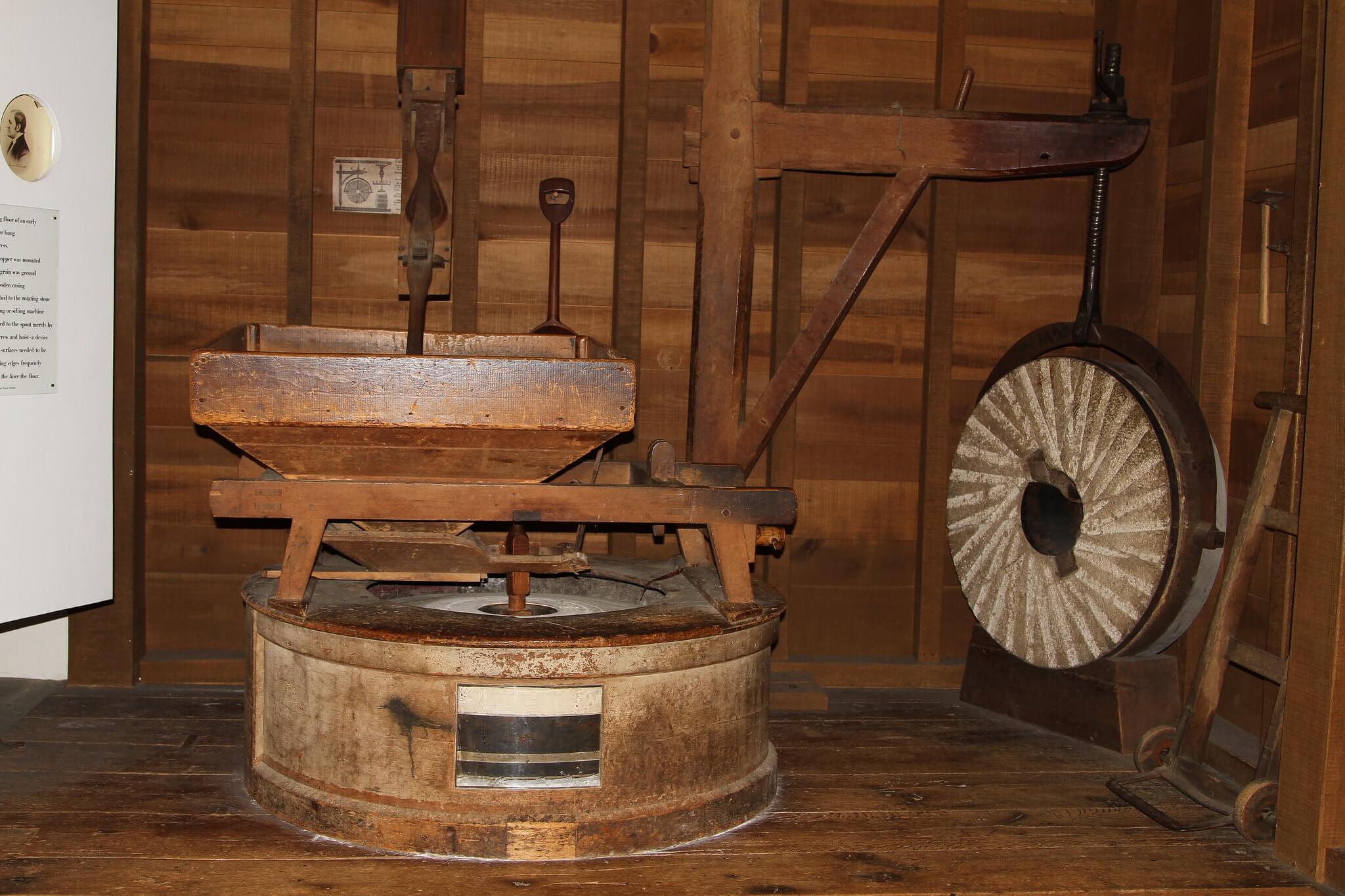
Tours are conducted at each attraction area of the museum grounds. Between the attraction areas, shuttle drivers also provide tour information. The machine shop offers demonstrations of the 16-ton mill, working 19th century machinery, and a black powder explosion demonstration. The powder yard and workers’ hill areas offer self-guided tours. The historic homes and gardens offer an orientation talk about the du Pont family, and visitors to the Eleutherian Mills residence are shown the house by a series of tour guides. Each guide provides an overview of topics of interest in their area with varying degrees of depth. They are given a basic script for each area but can expand beyond it.
The Hagley Library houses the largest collection of historic documents related to American business and technology. Opened in 1961, the library collects and preserves the history of American enterprise. It should also be noted that its website includes a statement on a lack of African-American resources: “We are also updating current processing and cataloging documentation to guide staff in describing our collections for our researchers so that the experience of race and evidence of race relations and institutional racism can be more easily discovered.”
The displays throughout the museum focus on the history of the du Pont family and company as well as the mechanics of the mill components. This narrow but thorough focus meets scholarly standards. The displays also thoughtfully highlight the history of the workers of the mill. Tour guides are often retired individuals who have a desire to teach history and the workings of the mechanical components of the site.
For the most part, the site does not reveal inherent ideological bias. The “Nation of Inventors” exhibit thoughtfully takes visitors through 19th century America’s “tidal wave of human ingenuity and resources.” The majority of the exhibit offers scholarly and clear exposition on the time period and patents.
On the second floor, a section devoted to “a diverse crowd” highlights the exhibits in a different color than the main exhibits. This diverse crowd separates “women inventors,” “black inventors,” “immigrant ingenuity,” and even “Delaware inventors.” These exhibits highlight the challenges faced by these groups with a touch of presentism, but they include quotes from people of the time recognizing these challenges. For example, a quote from Samuel Fisher, the commissioner of patents from 1869 to 1870: “Any sketch of American inventors would be imperfect which failed to do justice to the part taken by women.” Arguably, the inventors in this diverse crowd would have been better served by being incorporated into the main exhibits.
Hagley Museum is very family friendly, especially for boys. After viewing the exhibit in the Visitors’ Center, visitors can walk past the powder mill buildings and canal or take the shuttle to the machine shop demonstration, which is a must-see for anyone who takes an interest in “how things work.”
The Hagley Museum was originally the powder mill of the du Pont family. The patriarch of the du Pont family, Pierre Samuel du Pont de Nemours, a friend of Thomas Jefferson’s, moved the family from France to the banks of the Brandywine River in 1800. His son, Éleuthère Irénée (E.I.) du Pont, was a trained chemist who established the black powder mill. The DuPont company eventually grew to be the largest gunpowder manufacturer in the world.
The story of the du Pont family, as reflected at Hagley, highlights the history of American entrepreneurship. From E.I. du Pont, who worked with Alexander Hamilton, to Louise E. du Pont, who helped to create the National Trust for Historic Preservation in 1949, the du Pont family illustrates the possibilities of the American spirit of ingenuity.
Owned By: Hagley Museum and Library
Operated By: Hagley Museum and Library
Government Funded: Yes
Did you know?
The building that today houses the National Portrait Gallery in Washington D.C. was once the home of the U.S. Patent Office known as the “Temple of Innovation.”
Recommended Reading
DuPont Dynasty: Behind the Nylon Curtain by Gerard Colby
Across the Creek: Black Powder Explosions on the Brandywine by Richard D. Templeton.
Reviewed By
Claire Aguda
Visiting Research Fellow at the Russell Kirk Center for Cultural Renewal
The opinions expressed above are those of the Reviewer who is providing a good-faith historical assessment to educate the public. Reasonable opinions can vary, and the Reviewer’s opinion is not necessarily the opinion of The Heritage Foundation or its affiliates.