Guilford Courthouse National Military Park
Site of a significant Revolutionary War battle that weakened British forces before their surrender to George Washington
Site Details
Pin location is approximate.
2332 New Garden Rd
Greensboro, NC 27410
Family Friendly?
Yes
Visitors Per Year
405,000
The visitors’ center has a three-room museum exhibit that provides the context of the Battle of Guilford Courthouse, details of events, and the military strategy involved. The museum contains an impressive collection of swords, bayonets, muskets, rifles, and other physical artifacts from the battle. High points of the exhibit include the artifacts and maps illustrating troop movement.
The park offers self-guided audio tours with recordings provided through the National Park Service app; they are 1-2 miles long and move through the first, second, and third lines of the battle. There are walking, biking, and driving tour options, and monument and battlefield specific tours. The information provided through the recordings is excellent and draws from a variety of sources, but in some places, the recordings are mislabeled, and the walking directions are confusing. Visitors should be prepared to navigate which recording lines up with which monument or battlefield site.
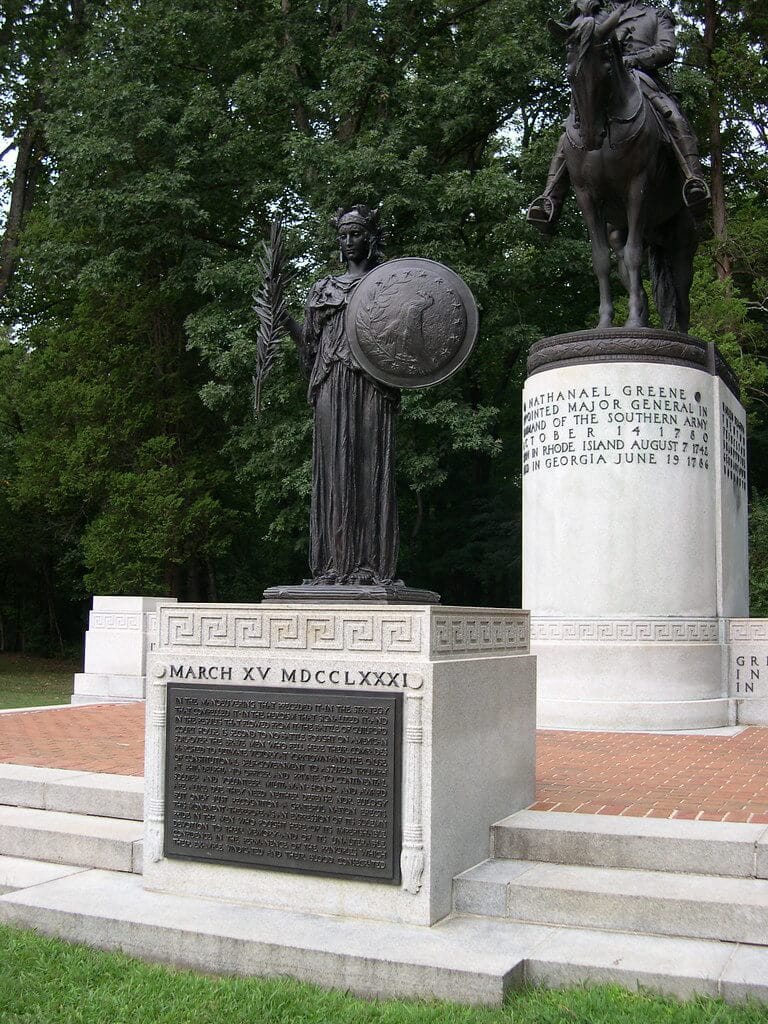
Guilford Courthouse National Military Park is filled with a variety of different monuments; several are directly tied to the Battle of Guilford Courthouse, while others are relevant to local history or significant figures who have supported the park over the years.
The museum exhibits, created in 2001, are accurate, with a good mixture of historical descriptions and quotations from those present at the battle.
Overall, the rangers provide factual and straightforward accounts, but some demonstrate a commitment to historical revisionism in their presentations.
Five “Caution: Additional Context Required” signs were added last year, according to a ranger, for purposes of inclusive representation, which introduce some element of ideological bias to the narrative. These signs suggest historical records become outdated after 25 years, encourage visitors to challenge information encountered, and put forth controversial theories. Some examples: “The Cause of Conflict in the West?” “Revolutionary Women,” “Who is a Citizen?” and “An Elected King?” Such questions are obviously not pertinent to a battlefield and could reflect shifts in historical scholarship and American culture over the past 25 years.
The signs offer unnecessary generalizations about women, slavery, citizenship, and presidential power in the constitutional era. For example, to an existing exhibit on slavery is attached a sign entitled “Slavery: Planned at the Founding.” The sign concludes that “Slavery stood at the center of politics, the economy, and society in the Carolina colony.” Such a conclusion is not warranted by the evidence provided (a single quotation from the Fundamental Constitution of Carolina).
The site lends itself to children who can walk significant distances. The park is laid out well for walking, biking, or driving. Families who enjoy historically themed hikes will find the paved paths easily accessible, while those with older children will find the more challenging dirt paths through the woods appropriate.
The Battle of Guilford Courthouse mattered because a significant proportion (over 25 percent of General Cornwallis’ men) of the British army died, or were fatally wounded, during the battle. It was a costly victory for the British, and the weakened British army would later surrender at the Battle of Yorktown. This battle also featured heroes of the American Revolution such as Henry “Lighthorse Harry” Lee and Nathanael Greene. The reenactment documentary explains the history, but the remainder of the park does not articulate the significance of the battle with sufficient clarity.
The park provides a great opportunity to experience the complexity of preserving public history. This park began as a local history initiative with a founder who wanted to preserve a “pleasure ground” of monuments. When the National Park Service took it over in the 1930s, their mission involved preserving the actual battlefield. The mixture of local-national and public-private forces that go into preserving a specific place over time illustrates the complexity of past remnants surviving into the present.
Owned By: National Park Service
Operated By: National Park Service
Government Funded: Yes
Did you know?
George Washington visited Guilford Courthouse in 1791, a decade after the Battle of Guilford Courthouse.
Recommended Reading
- The Battle of Guilford Courthouse: A Most Desperate Campaign by John R. Maas
- Guilford Courthouse 1781: Lord Cornwallis’s Ruinous Victory by Angus Konstam
- Long, Obstinate, and Bloody: The Battle of Guilford Courthouse by Lawrence E. Babits
Reviewed By
Josh Herring, PhD
Classical Education and Humanities Professor at Thales College
The opinions expressed above are those of the Reviewer who is providing a good-faith historical assessment to educate the public. Reasonable opinions can vary, and the Reviewer’s opinion is not necessarily the opinion of The Heritage Foundation or its affiliates.