Goliad, Presidio La Bahia, and Fannin Battlefield Historic Sites
Sites clustered around Goliad, Texas that are significant in the early history of Texas and the United States, including a Spanish colonial mission, a Spanish colonial fortress, and the site of the Battle of Coleto
Site Details
Pin location is approximate.
108 Park Rd-6
Goliad, TX 77963
Family Friendly?
Yes
Visitors Per Year
33,000
For newcomers to the Texas story, the Goliad sites offer a great way to gain an overview of the story of the Lone Star State from 1721 to 1836. Events that happened at the remote location on the Texas coastal plains helped forge an important part of the story of the United States in unexpected ways. All of these sites are self-guided and lie within a dozen-mile radius of each other. Interpretive panels at each site do a great job of providing an overview.
- For fans of the Alamo, think of these sites as offering an idea of what a Spanish mission and presidio complex might have looked like without being covered over by the urban footprint of a modern city like San Antonio. Missions, with their populations of native converts and their growing herds of livestock, made tempting targets from Indian raids. This was the pattern all over the Spanish Empire, but the complex at Goliad is one of the most complete examples—although restored from their original ruins—in the country.
- The recommended order would be Goliad State Park and Historic Site (including Mission Espíritu Santo), then a mile away to Presidio La Bahia State Historic Site before driving about a half dozen miles to Fannin Battlefield State Historic Site.
- Allow about an hour to tour Mission Espíritu Santo de Zúñiga and visit exhibits in the museum and in the workshop that describe the role of this facility in the assimilation of local native peoples into the Spanish population of Tejas and the birth of the Texas cattle ranching industry. A nature trail down to the banks of the San Antonio River offers decent birding as well. Take your receipt—it is good for half off at your next stop.
- Drive across the San Antonio River and prepare to see a variety of sites related to Presidio La Bahia and the role it played in Texas and American history. Start with the fortress and its compelling story related to the Texas Revolution. A brief but outdated video serves as an introduction; however, the exhibits in the next room are first-rate. Walk the walls, cross the parade ground, and learn about life in this frontier outpost. Across the street, there is the restored home of one of the most important heroes of North American history, Ignacio Zaragoza—the victor of the Battle of Puebla, fought on May 5, 1862 (Cinco de Mayo), when Mexican forces defeated a French invasion. Born in Mexican Tejas, Zaragoza and his family fled the Republic of Texas and resettled in northern Mexico. To the southeast of the fort and Zaragoza house is the mass grave of the more than 400 American volunteers massacred on March 27, 1836, after surrendering to Mexican forces. Allow at least two hours to see all of these sites.
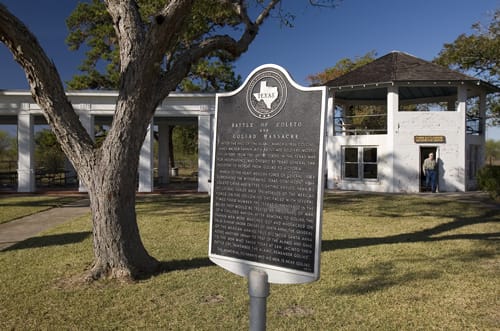
- Drive 15 minutes over to Fannin Battleground State Historic Site to walk the ground where the Texians made their stand before surrendering to the Mexican government forces. Allow a half hour or more to walk the site, read the outdoor interpretive panels, and see the small but well-done indoor exhibit.
There is a lot to take in at these sites around Goliad, Texas. It starts with the prehistory of the Aranama people, their move into the mission, and the role of the nearby presidio to protecting this work. It wraps up with the dramatic role these locations played in the story of the Texas Revolution and the infamous Goliad Massacre.
There is no clear bias at any of these sites. When a point of controversy is raised, both sides are investigated. For instance, the debate rages over whether the execution of the Texian prisoners was a massacre, or simply the death penalty being applied to foreign adventurers by Mexican law. The panel that discusses the issue starts with an 1828 definition from Webster’s Dictionary: “If a soldier kills an enemy after he has surrendered, it is a massacre . . . .”
These sites are sensitive to the fact that this story is a bi-national story. Mexican perspectives are considered without drawing clear lines between “good guys and bad guys.” Those conclusions are left to the visitor. There is no hint of so-called “colonizers and oppressors” narratives that might have been easy to slide in. The Aranama are not portrayed as victims of Spanish schemes, but more as partners in the great effort of the mission. Mexican soldados are not portrayed as villains, nor American volunteers as pure-hearted. There is not a firm conclusion over what Texian and Mexican motives might have been related to the fighting in 1835–1836, but plenty of discussion over what the troops of both armies faced in those deadly days.
Notably, slavery is never listed as a major factor in the Texas Revolution, which is a pleasant and long overdue departure from recent trends that distort the historical record in order to advance grievance narratives. Visitors instead leave with a sense that life on the frontier was hard, the creation of the Republic of Texas was full of suffering, and all of the players in this historical drama had agency—and a significant role to play.
All these locations have plenty of room for children restless from a road trip to stretch their legs. Exhibits geared specifically to younger visitors can be found at each location. Parents will still need to provide context and help explain what the youngsters are seeing. Goliad State Park offers camping, hiking trails, and RV hookups as well.
South Texas is rugged country. It can also be hot. So, pack water, be mindful of any wildlife that might be on nature trails, including rattlesnakes, and prepare for an outdoor adventure with periodic respite in air-conditioned museum spaces. If the family is camping, bring bug spray to ward off mosquitoes and chiggers, and sunscreen. Interpretively, discussions of military violence are handled well, and will not prove threatening to most school-aged children.
Texas is an important part of the United States, and its origin story is instructive. The Spanish missions and presidio around Goliad were where western civilization was introduced to a remote corner of the continent. The Spanish faced challenges in establishing a presence in Texas. Reacting to threats from other European competitors, they knew they needed to occupy this vast domain. Doing so remained a challenge. Among those challenges, the natives needed to be assimilated and turned into Gente de Razón, or “reasonable people.” Otherwise, a military presence would be required to defend against indios bárbaros, or barbarian Indians. This was a job for presidios, and the soldiers stationed there.
The American idea—born in Philadelphia back in 1776—was tested by the fire of another revolution at Goliad. There would be no Texas without Spanish efforts at settling this region. Neither would there be a Texas without the sacrifices made by American volunteers behind the walls of Presidio La Bahia and among its wildflower-dazzled prairies nearby.
For those intrigued by the story of the Texas Revolution but confounded by the urban setting of the Alamo or the industrial neighborhood of San Jacinto, the Goliad sites will prove a pleasant alternative. After all, the Texas that was being settled and fought over resembled the country around Goliad more than the overbuilt sprawl of present-day San Antonio or Houston.
Owned By: The State of Texas
Operated By: Texas Historical Commission and Texas Parks and Wildlife
Government Funded: Yes
Did you know?
Cattle driven by vaqueros (cowboys) from Mission Espiritu Santo fed Spanish and American armies operating against the British on the Lower Mississippi River and the Panhandle of Florida, resulting in the decisive allied victory at Pensacola that helped the United States win its independence.
Recommended Reading
- Mission Espíritu Santo de Zúñiga: A Frontier Mission in South Texas by Tamra Lynn Walter
- Presidio La Bahia del Espiritu Santo de Zúñiga: 1721 to 1846 by Kathryn Stover
- Texian Iliad by Stephen L. Hardin
- Goliad, part of the E Pluribus Texas series (https://www.youtube.com/watch?v=Y7V74gzyDlA&list=PLvMfJzNgyYdLodCuserX10-xOSLjYq07q&index=20)
Reviewed By
Donald S. Frazier
PhD, Director of the Texas Center at Schreiner University
The opinions expressed above are those of the Reviewer who is providing a good-faith historical assessment to educate the public. Reasonable opinions can vary, and the Reviewer’s opinion is not necessarily the opinion of The Heritage Foundation or its affiliates.