Frederick Douglass National Historic Site
Final home of the renowned abolitionist, orator, and statesman who escaped slavery to become a pivotal figure in the fight for racial equality
Site Details
Pin location is approximate.
1411 W St SE
Washington, DC 20020
Family Friendly?
Yes
Visitors Per Year
35,000
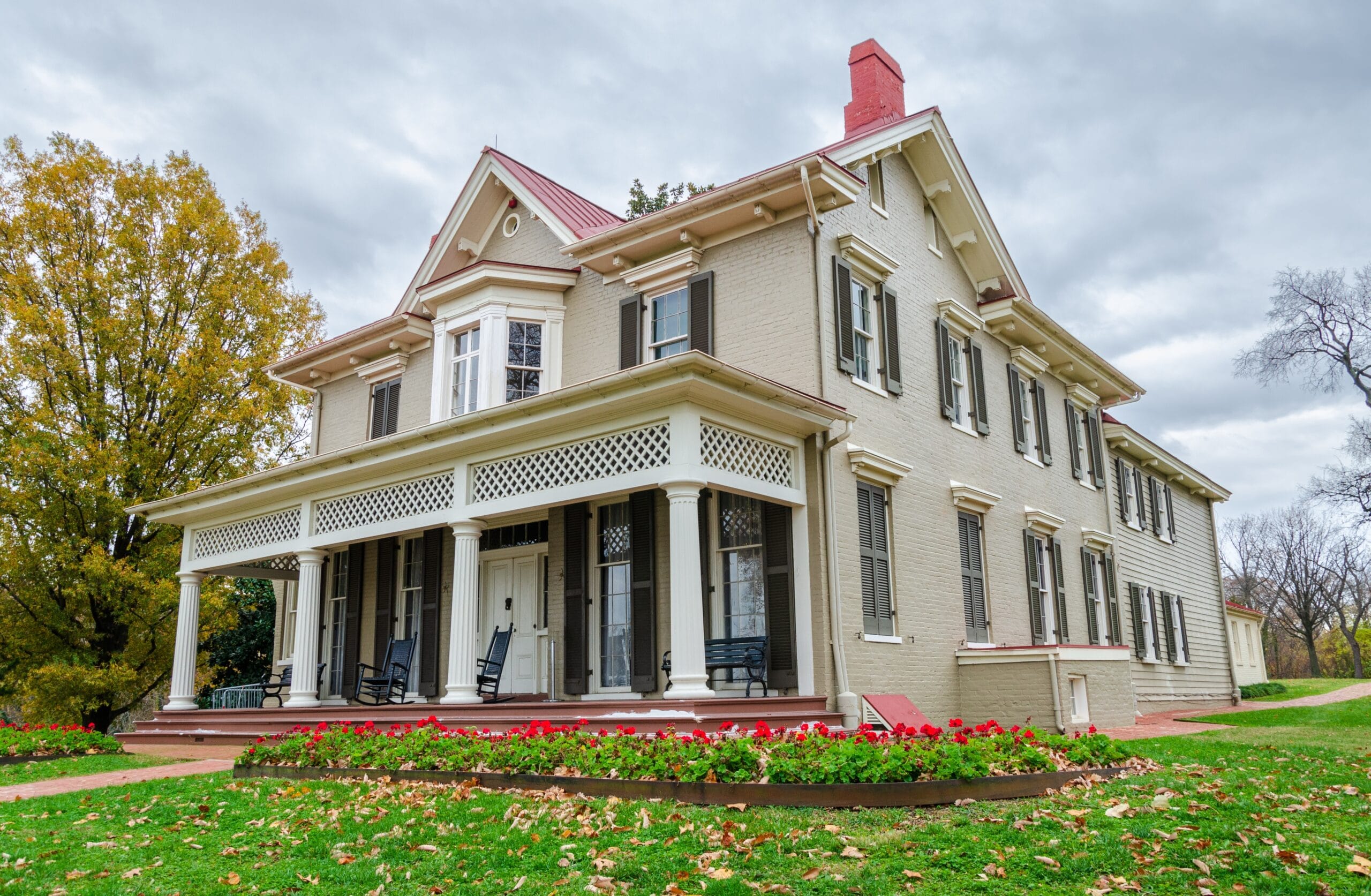
The Frederick Douglass National Historic Site is in Anacostia, a historic neighborhood in southeast Washington, D.C., with a spectacular view overlooking the city. By the time Douglass moved to the area to take a post as the U.S. Marshal for the District of Columbia, he was a legendary figure, sometimes referred to as “the Sage of Anacostia.” Douglass devoted his life to the struggle to secure liberty and equal rights for all.
Biographical Movie: There is a 20-minute video at the Visitors’ Center that gives a good overview of Douglass’s life. In terms of production values, the movie is quite dated, but it is accurate and informative in setting forth the main episodes of Douglass’s formation and public career. It covers how he learned to read, his courageous physical battle with a slave breaker during his teenage years, his daring escape to freedom, and his career as an abolitionist.
Guided tour of the home: Cedar Hill is filled with original furnishings. Often, historical sites must rely on reproductions, but Cedar Hill possesses objects (furniture, paintings, statuary, and books) that were owned by Douglass and have been in the home since he lived there. Tour guides are often very knowledgeable and very interactive with the group. Children and adults are encouraged to ask and answer questions. The tour focuses on the family life of Douglass during his last years, often taking note of the contrast between his early life in slavery, where he was cruelly separated from family connections, and his later life, with his wife, children, grandchildren, friends, and prominent visitors all gathered round him. Be sure to visit the “Growlery,” a windowless brick building with only a desk and chair in the rear of the property where Douglass would go to think and write.
Bookstore: The bookstore is small, but it contains a good array of children’s books, as well as books for adults. Copies of The Columbian Orator, which Douglass managed to acquire as a boy and took with him when he escaped from enslavement, are usually available. The book’s famous speeches extolling liberty are highly recommended for today’s young people.
In general, the site does a good job of presenting Douglass’s remarkable life and career. It also acknowledges the biracial character of the fight to end slavery: Many of Douglass’s close colleagues in the abolitionist movement, such as Wendell Phillips, whose bust is featured in the parlor of the home, were white.
It would be helpful to provide more information on Douglass’s resignation from the American Anti-Slavery Society (AASS) in 1851 and his shift to the Liberty Party. This was an important reorientation. William Lloyd Garrison, the founder of the AASS, denounced the U.S. Constitution as a “pact with the devil” and called for its annulment. The mature Douglass rejected this pro-slavery interpretation of the Constitution and instead declared that the Constitution should be viewed as a “glorious liberty document” that could be an effective anti-slavery instrument. While Douglass was always a powerful critic of American failings, after 1851, he regularly praised the Founders. He embraced the “saving principles” of the Declaration of Independence and the noble aims of the Constitution. His patriotism could be a model for us today, as we grapple with how to combine love for country with honesty about our shortcomings.
Given that Douglass was born enslaved and spent much of his life in service to the cause of liberty, the focus on slavery is fully justified, and there are no other indications of ideological bias.
There is an annual Frederick Douglass Oratorical Contest in which students learn to deliver one of Douglass’s great speeches. Students can participate online or in person. Information is available at www.nps.gov/frdo.
Despite being born into slavery, Frederick Douglass became literate through his own efforts. He accomplished a daring flight north to freedom as a young man. He quickly became a well-known anti-slavery speaker, traveling extensively on the abolitionist lecture circuit, both in the United States and abroad. After his freedom was purchased for him by English friends, he founded an anti-slavery newspaper, The North Star, and continued as both an editor and an orator for many decades. He consulted with President Lincoln during the Civil War about the status of black troops. After the war, he was instrumental in the adoption of the 15th Amendment to the U.S. Constitution. As a speaker and author, he continued the struggle for civil rights for all Americans until his death in 1895.
The home sits atop a hill, with the Visitors’ Center located at the base of the hill, adjacent to the parking lot. The home is accessed via outdoor steps or a switchback ramp. There is no elevator.
Owned By: National Park Service
Operated By: National Park Service
Government Funded: Yes
Did you know?
Frederick Douglass was the most photographed American of the 19th century. Be sure to page through the site’s display copy of Picturing Frederick Douglass, a beautiful volume that contains all 160 known photographs of Douglass, taken between 1841 and 1895.
Recommended Reading
Narrative of the Life of Frederick Douglass, an American Slave by Frederick Douglass
My Bondage and My Freedom by Frederick Douglass
Life and Times of Frederick Douglass by Frederick Douglass
Frederick Douglass: Prophet of Freedom by David W. Blight
The Essential Douglass: Selected Writings & Speeches edited by Nicolas Buccola
Frederick Douglass: Race and the Rebirth of American Liberalism by Peter C. Myers
Reviewed By
Diana Schaub
Professor Emerita of Political Science at Loyola University Maryland and non-resident Senior Scholar at the American Enterprise Institute
The opinions expressed above are those of the Reviewer who is providing a good-faith historical assessment to educate the public. Reasonable opinions can vary, and the Reviewer’s opinion is not necessarily the opinion of The Heritage Foundation or its affiliates.