Fort Totten State Historic Site
Fort Totten was an important military outpost during the Sioux Wars, then became an Indian Agency and an Indian boarding school.
Site Details
Pin location is approximate.
417 Cavalry Circle
Fort Totten, ND 58335
Family Friendly?
Yes
Visitors Per Year
3,000
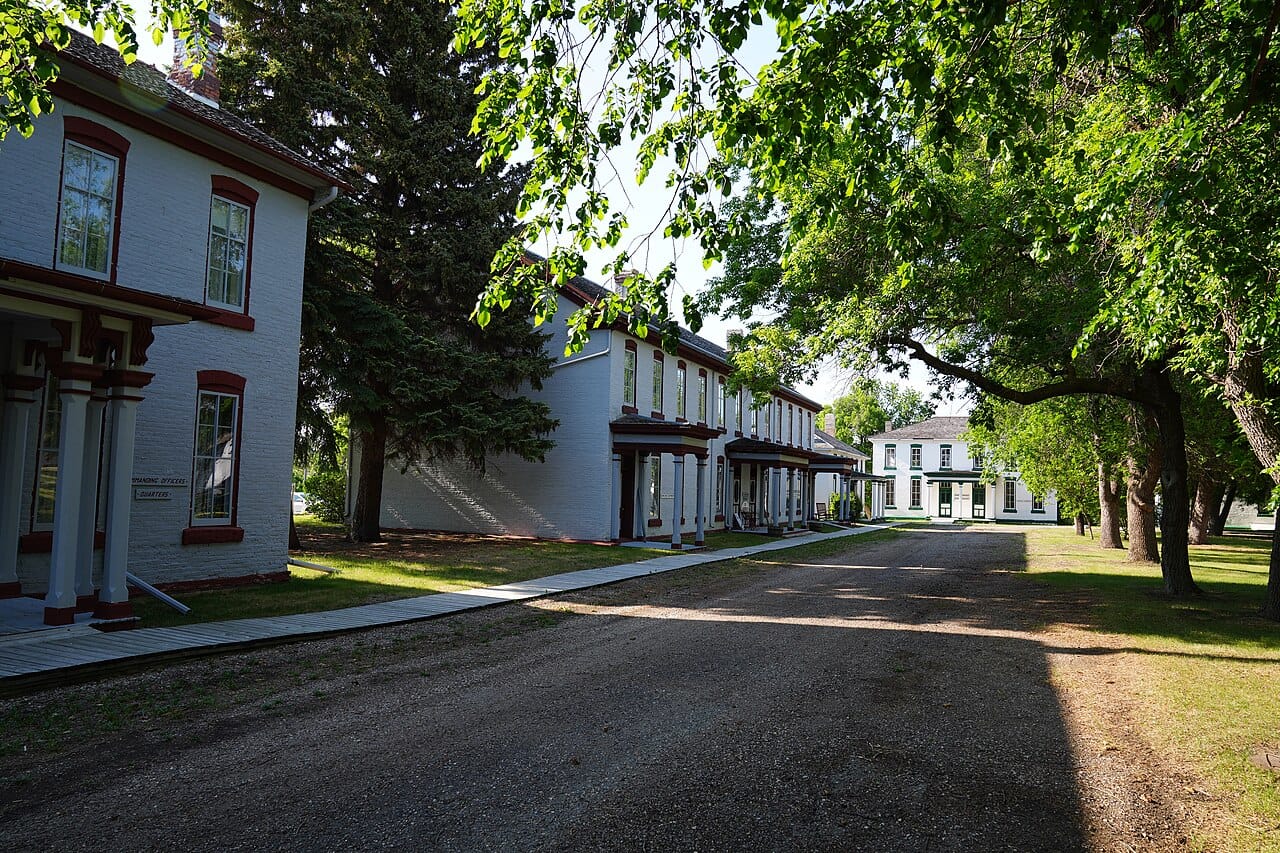
The buildings of the fort are well preserved, and many of them contain exhibits and can be self-toured. The buildings surround a large parade ground where children can freely run.
The former officers’ quarters, now the Totten Trail Inn, has pictures, captions, and artifacts on the walls that inform visitors about all aspects of life at the fort and later boarding school. The innkeeper, a volunteer with the foundation, gives tours of the inn. The tour takes less than an hour, but there are several hours’ worth of fascinating information on the walls and in the rooms. A large part of the 7th Cavalry was stationed at Fort Totten, so there is also information about Custer and his men, including the first newspaper account of the Battle of the Little Bighorn.
Other buildings house the school’s sewing room, student dormitories, soldiers’ quarters, and the like, as well as the interpretive center and gift shop. The exhibits in these buildings explore the fort’s role as an Indian boarding school (one of the largest in the nation) in some depth. More than just the Fort Totten school is covered; the Grey Nuns’ related educational efforts on the reservation are described, as are other nearby Indian schools and the national argument about assimilation. The fort’s stint as a “preventorium” aimed at curbing the spread of tuberculosis on the reservation is also covered.
Overall, the information presented is well balanced and comprehensive. There are many photos, quotes, and explanatory text that detail the experiences of both the Indians and the soldiers.
Most of the information is easily digestible, but sometimes it goes into great depth: One of the rooms in the Inn has a binder, which was open to an academic journal article about the Catholic nuns brought in from Canada to run the school after the fort became an Indian boarding school in 1891.
The controversial project of educating American Indians at boarding schools is presented fairly, with both negative and positive dimensions shown.
One of the buildings contains a video, produced by the National Park Service and Northern Plains Heritage Foundation of North Dakota, which is biased. It’s an hour and a half long and focuses on the Sioux’s perspective of the broader war (there is nothing in the film specific to Fort Totten). The presentation is one-sided, and seems like an effort to keep grievances alive. Most of the speakers featured in the film are current tribal members, freely speculating about what was going on in participants’ minds. European-American culpability is played up, but Indian attacks occur in the passive voice and European-American suffering is ignored. One of the “historians” who speaks is a Democrat politician with no PhD or academic position. Fortunately, families can easily ignore the video, which is the only thing marring an otherwise unbiased site.
Fort Totten is family friendly with the exception of the video, parts of which are gruesome and upsetting. Besides its ideological bias, the video opens with footage of a mass hanging and later shows a corpse in rather bad shape. Children especially may be interested in aspects of life at the school, including photos of the women’s tennis and basketball teams in their stifling 1890’s dress. Families can stay the night at the Totten Trail Inn, which is a fun experience, and each room is distinctive.
Fort Totten is a well-preserved example of a frontier fort during the Indian Wars. It was built in 1867 to protect travel and supply routes, and to supervise the nearby Devil’s Lake Indian Reservation. Its later role as a boarding school provides an opportunity to learn about the complex history of American Indian education and assimilation. From 1891 to 1959, Fort Totten was engaged in the controversial project of teaching Indian children from nearby reservations farming, sewing, and other useful arts while suppressing their native language and culture. Quotes from the students show how hard it was for them, as well as how important it was for the later success of many of them.
Owned By: State Historical Society of North Dakota
Operated By: State Historical Society of North Dakota
Government Funded: Yes
Did you know?
The painter James Whistler’s brother was a commander of Fort Totten.
Recommended Reading
Frontiersmen in Blue: The United States Army and the Indian, 1848–1865 by Robert Utley
Forts of the Northern Plains: Guide to Historic Military Posts of the Plains Indian Wars by Jeff Barnes
Reviewed By
Alex Rolfe
Library Director at George Fox University
The opinions expressed above are those of the Reviewer who is providing a good-faith historical assessment to educate the public. Reasonable opinions can vary, and the Reviewer’s opinion is not necessarily the opinion of The Heritage Foundation or its affiliates.