Fort McHenry National Monument and Historic Shrine
Principal site of the Battle of Baltimore, a pivotal episode of the War of 1812 and the inspiration for the “Star-Spangled Banner.”
Site Details
Pin location is approximate.
2400 E Fort Ave
Baltimore, MD 21230
Family Friendly?
Yes
Visitors Per Year
500,000
Fort McHenry—the nation’s only National Monument and Historic Shrine operated by the National Park Service—provides key insights into the post-Revolutionary War period. In addition to an extensive history of the fort itself, the site emphasizes the larger context of the 1814 battle: its immediate and lasting impact on the people of Baltimore, on the volunteers who manned the fort and beat back the British forces, and on the leaders who risked their lives to prevent a catastrophe.
The fort tour is self-guided and includes virtual features to enhance the exhibits and memorabilia. Park rangers are available to answer questions and prompt discussions.
- The visit is highlighted by a scheduled multi-media presentation in the Fort McHenry Visitor and Education Center, which sits at the park entrance. This interactive experience offers rich detail of everyday life in early 19th century Baltimore, including the impact of the battle itself.
- The centerpiece of the presentation covers the role of Francis Scott Key in strengthening public sentiment for the American cause. In the early hours following the bombardment, through smoke and flames, Key saw the massive American flag still flying over the fort. Today, that same flag is an artifact in the care of the Smithsonian National Museum of American History in Washington, D.C. Guests at the fort may experience a rendition (sung live on special occasions) of Key’s “Star-Spangled Banner” and often join in. At the end of the anthem, a curtain rises to reveal a sweeping view of the harbor where the bombardment took place.
- The scope of the conflict—from the months of fighting that preceded the Battle of Baltimore to its immediate aftermath—is a high point of the experience. The event takes on greater significance when seen in its totality. It served as a rallying cry for Americans across the country—a kind of Pearl Harbor onslaught in which we prevailed over an enemy determined to reclaim a major part of the country.
- George Armistead, who served as commander of the fort during the attack, was praised for his leadership and promoted afterwards. But the event left him severely weakened, and he died three years later at age 38.
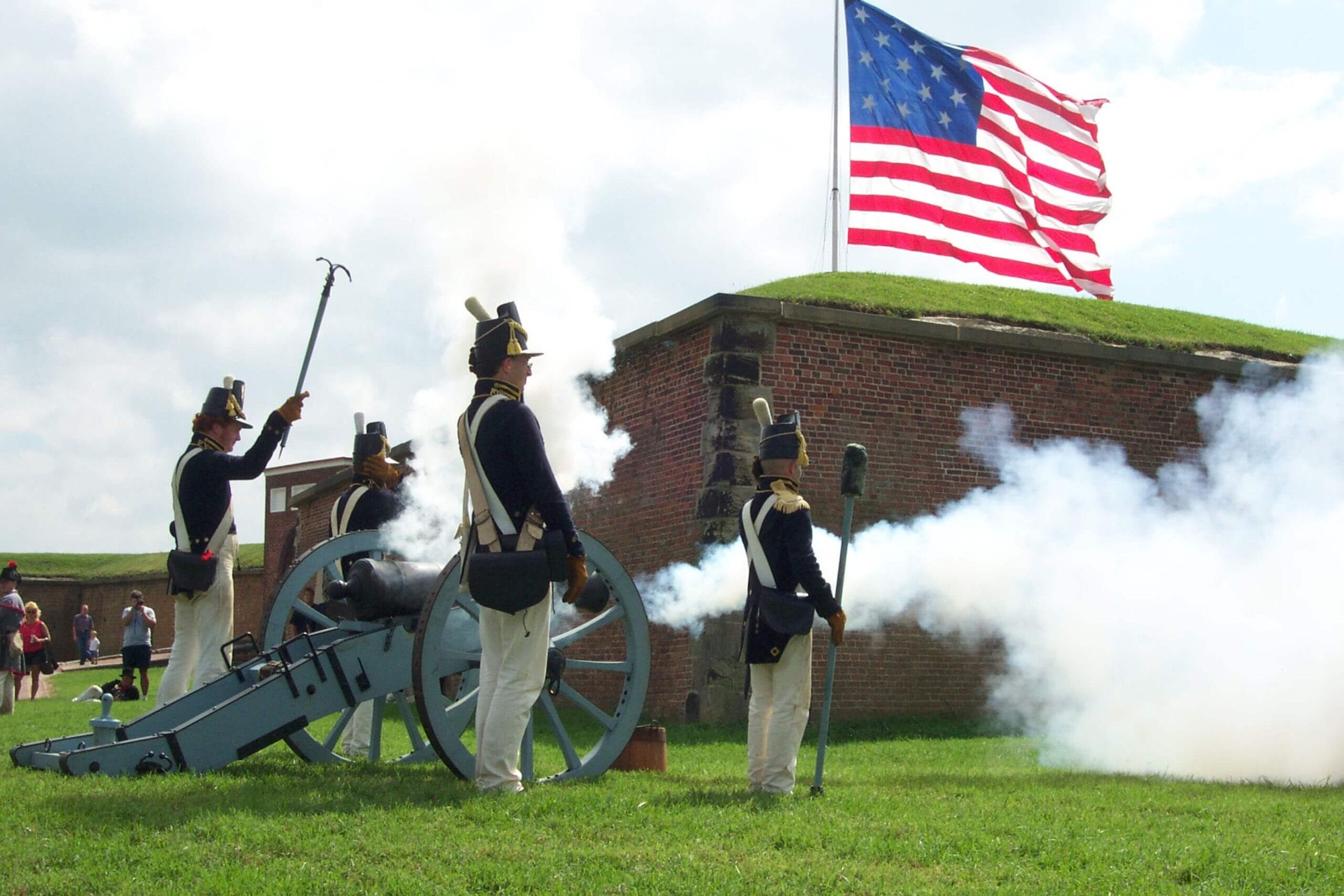
No part of the nearly 44 acres that make up the park is untouched by history. Just outside the garrison, period cannon are displayed as if ready to fire. Inside the fort, exhibits showcase daily life during the war. One featured piece shows the fort’s importance in many conflicts since then, especially during the Civil War nearly 50 years later. From the grassy fields of the perimeter, it is easy to understand the strategic importance of Fort McHenry—economically, militarily, and psychologically.
Fort McHenry’s tours and exhibits are accurate, comprehensive, and proportional. The on-site experts have a rich sense of history and routinely tell stories about the fort that add to the experience.
The fort itself is not without controversy, and that too is examined in a precise and balanced way. As the Civil War grew in intensity, President Lincoln’s troops commandeered the site and used it as a prison for captured Confederate soldiers. With Southern sympathizers active throughout the city, Lincoln also jailed public officials, businessmen, and activists, including the grandsons of both Key and Armistead. Fort McHenry’s guns were actually turned to face the city below.
Across the span of presentations and exhibits, nothing stands out as antithetical to reason or debate. Overall, the park does not offer a simplistic, “pro-war” point of view.
The life story of Francis Scott Key does not hide the fact that he was a slaveholder and legal defender of some anti-American figures before the war. He openly derided abolitionists and recommended a gradual end to bondage.
Access to the grounds surrounding the fort is free. A fee of $15 for visitors 16 and older provides entrance to the fort itself, including the garrison, various buildings, displays, and points of interest. The fort is a military installation, however, so some of its contents may be upsetting.
Fort McHenry is also well suited for a casual outing, such as a family picnic or a long walk. The Port of Baltimore is a global economic machine, with a constant flow of ship traffic and a lively mix of commercial and recreational boating.
With the War of 1812 receiving more attention in recent years, there is a surge in popularity for Fort McHenry. From school-age children on, people want to know how the conflict unfolded and what happened at the fort that made a difference in the outcome. Both an expression of liberty and the limitations thereof are in play, the idea being that the continuity of the nation can turn on a handful of events, unfolding over hours or days. Perhaps nowhere else in the eastern half of the country is this perspective presented more clearly and effectively. The battle and its consequences seem to play out in real time for the visitor.
The Fort McHenry National Monument and Historic Shrine offers the best in historical touring. The attention to detail, such as the fully restored, windowless powder magazine, helps send the visitor back across the centuries. There is an architectural simplicity to the plain brick structures that make up the installation—the fort’s builders worked with what little they had and innovated where they could. At certain spots around the site, the Americans’ dogged determination to defend their port city is the true heart of the story behind this legendary battle.
So much time has passed, but this 1814 victory remains a major achievement for the nation. It lends itself to the kind of storytelling that is foundational to a free society, while also serving as a reminder of both our nation’s vulnerabilities and its determination.
One of the more interesting parts of this experience is the care and attention paid to “The Star-Spangled Banner”—its creation, meaning, and mythology. Particularly in the Visitors’ Center, the story of the flag and the anthem is told with appropriate reverence. This is about much more than the music heard before athletic events.
Owned By: National Park Service
Operated By: National Park Service
Government Funded: Yes
Did you know?
When the British bombardment of Ft. McHenry began on September 13, 1814, Francis Scott Key, a prominent government lawyer from Frederick, Maryland, was aboard a British ship in the Patapsco River near Baltimore’s harbor, seeking the release of an American doctor from British hands. Key, watching the battle and moved by the Americans’ resistance to the British Navy, wrote a poem, “Defence of Fort M’Henry.” It was printed in a local paper and soon set to music. Over the decades, the song became known as “The Star-Spangled Banner” and was officially adopted by Congress as the national anthem in 1931.
Recommended Reading
- The Dawn’s Early Light by Walter Lord; 1812
- The War That Forged a Nation by Walter R. Borneman
- Redcoats, Rockets, and Rescue: The Story of the War of 1812 for Kids by James Smith
- The Biggest (and Best) Flag That Ever Flew by Rebecca C. Jones
Reviewed By
Kurt L. Schmoke
President of The University of Baltimore and former Mayor of Baltimore
The opinions expressed above are those of the Reviewer who is providing a good-faith historical assessment to educate the public. Reasonable opinions can vary, and the Reviewer’s opinion is not necessarily the opinion of The Heritage Foundation or its affiliates.