Fort Clatsop
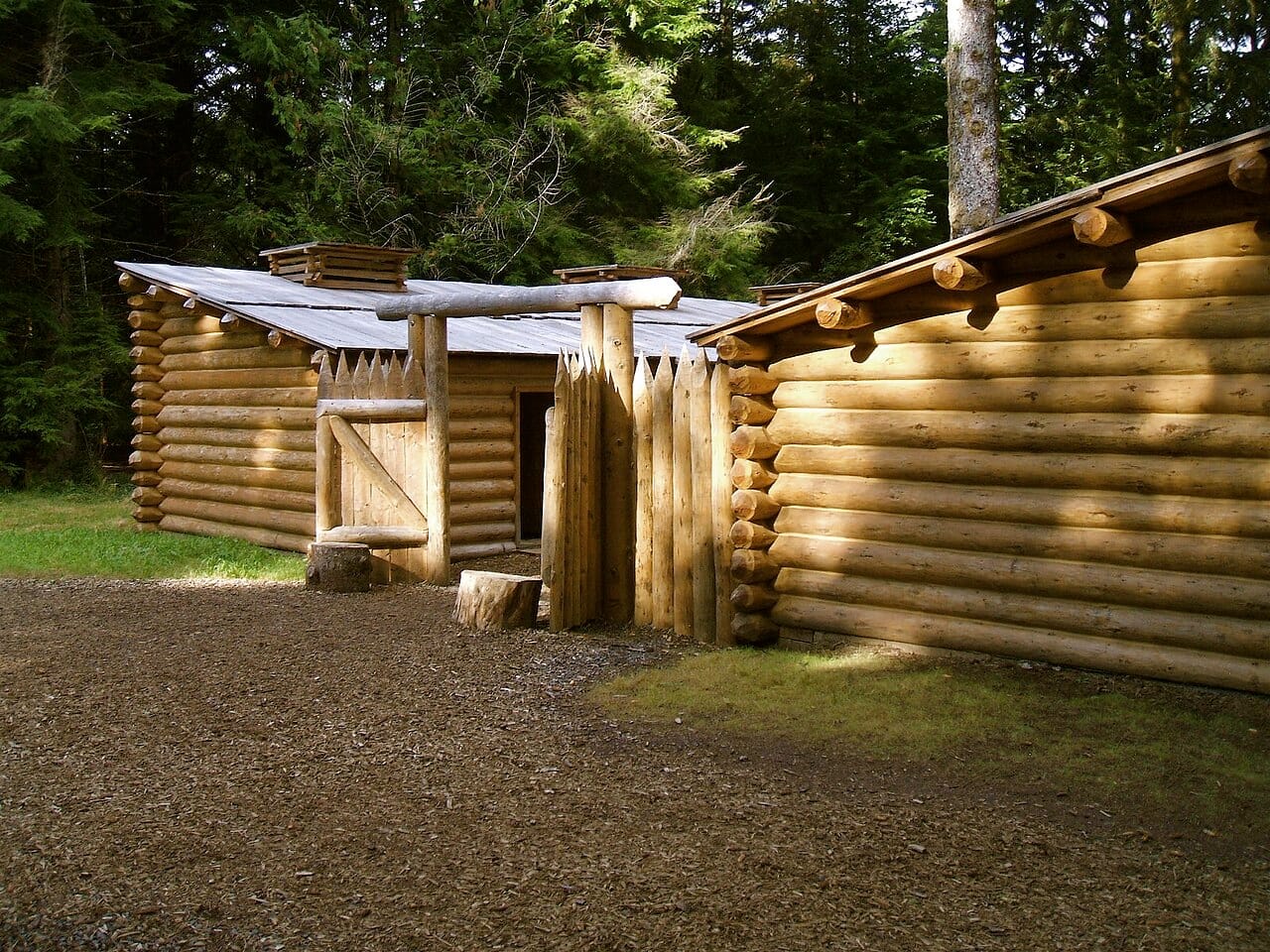
Fort Clatsop was the winter encampment (December 1805 to March 1806) for Lewis and Clark’s Corps of Discovery.
Site Details
Pin location is approximate.
92343 Fort Clatsop Rd
Astoria, OR 97103
Family Friendly?
Yes
Visitors Per Year
300,000
The Visitors’ Center has a 22-minute film that provides a good overview of the winter encampment at Fort Clatsop, a 34-minute film that provides an excellent overview of Lewis and Clark’s journey from St. Louis to Fort Clatsop, and a small museum with informative signs and reproduced weapons, tools, and the like that the Corps of Discovery would have had. Other offerings include:
- An excellent reproduction of the fort,
- Interpretive rangers in period dress,
- Good hiking trails in and around the park, and
- Lewis and Clark’s salt works, located approximately 15 miles from Fort Clatsop.
The videos are accurate and fair and, between the two of them, provide an excellent overview of Lewis and Clark’s journey from St. Louis through the winter of 1805–1806 at Fort Clatsop. The interpretive rangers offer interesting talks on narrower topics, including “Jefferson’s Cryptography” and “The Fur Trade Connection.”
There is no apparent ideological bias at the site.
A family with children will want to spend two to three hours watching the films, seeing the fort, and listening to ranger talks and asking questions of them. There are good hikes from the park through Oregon’s beautiful forests that range from 0.9 to 6.5 miles.
On May 2, 1803, the United States purchased the Louisiana Territory from France. Congress agreed to fund a small military expedition known as the “Corps of Discovery” to explore the new territory. President Thomas Jefferson asked his personal secretary Meriwether Lewis to lead the expedition, and he selected William Clark to be its co-leader. Among their charges was to map the territory, collect samples of new animals and plants, make diplomatic contact with Native American tribes, and find the fabled Northwest Passage (the presumed but non-existent water-route from the Atlantic to the Pacific Ocean).
The expedition of almost 50 men left Saint Louis on May 14, 1804. It wintered near Bismark, North Dakota, and on April 7, 1805, Lewis and Clark sent some of the soldiers back to St. Louis with maps, artifacts, and specimens for President Jefferson. The rest of the group continued westward with 33 people, including two interpreters, a French-Canadian trapper named Toussaint Charbonneau and his Shoshone wife Sacagawea, along with their baby. After crossing the Rocky Mountains, the expedition reached the Columbia River, which they followed to the Pacific Ocean. In November of 1805, members of the expedition built Fort Clatsop, where they stayed until they began their journey home on March 23, 1806. The Corps of Discovery arrived at St. Louis on September 23, 1806, officially bringing the Lewis and Clark expedition to an end. This important journey of discovery helped open the West to American settlers.
The Fort is near Astoria, Oregon, and the Pacific Coast, so a family might want to combine a trip to the fort with a visit to one of these locations.
Owned By: National Park Service
Operated By: National Park Service
Government Funded: Yes
Did you know?
Lewis and Clark’s expedition was greatly assisted by a Native-American woman named Sacagawea, whose image appeared on the Sacagawea dollar coin, first issued in 2000.
Recommended Reading
- The Definitive Journals of Lewis and Clark, Vol 6: Down the Columbia to Fort Clatsop, ed. Gary Moulton
- Fort Clatsop: The Story Behind the Scenery by Daniel Dattilio
- Undaunted Courage: Meriwether Lewis, Thomas Jefferson, and the Opening of the American West by Stephen E. Ambrose
- Blue Beads: A Story of Friendship by Christine Carpenter
- Along the Trail with Lewis and Clark: A Guide to the Trail Today, Third Edition by Barbara Fifer
Reviewed By
Mark David Hall
Professor at Regent University’s Robertson School of Government
The opinions expressed above are those of the Reviewer who is providing a good-faith historical assessment to educate the public. Reasonable opinions can vary, and the Reviewer’s opinion is not necessarily the opinion of The Heritage Foundation or its affiliates.