Fort Atkinson State Historical Park
The first U.S. military post west of the Missouri River served as a military, economic, and cultural hub of early Nebraska settlement.
Site Details
Pin location is approximate.
201 S 7th St
Fort Calhoun, NE 68023
Family Friendly?
Yes
Visitors Per Year
25,000
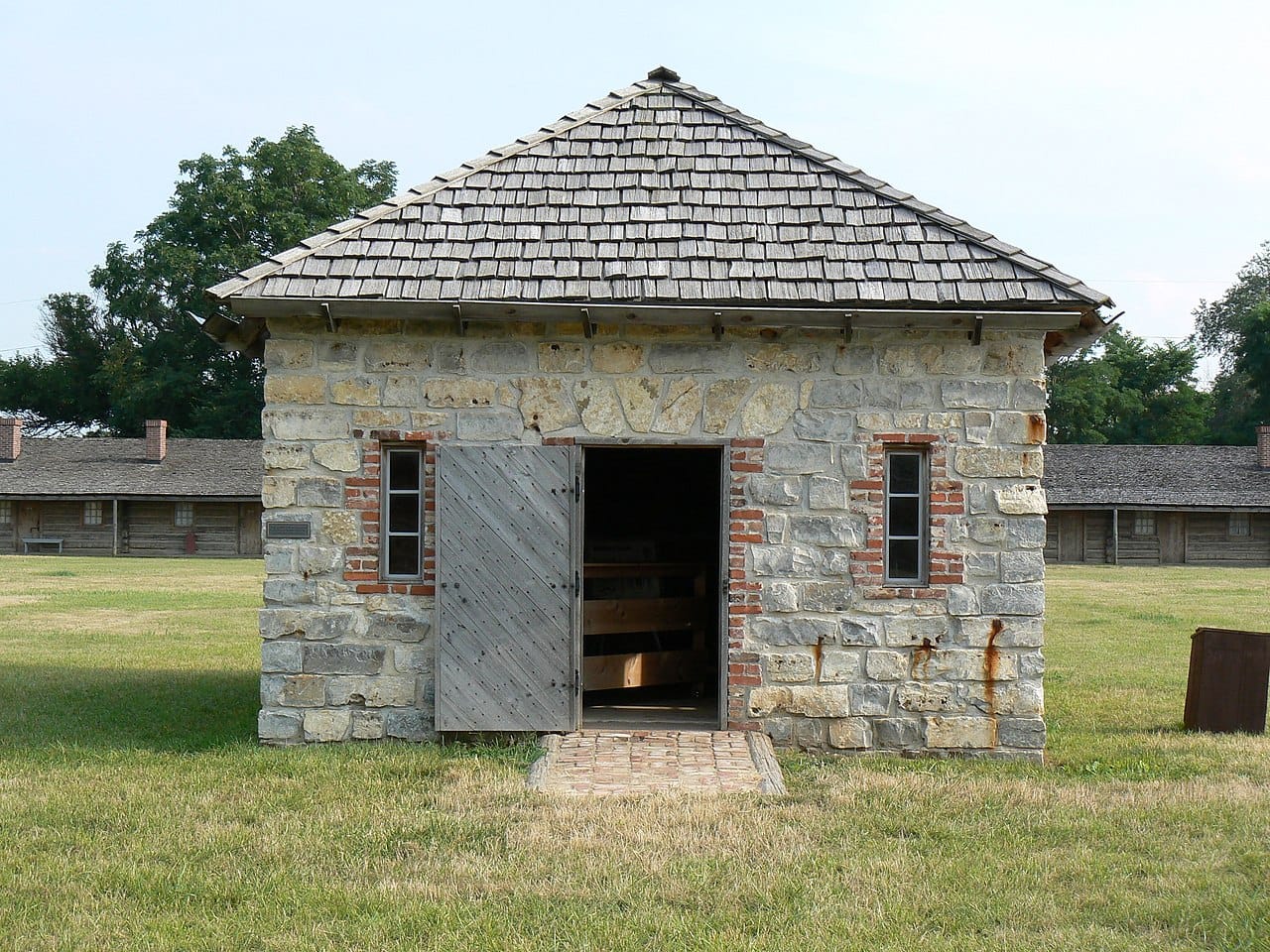
- The main portion of the fort consists of a quadrangle of reconstructed buildings, including barracks, gates, an armorer’s shop, council house, and sutler’s store. These structures display the daily life of soldiers and families on a military fort in the early 19th century. Many of these exhibits are interactive, allowing visitors to enter the rooms and handle certain objects.
- On special days, such as the 4th of July, Fort Atkinson has live reenactments, including blacksmith demonstrations, weaving, cannonball firing, soldier marching, and public readings of the Declaration of Independence. These are the best days for guests to visit because they can enjoy extensive displays and are encouraged to interact with the live actors.
- The site emphasizes broader life and culture at a frontier fort rather than focusing on a narrow theme, providing a proportional overview of military and civilian experiences.
The accuracy of the site is commendable. The exhibits and reenactors ground their work in primary documents, presenting history as it unfolded rather than as a platform for modern ideological debates. Fort Atkinson demonstrates pride in America’s Founding principles, presenting them in their proper historical context. The result is a balanced view of military and civilian life on the frontier, without exaggeration or notable omission.
Fort Atkinson avoids the kind of ideological overlay that often clouds historical interpretation today. Here, visitors encounter the history of the frontier told in the voices and values of the early 19th century. The readings of the Declaration of Independence and the pride reenactors take in their work reflect genuine patriotism. Importantly, this is presented not as political activism, but as a faithful representation of how Americans of the period understood their nation and its Founding ideals.
The site is especially well suited for families. Children can explore interactive rooms and watch engaging demonstrations such as blacksmithing or cannon fire (though parents should be aware that cannon demonstrations are loud). The fort’s trails provide space for walking, exploration, and picnics, making the visit both educational and enjoyable.
Established in 1820, Fort Atkinson was the first U.S. military post west of the Missouri River, marking a key step in American expansion and control of the frontier following the Louisiana Purchase. From its commanding position on the frontier, the fort protected trade routes and supported the fur trade economy, housing the 6th Infantry Regiment and facilitating interactions with Native tribes and traders. It was a base for expeditions and a supply point for the Upper Missouri region.
At its height, the fort housed around 1,200 soldiers, families, and workers, serving as both a military stronghold and a stabilizing presence in a rapidly changing region. As Nebraska’s first “town,” it hosted the state’s earliest school, library, and recreational facilities like a bowling alley. Blacksmiths, craftsmen, and families lived and worked inside its walls, while soldiers maintained contact with nearby settlers, traders, and Native tribes. This made the post not only a base for defense, but also a hub of economic activity and cultural exchange. In this dual capacity, the fort reflected the broader American effort to secure the frontier while fostering the growth of civic life in the trans-Missouri West.
Abandoned in 1827, the site was rediscovered and reconstructed in the 20th century by the Nebraska Game and Parks Commission. It stands today as a symbol of the challenges and achievements of early westward expansion.
Fort Atkinson is situated in current-day Fort Calhoun, Nebraska, and is close to Omaha and several other towns within easy driving distance. Therefore, ample housing, dining, and recreational options are nearby. Omaha features several other destinations that could be included in a family outing.
Owned By: State of Nebraska
Operated By: Nebraska Game and Parks Commission
Government Funded: Yes
Did you know?
Fort Atkinson was built on the “Council Bluff” site where Lewis and Clark held their historic council with the Otoe–Missouria tribes in 1804, a pivotal early diplomatic encounter between the U.S. government and Native American nations that shaped future relations.
Recommended Reading
- Fort Atkinson by Kenneth C. Flint
- History and Stories of Nebraska by Addison Erwin Sheldon
- Husker Numbers: A Nebraska Number Book by Rajean Luebs Shepherd.
Reviewed By
Steve Bullock
CEO of PerfectRx, former Professor and Vice President for Academic Affairs of Midland University, and Professor and Associate Vice Chancellor for Academic and Student Affairs of University of Nebraska at Omaha
The opinions expressed above are those of the Reviewer who is providing a good-faith historical assessment to educate the public. Reasonable opinions can vary, and the Reviewer’s opinion is not necessarily the opinion of The Heritage Foundation or its affiliates.