Ford’s Theatre National Historic Site
Site of Abraham Lincoln’s assassination.
Site Details
Pin location is approximate.
511 10th St NW
Washington, DC 20004
Family Friendly?
Yes
Visitors Per Year
650,000+
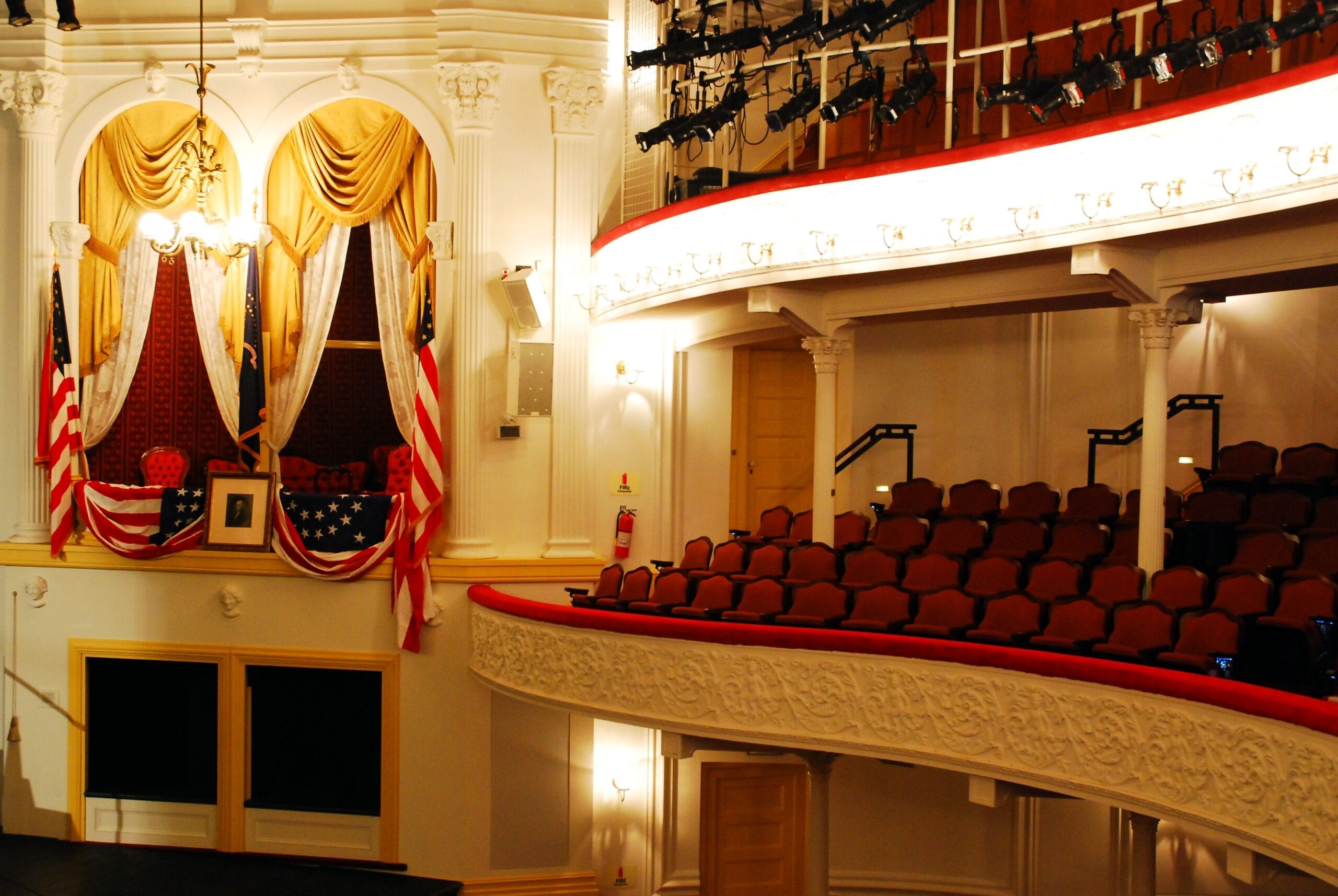
In the busy spring and summer season, the tour includes a narrative presentation of the assassination inside Ford’s Theater and a visit to the Peterson House across the street, where Lincoln slowly passed away after being shot in the balcony box at Ford’s Theater. In the off-season, access to the box where John Wilkes Booth shot Lincoln is often available, but not when the site is busy.
There are two museums: One covers Lincoln’s presidency during the Civil War and the assassination itself, and the other, the Peterson House, covers his death, funeral, and legacy. Visitors will learn about Lincoln’s prosecution of the Civil War and the societal tension of that period, as well as his habits and virtues as President. They will also learn about the conspiracy that led to his death and the nation’s mourning of his death with honors and lasting memorials.
- There are two short videos shown, one in each museum: The first, beneath Ford’s Theater, is a film about Lincoln’s relationship with Frederick Douglass during the Civil War.
- The second, above the Peterson House, is a video about civil rights and Martin Luther King’s speech at Lincoln’s Memorial on the Washington mall.
Given the subject of the two museums, namely Lincoln’s prosecution of the war and his assassination at the hand of Booth, who was fueled by pro-slavery sentiments, these topics are not wholly inappropriate. But they seem less fitting than a video about Lincoln himself given that he is the site’s primary subject.
The exhibits are generally informative and thoughtfully engaging. There is a good focus on the person of Lincoln and the Civil War generally, as well as two special sections, one on the assassin Booth and his fellow conspirators and the other on the manhunt that resulted in their arrests, trials, and executions.
While each tour guide or presenter on the Ford’s Theater stage gets to write his or her own script, the presentation given on the day of the site review was excellent—full of historical detail and a proper respect for both the truth and the historical significance of Abraham Lincoln. Different presenters use role-playing monologues or, alternatively, self-authored scripts, so a full evaluation of that aspect of the site is not wholly clear. But the tone of the site overall is positive.
- The only glaring inaccuracies come in the part of the site that highlights President Lincoln’s legacy, in the museum attached to the Peterson House. In it, a prominent display offers a very slanted and inaccurate interpretation: “Most early depictions of Lincoln commemorated The Great Emancipator. But with the postwar betrayal of former slaves’ political and economic rights, the reunited nation was eager to move on. It wasn’t the abolition of slavery that assured Lincoln’s place in the history books, but the preservation of the Union.” This statement is internally contradictory. Lincoln was put in the history books early on as both the Great Emancipator and the champion of the Union.
- Nearby, another display contains a minor inaccuracy in its description of the Freedman’s Memorial, located near Capitol Hill in Lincoln Park. The memorial depicts Lincoln standing with a protective hand hovering over a former slave, as the slave removes his own chains. The display says that the memorial shows “Lincoln striking the shackles from a kneeling ex-slave.” But the intended design and the statue itself clearly show the ex-slave freeing himself while Lincoln provides metaphorical political and military protection to do so. The implication is that the memorial falsely gives Lincoln credit for the work of African Americans, when, in fact, the statue carefully avoids just that.
With the exceptions of a mild overemphasis on race that focuses too much on events that occurred long after Lincoln’s assassination and of the more concerning dismissal of Lincoln’s legacy as an emancipator and hero of liberty for all discussed above, the displays and presentation were not ideologically marred.
Given the focus on assassination, parents may not find it an appropriate site for younger children. Exhibits in both Ford’s Theater and the Peterson House include some gory medical details and accounts of the violent assassination of Lincoln and of secondary assassination attempts by Booth’s co-conspirators.
The Peterson House museum features a number of pictures of the hanging of Booth’s co-conspirators on the descending staircase that leads to the gift shop. Parents may want to divert younger children’s attention when passing through that section.
Abraham Lincoln was a great American statesman, who combined a shrewd political wisdom with a strong desire for equality for all Americans. His moral integrity and high regard for the American system as the best means for ending slavery while securing the sustained prosperity, peace, and liberty for all, under the rule of law, led him to both preserve the Union and provide for the end of the institution of slavery. He did all this while leading the country through its bloodiest days of civil strife. The Emancipation Proclamation, his disposition toward peace and unity, his patience in time of war—these remain a lasting part of his legacy as the most esteemed American president according to polls, year after year.
Lincoln was the first president assassinated, on April 14, 1865, and his death touched off a period of mourning in which no less than 83 percent of Americans attended memorial services across the nation. He was beloved for his wise and galvanizing words, as in his Gettysburg Address and his Second Inaugural Address, and he was honored for dying in service to the principles and people—all the people—of the United States. At Ford’s Theater, days after the Civil War had ended, Lincoln gave, as he said at Gettysburg, “the last full measure of devotion.”
Ford’s Theater operates in partnership with a private organization, the Ford’s Theater Society, which continues to stage theatrical productions in the historic venue. The box office can be found at the Ford’s Theater website above.
Owned By: Ford’s Theatre Society and the National Park Service
Operated By: National Park Service rangers and employees operate the tours and museum spaces; private companies operate the snack and gift shops, as well as the working theater.
Government Funded: Yes
Did you know?
Lincoln loved the theater, especially the plays of Shakespeare, which he often quoted to his staff.
Recommended Reading
Abraham Lincoln: A Biography by Lord Charnwood
Lincoln and the American Founding by Lucas E. Morel.
Reviewed By
Matthew Mehan
Associate Dean and Associate Professor of the Van Andel Graduate School of Government at Hillsdale College in Washington D.C.
The opinions expressed above are those of the Reviewer who is providing a good-faith historical assessment to educate the public. Reasonable opinions can vary, and the Reviewer’s opinion is not necessarily the opinion of The Heritage Foundation or its affiliates.