Emily Dickinson Museum
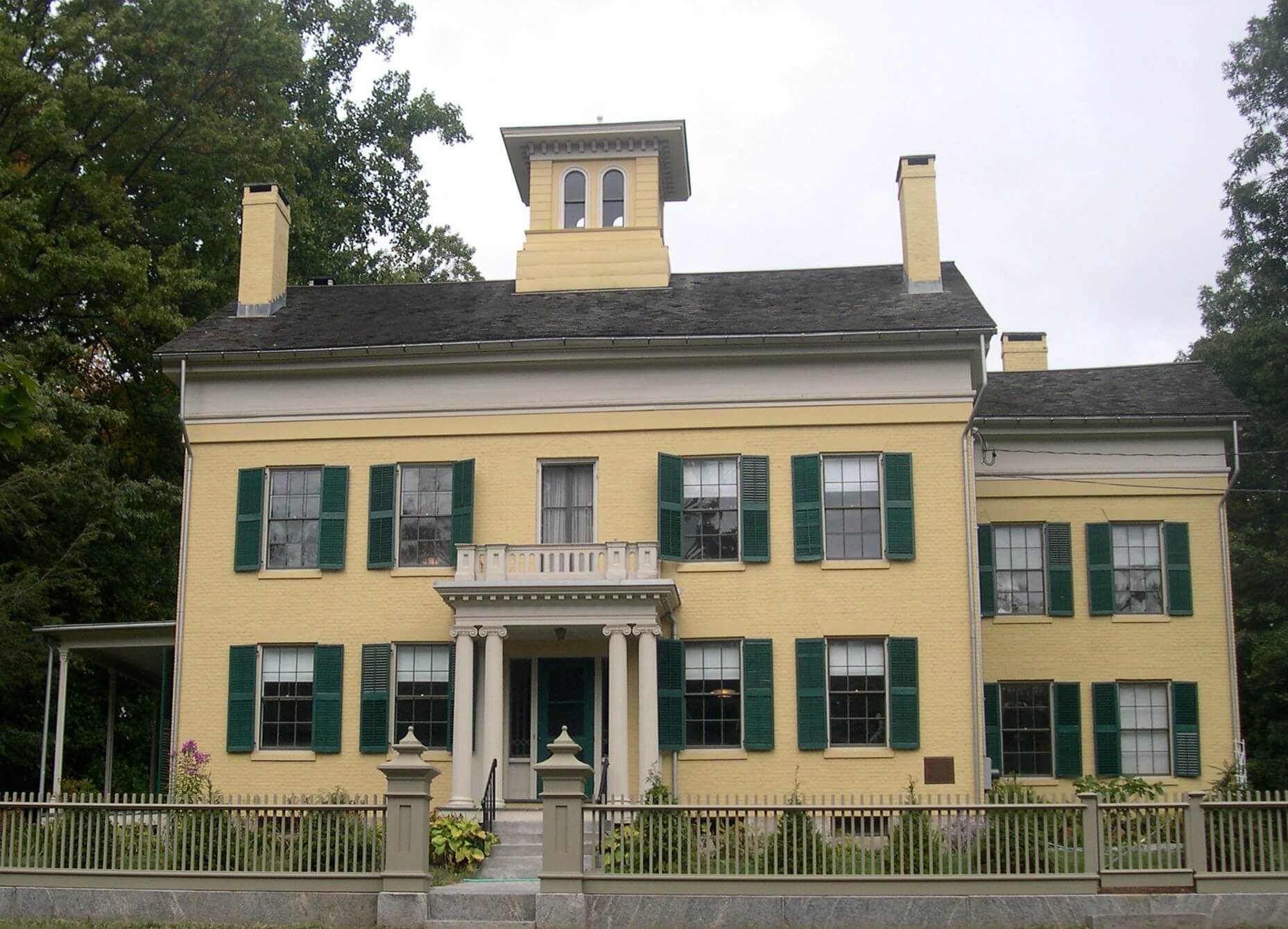
Birthplace and home of the famous 19th-century poet, who is considered perhaps the greatest lyric poet in American history
Site Details
Pin location is approximate.
220 Main St
Amherst, MA 01002
Family Friendly?
Yes
Visitors Per Year
15,000
The Emily Dickinson Museum is comprised of two sites: the Homestead (where Emily Dickinson lived and died) and Evergreen (where her brother Austin lived with his family). In neither tour is there an obvious script being followed. Both tours provide a good description of the history of the home and the everyday life the Dickinson family lived there over many decades.
The Homestead Tour lasts 45 minutes. The period furniture and decorations of the homes are described in detail and guides convey how Emily Dickinson’s life developed between the two homes, with the Homestead being the site of dinner parties with notable people from the community. Dickinson herself went back and forth between the homes, sometimes late into the evening, often retreating to her room to write poetry.
After a 30-minute break, the Evergreen Tour starts and lasts 25 minutes. The tour guides portray the Evergreen site as “how it was in the 19th century,” but it simply seems in need of restoration. The references to her poems are brief. The related history of how Emily Dickinson’s manuscripts were transmitted, edited, and sold to Harvard University is sometimes overly complicated. The account the guides give of Mabel Loomis Todd’s affair with Dickinson’s brother Austin, and Todd’s later work with Dickinson’s first editor, Thomas Wentworth Higginson, is also difficult to follow.
The tour guides are knowledgeable but can be disorganized and hard to follow. The Homestead tour guides sometimes simplify Emily Dickinson’s religious outlook as stemming from a Romantic period disregard for formal religion, whereas most biographers recognize Emily Dickinson’s complex and subtle relationship to faith.
The tour guides for the Homestead sometimes make passing references, easy to miss, that an erotic lyric of Emily Dickinson’s might have been written to another woman, her brother’s wife. The Emily Dickinson Museum YouTube Channel, on the other hand, is explicitly ideological. Many of the videos on the site are recordings of events held at the Museum and celebrate abortion, homosexuality, and a whole host of progressive causes, using Emily Dickinson’s poetry to promote this world view. Visitors may not encounter such content on a given day, but such events are indicative of an ideology that animates the site operators and could portend further changes.
The small museum shop has books, knickknacks, and such that will be of little interest to children. There is a room in the Homestead with benches and a display about Emily Dickinson’s poetry that is geared towards children or perhaps school groups. Both houses are well air-conditioned and are easy to access, although the stairs are steep and elderly and younger visitors may need assistance on them. Young children need to be monitored amid the antique furniture.
Emily Dickinson honed to perfection hundreds of short poems that express wonder at nature’s endless variety and puzzle over the mysteries of love and death and the afterlife. In their intense inwardness—her poems often start from Dickinson’s solitary reflections—her poems speak to universal concerns over human nature.
From her letters, we know she read English and American writers extensively, and adored Shakespeare. Her literary influences show how, in her relative isolation, with her books, Dickinson lived among poets. Her gift for metaphor was squarely on the level of genius. Images from her poems show a talent, range, and poetic power equal to the finest poets in the American experience. Emily Dickinson’s verse shows how we may find teachers in tulips, eternity in a cobweb. She was a pioneer of the spirit, and her poems are literary treasures for all Americans.
Owned By: Amherst College
Operated By: Amherst College
Government Funded: Yes
Did you know?
Emily Dickinson’s sister-in-law and nieces, after Dickinson’s death in 1886, visited Europe, and brought back pieces of Catholic religious art to decorate the Evergreen home.
Recommended Reading
- Emily Dickinson: Selected Poems and Commentaries by Helen Vendler
- Emily Dickinson and the Art of Belief by Roger Lundlin
Reviewed By
Mike Ortiz
Teacher at The Heights School in Potomac, Maryland
The opinions expressed above are those of the Reviewer who is providing a good-faith historical assessment to educate the public. Reasonable opinions can vary, and the Reviewer’s opinion is not necessarily the opinion of The Heritage Foundation or its affiliates.