Colonial Williamsburg
Former capital of Virginia and now America’s largest living history museum, showcasing colonial life and pivotal events of the American Revolution
Site Details
Pin location is approximate.
101 Visitor Center Dr
Williamsburg, VA 23185
Family Friendly?
Yes
Visitors Per Year
500,000
Colonial Williamsburg is a living history museum, a reconstructed town situated in the 18th century. Character interpreters in colonial garb wander the streets, and many of the buildings are open for tours or occupied by an employee prepared to explain a trade (such as bookbinding). There is a great deal to see and do, and the Colonial Williamsburg Foundation recommends that the first-time visitor:
- Tour the Governor’s Palace and the Capitol
- Explore at least four trades
- Meet at least two nation-builders
- Experience diverse voices (a number of tours and performances focus on African Americans, women, slavery, and Native Americans, with the hour-long Paradox of Freedom tour available up to six times daily)
- Take a carriage ride
- See two performances
- Explore the archeological sites and art museums
- Go to an evening program
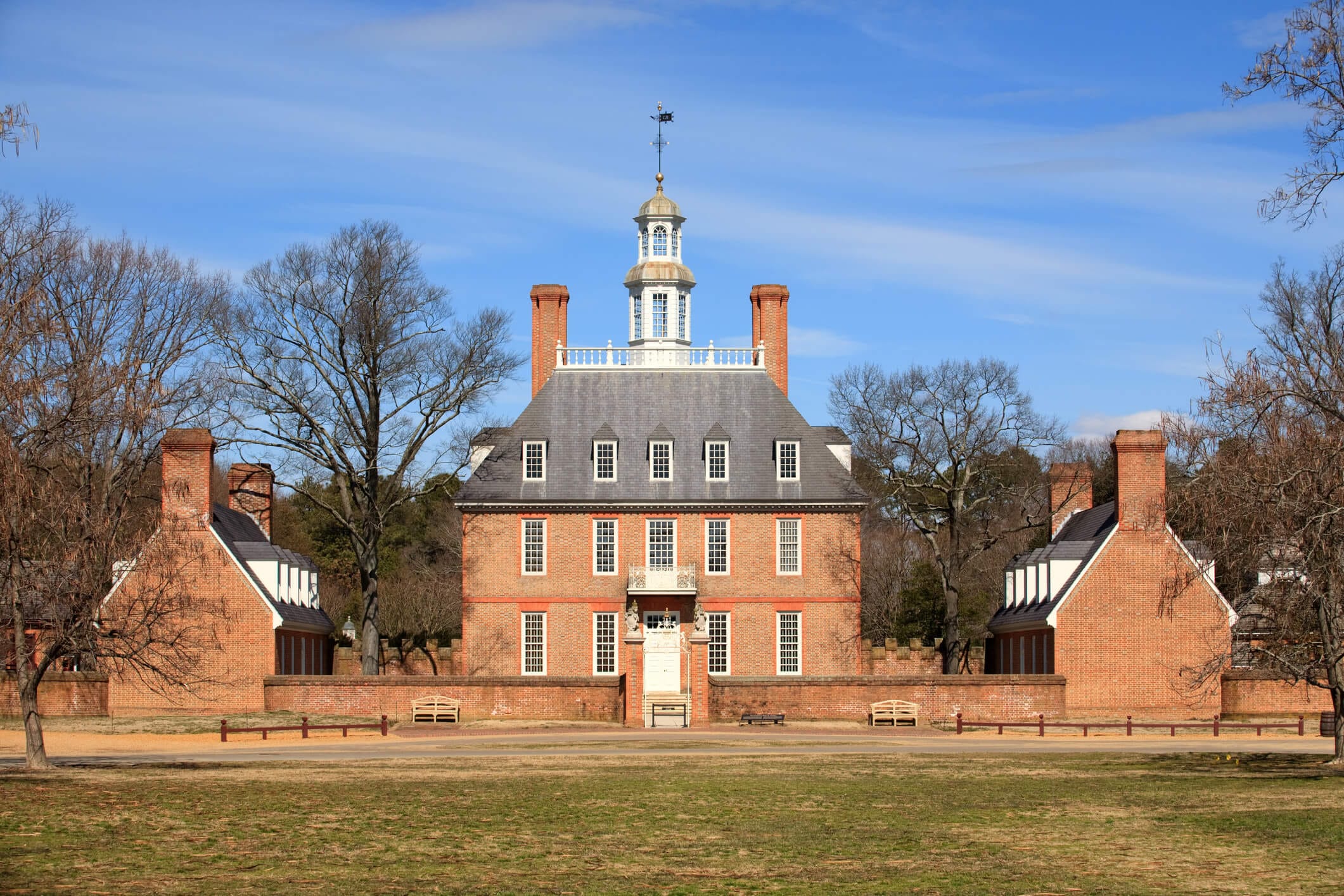
The Governor’s Palace stands as it would have stood when Lord Dunmore, the last royal governor of Virginia, resided in it. Lord Dunmore lost popularity after stealing gunpowder from the Williamsburg magazine and is most famous for Dunmore’s Proclamation, which offered freedom to enslaved people if they agreed to fight for the British. The Capitol is likewise reconstructed to be a reminder of Virginia’s governmental structure under British rule; the courthouse, Governor’s Council, and House of Burgesses are all situated in the same building. These tours last about 20 minutes and are informative and interesting.
Colonial Williamsburg offers plenty in the way of entertainment, and there are a host of rotating and specialty tours. There are outdoor stages and a theater in the art museum, which houses an extensive collection of artifacts like musical instruments, weapons, portraits, and pottery.
The Nation Builder performances, available once or twice per day and lasting 30 minutes, are the most valuable. Actors portraying figures like George and Martha Washington, James Madison, and Gowan Pamplet deliver monologues detailing the accomplishments and historical significance of those individuals.
The tours and exhibits are mostly historically accurate, and the Nation Builders are often exceptional. In recent years, the Nation Builders have been somewhat sidelined, as have tours that focus on the Founding Fathers and Revolutionary history.
Theater programs and performances are a mixed bag, sometimes including false or apparently ideologically driven content.
- According to one visitor, an actor during “Draw the Line” (a play depicting the signing of Dunmore’s Proclamation) asserted that, “This country is here because of fear of black people getting their liberty.” This is an echo of the erroneous contention of the 1619 Project that the American Revolution was fought to protect slavery.
- Other theater programming seems to lose sight of Williamsburg’s core mission. One of the specialty performances, Ladies of Llangollen, depicts a romance between two Irish women with no seeming connection to Colonial Williamsburg.
The Colonial Williamsburg Foundation appears to be trending in an ideological direction.
- The vice president of education, research, and historic interpretation at the Colonial Williamsburg Foundation, held out the need for the foundation to commit itself “to the unfinished work of eradicating systematic racism.”
- In 2023, Colonial Williamsburg partnered with the New York Historical Society to host a teacher chat on “Queer History and Methodologies” and a workshop on “Best Practices for Teaching Queer History.”
Tour guides and character actors quite often “provoke” visitors with ideological questions, and some of the actors and theater events inject political commentary or engage in political activism.
- In 2019, the foundation established a Gender and Sexual Diversity Research Committee, and in June and October specialty programs include LGBTQIA content.
- Character actors contended that the 13th amendment became an avenue for the re-enslavement of black men, in particular, through the prison system, and that, “Now is the time for us to fulfill the promise of those words and create an equitable society. By any means necessary.”
Colonial Williamsburg is a destination built for families and children. Compared to other historic sites, more elements, like theater events and carriage rides, are geared towards tourists, and guests are encouraged to stay for days rather than an afternoon. Children will particularly enjoy the presentations of the trades (blacksmiths, bookbinders, etc.) and roaming character actors. Colonial Williamsburg hosts a wide range of specialty events, like haunted ghost tours and concerts, that are entertaining and engaging.
Parents will want to exercise caution when it comes to the theater performances. As is expected, depending on the ages of children, some content may not be appropriate. An additional caution is that the events can be political in nature (particularly in October and June for LGBTQIA celebrations). Such performances are when character actors are most likely, in their words, to attempt to provoke guests to make them feel “uncomfortable.”
Williamsburg was the capital of Virginia from 1699 to 1780 and one of the most important sites for America’s colonial and revolutionary history. Lord Dunmore’s Proclamation was significant, and Virginia was a crucial state for determining whether America would declare independence.
Colonial Williamsburg saw the beginning and end of the American Revolution. Revolutionary rumblings gained momentum when Britain passed the Stamp Act, and firebrand Patrick Henry, who was Virginia’s first elected governor, delivered his Caesar–Brutus speech against the Act in the Williamsburg Capitol. In that same Capitol building, Thomas Jefferson (the second governor) introduced a bill for religious freedom, and members discussed the passing of the Virginia Declaration of Rights. Thomas Jefferson attended neighboring William & Mary, and the house of his mentor, George Wythe, Founding Father and Attorney General of Virginia, is in Colonial Williamsburg. Several of the Virginia Conventions, during which patriots debated separating from Britain, occurred in Williamsburg, with Peyton Randolph (his house is also in the capital) presiding as president. In 1781, in advance of the decisive battle of Yorktown, George Washington assembled the Continental Army in Williamsburg.
Owned By: Colonial Williamsburg Foundation
Operated By: Colonial Williamsburg Foundation
Government Funded: Yes
Did you know?
Patrick Henry, famed for proclaiming “Give me liberty or give me death”, was Virginia’s first elected governor, and he ran his administration from Williamsburg.
Recommended Reading
- A Williamsburg Galaxy by Burke Davis
- Williamsburg: Before and After: The Rebirth of Virginia’s Colonial Capital by George Humphrey Yetter
Reviewed By
Brenda Hafera
Assistant Director and Senior Policy Analyst in the B. Kenneth Simon Center for American Studies at The Heritage Foundation
The opinions expressed above are those of the Reviewer who is providing a good-faith historical assessment to educate the public. Reasonable opinions can vary, and the Reviewer’s opinion is not necessarily the opinion of The Heritage Foundation or its affiliates.