Chickamauga and Chattanooga National Military Park
Site commemorating three significant Civil War battles that took place near Chattanooga, Tennessee
Site Details
Pin location is approximate.
3370 Lafayette Rd
Fort Oglethorpe, GA 30742
Family Friendly?
Yes
Visitors Per Year
1,003,000
The Chickamauga and Chattanooga National Military Park consists of three sites near Chattanooga, Tennessee: the battlefields of Chickamauga, Lookout Mountain, and Missionary Ridge.
The Chickamauga site is the most extensive. The Visitors’ Center at the entrance serves to orient and interpret all three sites and has three noteworthy components:
- First, a small exhibit places the battles in the larger context of the Civil War. Presented well, this brief introduction is very helpful in establishing the chronological order of the battles and explaining their significance.
- Second, an introductory film, The Campaign for Chattanooga: Death Knell of the Confederacy, is very well done. It recreates the drama of the battles with reenactors and includes many primary letters and journal entries from participants. The narrative is eminently fair and, in the end, moving, concerning the lives lost.
- Third, the center is home to the Fuller Gun Collection, an extensive collection of historical firearms from the earliest colonial period to the 20th century. Many guests will find the design and evolution of the guns fascinating.
Visitors to the Chickamauga site can then take a driving tour of the battlefield (or explore it on foot or bicycle). Important points along the way are well marked, and the informational signage is clear. The battlefield is marked by memorials throughout.
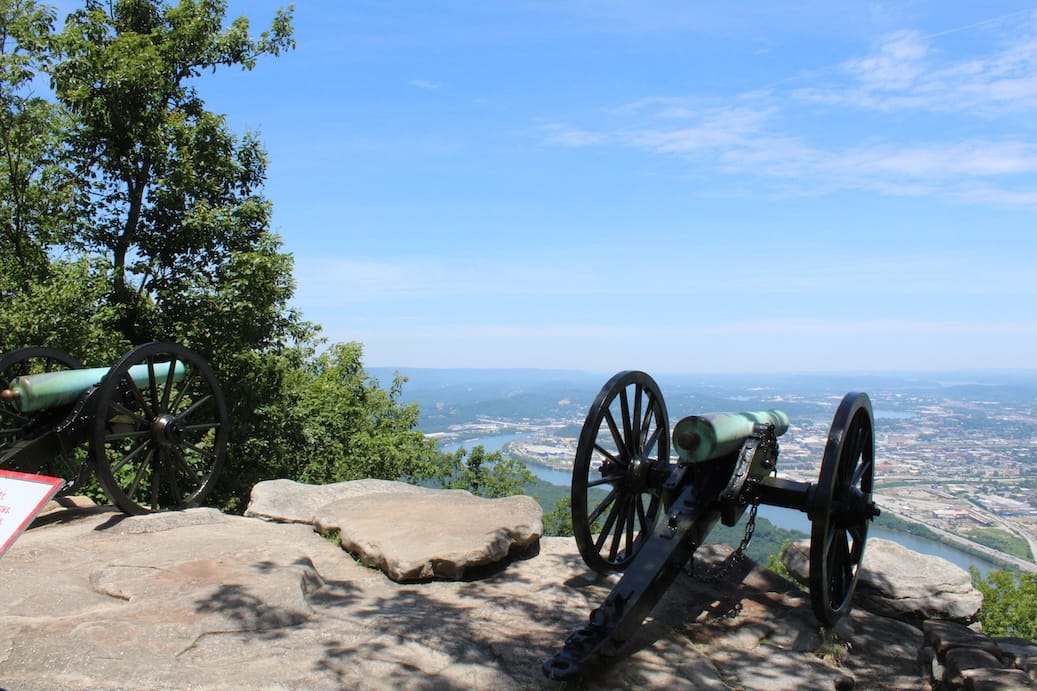
The Lookout Mountain site is situated across the state line in Georgia and marks the defensive lines captured by the Union armies after scaling the heights of the mountain. A smaller visitor center here makes sense of the battles around Chattanooga. Its presentation is brief but also well done. The site itself is called Point Park and is home to several significant monuments. It offers outstanding vistas of the Tennessee River and Chattanooga.
The Missionary Ridge area consists of small plots of land (“reservations”) and memorials spread along the ridge and through a residential neighborhood. Some are on private property, while others are accessible immediately off the road or following a short hike.
Visitors can explore all three sites on their own, but Ranger tours are available at Chickamauga and Lookout Mountain. The Rangers are engaging and friendly and present significant information about the site, and each Ranger can personalize how he or she will make the presentation to a group.
The text throughout the site is well crafted. The events of the battles are covered carefully. The Civil War itself is handled in line with scholarly interpretation. The introductory movie is well done, recognizing the human stories on both sides of the conflict.
The presentation at the site was not distorted by significant ideological interpretations, nor was it marked by presentist (interpreting the past through a modern lens) concerns. It traces the events at the three sites well and honors all those who fought on the battlefields.
The park is highly recommended for families. All exhibits are accessible to guests of different ages. The park also has a lot of outside open space to run and explore. The battle scenes in the introductory movie, however, may be scary for young children.
The three sites around Chattanooga were critical contests in the Western Theater of the Civil War. As the Union army advanced through Tennessee, they captured Chattanooga and sought to use it as a base to move into Georgia. South of the city, in September 1863, the Confederate army launched a surprise counterattack at Chickamauga. The Union army was driven back, although preserved by George H. Thomas’s sturdy defense. Regrouping in Chattanooga, the Union army, now under the command of Ulysses S. Grant and William T. Sherman, sought to break the Confederate siege of the city. Across two days in November 1863, the Union forces stormed up Lookout Mountain and Missionary Ridge. While Chickamauga was a Confederate victory, the Union breakout from Chattanooga significantly weakened the western Confederate army and opened the next Union campaign toward Atlanta.
Owned By: National Park Service
Operated By: National Park Service
Government Funded: Yes
Did you know?
Union General George H. Thomas here earned the nickname “The Rock of Chickamauga” because of his action to reform the Union lines and protect retreating Union troops.
Recommended Reading
- Fields of Honor: Pivotal Battles of the Civil War by Edwin C. Bearss
- Master of War: The Life of General George H. Thomas by Benson Bobrick
- Guide to the Battle of Chickamauga, edited by Matt Spruill
Reviewed By
Jonathan Den Hartog
Professor and Chair of the Department of History at Samford University
The opinions expressed above are those of the Reviewer who is providing a good-faith historical assessment to educate the public. Reasonable opinions can vary, and the Reviewer’s opinion is not necessarily the opinion of The Heritage Foundation or its affiliates.