Castillo de San Marcos National Monument
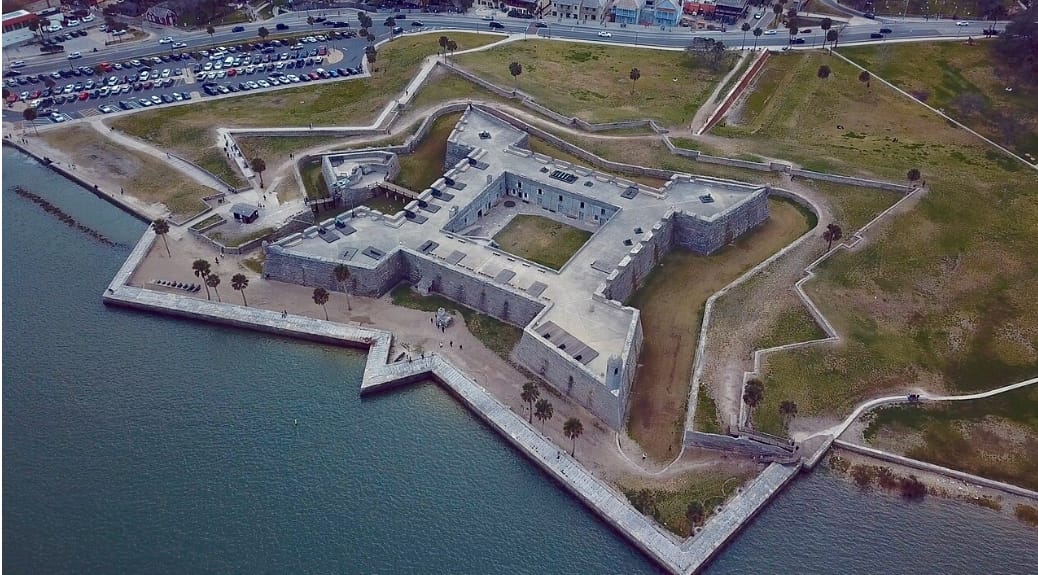
Oldest masonry fortification in the continental U.S., built by the Spanish beginning in 1672 to St. Augustine and the Atlantic trade route
Site Details
Pin location is approximate.
11 S Castillo Dr
St. Augustine, FL 32084
Family Friendly?
Yes
Visitors Per Year
650,000
Castillo de San Marcos is a compact site laid out for self-guided tours.
As of the summer of 2025, the only talks given on-site are by volunteer amateur historians, who develop their own presentations without scripts or talking points from the National Park Service. Presentations sometimes include the history of the fort’s battle flag and the Spanish Habsburgs, as well as the history of Spanish colonial St. Augustine. On weekends, cannon-firing demonstrations occur several times each day.
Most rooms in the fort contain signs explaining each room’s function, for example, barracks, storeroom, or prison. Additionally, they contain displays about people of interest who were connected to the fort, such as the Irish soldier who eloped with the Spanish governor’s daughter. The emphasis in most of the rooms is on the Spanish colonial period, during which the fort was attacked by British troops twice.
One room is dedicated to American use of the fort after it was turned over to the United States in 1821 and renamed Fort Marion. This room includes (among other things) displays about members of Plains Indian tribes who were held prisoner there in the 1870s. The space dedicated to this phase of the fort’s history appears proportional to its actual significance.
The exhibits at Castillo de St. Marcos are accurate and comprehensive. The site’s focus on the Spanish colonial period insulates it from most problems related to anti-American bias.
The displays about various 18th-century people appear to have been curated at least partially with an eye toward diversity, equity, and inclusion. For example, one display focuses on an 18th-century St. Augustine woman with no obvious connection to the fort, seemingly as a pretext for discussing female property ownership in Spanish Florida. On the whole, though, this tendency is a minor distraction from the overall presentation of material.
Castillo de San Marcos is a fairly compact site. Depending on the weather, the grounds are good for walking or picnicking. Inside the fort, parents can allow children to wander without fear of their getting lost. One of the rooms is dedicated to the National Park Service’s Junior Ranger program, which provides children with worksheets and games designed to help them learn more about the site. None of the displays is inappropriate for family viewing.
Castillo de San Marcos played a significant role in the military history of Spanish Florida. It was attacked by Great Britain in 1702 during Queen Anne’s War and in 1740 during the War of Jenkins’ Ear. After its transfer to Great Britain and then to the United States, it became part of a coastal network of fortifications but was never fired upon. Thus, it is appropriate for the presentation at the site to focus on its role as a military installation and on the Spanish colonial period. Visitors should learn about the colonial dynamics between Spain and England and about 18th-century warfare.
Owned By: National Park Service
Operated By: National Park Service
Government Funded: Yes
Did you know?
The fortress has a distinctive star-shaped design, which allows its garrison to fire on attackers from multiple angles with minimal blind spots.
Recommended Reading
Forts of Florida: A Guidebook by Rodney Carlisle and Loretta Carlisle
The History of Castillo de San Marcos by Luis Rafael Arana, Albert Manucy, and Jay Humphreys
The History of Castillo de San Marcos and Fort Matanzas: From Contemporary Narratives and Letters by the National Park Service.
Reviewed By
Jason Jewell
Chair of the Department of Humanities at Faulkner University
The opinions expressed above are those of the Reviewer who is providing a good-faith historical assessment to educate the public. Reasonable opinions can vary, and the Reviewer’s opinion is not necessarily the opinion of The Heritage Foundation or its affiliates.