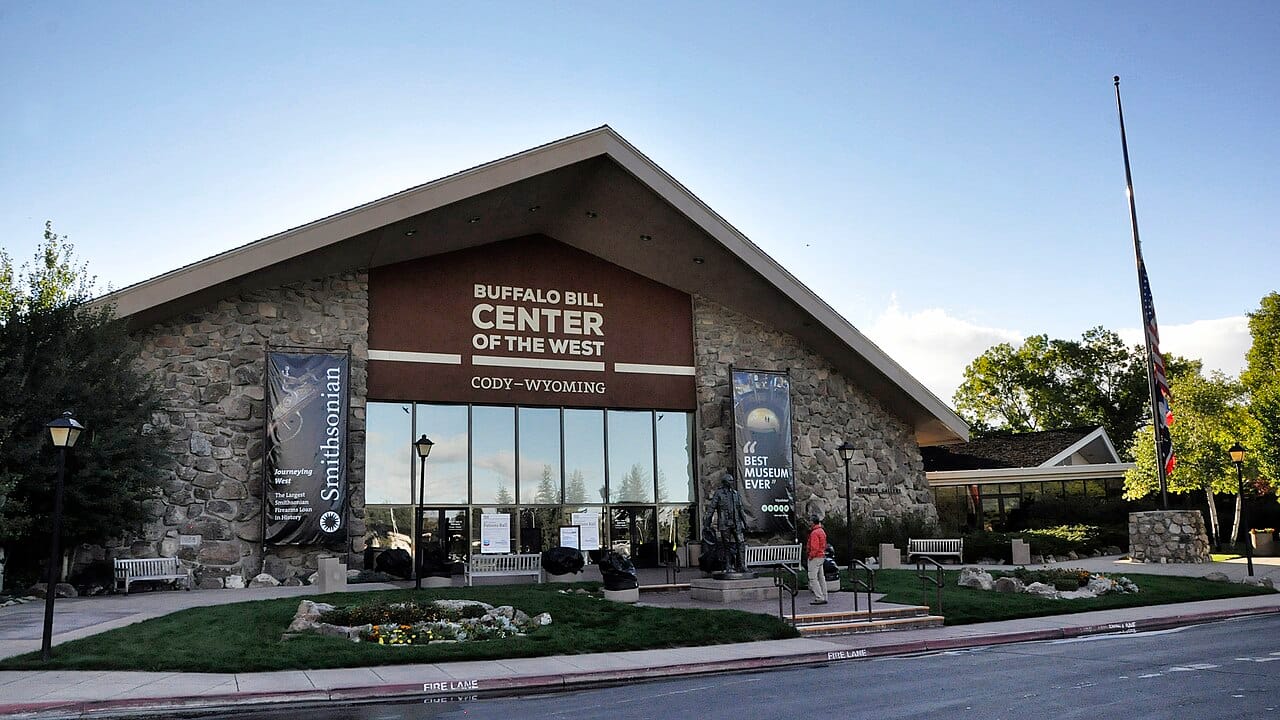
Buffalo Bill Center of the West
Museum complex dedicated to the history and culture of the American West, featuring exhibits on Buffalo Bill Cody’s Wild West shows and the region’s natural history, art, and frontier heritage
Site Details
Pin location is approximate.
720 Sheridan Ave
Cody, WY 82414
Family Friendly?
Somewhat
Visitors Per Year
200,000
The Buffalo Bill Cody Center features five museums: the Buffalo Bill Museum, the Cody Firearms Museum, the Whitney Art Museum, the Plains Indian Museum, and the Draper Natural History Museum.
Buffalo Bill Museum. First-timers should visit the Buffalo Bill Museum first to grasp the significance of Buffalo Bill Cody’s outsized personality and his world-famous celebrity.
- At the entrance, a holographic image of Buffalo Bill Cody welcomes visitors to a review of his extraordinary life. The artifacts in this museum comprise one of the finest collections that demonstrate how Victorian dress and technology coexisted with the ruggedness of the American frontier.
- Permanent exhibits: Buffalo Bill’s life (childhood, family), how he built a public persona, Buffalo Bill’s Wild West shows, and his ranching and entrepreneurial ventures.
The Cody Firearms Museum. Boasting over 4,000 firearms and 10,000 artifacts, including “bullet crossbows” and a “Wheellock Musket” (1570–1590 AD), the Cody Firearms Museum is an international destination. The entire gun collection of the Winchester Repeating Arms Company has been housed at the museum since the mid-1970s. Since that time, some of the most famous guns in history have been added, including the guns and holsters of the cast of Bonanza, Gunsmoke, the Bat Masterson and Johnny Ringo series, and Gary Cooper’s Colt .45 from High Noon. Also featured is Theodore Roosevelt’s model 1895 Winchester lever-action, which was made famous in his post-presidential African safari.
- In an extensive exhibit on Military History, the museum covers the evolution of military firearms from some of the oldest and rarest weapons of the past to the most common and famous of the modern era.
- Two exhibits stand out in particular. The first is a walk-through of the famous gunmaker, John Moses Browning’s workshop. The second is the world-class collection of rare firearms presented by the Timney trigger company, showcasing the beauty and artistry that can be found in gunsmithing.
- A recent exhibit on Guns of Buffalo Bill’s Wild West Performers & Other Cowboy Acts focuses on guns connected with Wild West shows and performers.
After absorbing the extensive library, visitors will be astonished to find themselves at the top of a grand spiral staircase leading to an extensive underground library of guns, where researchers can access large rolling “bookcases” full of rare guns. The museum also offers specialized “Vault Tours” with experts, providing access to historical artifacts in areas normally off‐limits.
The Whitney Art Museum. In 2025, the Whitney Western Art Museum ranked #2 in the nation according to Newsweek Magazine. The collection is notable for housing some of the oldest paintings from the era when settlers began to experience the Great Plains and the Rocky Mountains. Original work from the fur-trapping era includes paintings by Alfred Jacob Miller (1837), George Inness (1849), John Mix Stanley (1857), and Albert Bierstadt (1860), all of which are both beautiful and capable of mentally ushering the viewer a century and a half back to a time when the west was beautiful yet wild and dangerous.
- The museum’s themes include “Where is the West?” Native identity and representation in art, landscapes, and wildlife, and contemporary art versus historical art.
- For the history nerds in the family, Edgar Paxson’s famous painting of Custer’s Last Stand (1899) is immediately recognizable from history books. It is unexpectedly larger in size, and the detail of the horror and death of the moment leaves a lasting impression.
- The Whitney has produced a full-size replica of Frederic Remington’s famous art studio filled with his accoutrements and original works of art.
The Plains Indian Museum. When Buffalo Bill founded the Plains Indian Museum, “it began with clothing and personal items of Native performers who traveled the world with Buffalo Bill’s Wild West shows in the late 1800s.” Since then, it has grown into a large collection of original clothing, beadwork, tools, and musical instruments that showcase the tribes of the American West in a way that honors their culture.
- Exhibits cover art, history, traditions, and contemporary lives of Plains Indian peoples.
- From original tepees, a full-size replica of a Hidatsa Earth Lodge, and items such as a long, flowing buffalo horn bonnet and trailer of eagle feathers dating from 1830–1840, visitors immediately sense the authenticity of the museum’s depiction of the American Plains Indian.
- Included among the collection are several medals dating back as early as 1814 that were given as tokens of friendship to chieftains of several Plains tribes.
The Draper Natural History Museum. The Draper Natural History Museum is designed to be an introduction to the Greater Yellowstone region. The main area of the museum takes visitors on an expedition from the upper alpine regions through the mountain forests and mountain meadows and into the plains/basin environments of the greater Yellowstone region. Visitors feel immersed the journey as they descend through each sub-climate, experiencing the different sounds and even smells found in each of the surroundings.
The Buffalo Bill Museum vividly conveys the significance of Buffalo Bill’s personality and his genuine, world-famous celebrity. The artifacts in this museum form one of the finest collections that demonstrate how Victorian dress and technology coexisted with the ruggedness of the American frontier.
The Cody Firearms Museum conveys the value of firearms in the settling of the New World and the spirit of independence that branded the American West in the world’s imagination. In one spot, labeled “Keep the conversation going,” small notecards are posted, showing some of the comments visitors have left behind, both approving and disapproving of such a museum. This small area is balanced carefully, and the museum refrains from commentary, allowing visitors to draw their own conclusions.
The Whitney Western Art Museum presents all types of Western art without introducing political commentary, allowing the art to stand on its own.
The Plains Indian Museum does not shy away from addressing the sobering topics of the wholesale slaughter of the American bison and the wars of the late 19th century, but it is not the central focus of the museum. The museum, as a whole, is designed to showcase the Plains Indian way of life. Toward the end of the tour, visitors are confronted with the words of those who lived in that era expressing the horror of “diseases which they had no name for” and longing for the “country where they were born.” But the injection of modern commentary is avoided.
Overall, the Draper Museum offers one of the region’s most comprehensive histories of Yellowstone National Park’s development, though there are some issues with accuracy and balance. Upon entering the top of the spiral, visitors are confronted with a sign that presses the narrative of man-made global warming. In another area, the controversial introduction of the Northern Timber Wolf into Yellowstone National Park is downplayed. Yet the museum does provide a wall for comments that shows a variety of viewpoints to consider. Visitors will note the difference between the perspectives of those who are not from the area versus those who are.
In the natural history museum, the sign pressing the man-made global warming narrative suggests some ideological bias. Otherwise, the Center is largely unbiased. In the Buffalo Bill Museum, artifacts stand on their own merit without ideological commentary. The firearms museum presents the subject without apology or leftward genuflection. The Plains Indians Museum and the Whitney Western Art Museum lack political or ideological bias.
Four of the five museums are designed to be viewed rather than interacted with, so families with younger children may need to bring activities for children to do while the parents peruse the exhibits. On the other hand, the Draper Museum has many interactive exhibits for children to enjoy. The Draper has an interactive study area that offers children the opportunity to interact with items such as elk antler sheds and hooves from the region’s famous animals. One popular live exhibit is called “The Raptor Experience” with birds of prey such as hawks, eagles, owls, and kestrels.
The other museums are less suited for younger children, though they should intrigue older children. In particular, the Cody Firearms Museum features several interactive exhibits and engaging games designed for school-age children.
Buffalo Bill Cody wasn’t just a famous frontiersman; he became the living symbol of the American West at the very moment it was being transformed by settlement. From his work as a scout for the U.S. Army to his extraordinary international renown, Buffalo Bill and the performers who traveled with the Buffalo Bill Wild West show helped “personify” the West for audiences around the globe. Through his productions, figures such as Sitting Bull, Wild Bill Hickok, Calamity Jane, and Annie Oakley rose to worldwide celebrity, and Cody’s dramatized presentation of the frontier strongly shaped the world’s imagination of the Wild West, which endures to the present day.
The Buffalo Bill Center of the West is significant in that it not only tells the story of who Buffalo Bill was, but also how the story of the West was told, exported, and remembered. The Center preserves tangible connections to these iconic personalities, down to artifacts such as Annie Oakley’s firearms, while also inviting people to look beyond the stagecraft and ask what the wider West was actually like for soldiers, settlers, showmen, and the Plains Indians. In other words, many popular perspectives on the American West flow from the version Cody carried worldwide, and the museum helps place that influential narrative in a richer historical setting.
The Center’s five museums then widen that lens into a full panorama of Western history and culture. The Cody Firearms Museum showcases the pivotal role that firearms played in the settlement of the New World and the independence that accompanied the frontier spirit. The Whitney Western Art Museum preserves artistic windows into the Great Plains, Yellowstone, the Rocky Mountains, and Native populations—some of the earliest depictions that helped Americans “see” the West. The Plains Indian Museum stands as a major repository of cultural artifacts, curated with the help of tribes from across the Great Plains and the broader West. The Draper Natural History Museum offers one of the region’s most comprehensive accounts of Yellowstone National Park’s development, connecting the West of legend to the West of landscape, ecology, and enduring national heritage.
Tour information:
- Each museum is designed to be easy to self-interpret, though the center offers some exclusive expert-led tours.
- Visitors can request specific topics or areas of interest (military history, firearms, art, Native cultures, and the like).
- Some tours include access to “artifacts not on public display” and VIP areas.
Owned By: The Buffalo Bill Memorial Association
Operated By: The Buffalo Bill Center for the American West
Government Funded: No
Did you know?
The center features America’s most comprehensive gun collection.
Recommended Reading
- The Life of Hon. William F. Cody, Known as Buffalo Bill, the Famous Hunter, Scout and Guide: An Autobiography by Buffalo Bill
- The Illustrated History of Guns: From First Firearms to Semiautomatic Weapons by Chuck Wills
- Charles M. Russell: The Life and Legend of America’s Cowboy Artist by John Taliaferro
Reviewed By
Nathan Winters
President of the Wyoming Family Alliance
The opinions expressed above are those of the Reviewer who is providing a good-faith historical assessment to educate the public. Reasonable opinions can vary, and the Reviewer’s opinion is not necessarily the opinion of The Heritage Foundation or its affiliates.