Birmingham Civil Rights Institute
Museum focused on the black struggle for civil rights in Birmingham, Alabama during the 1950s and 1960s
Site Details
Pin location is approximate.
520 16th St N
Birmingham, AL 35203
Family Friendly?
Somewhat
Visitors Per Year
150,000
The mostly self-guided tour of the institute lasts an hour to an hour-and-a-half but can take longer or shorter. A volunteer guide introduces the Birmingham Civil Rights Institute before visitors enter a small theater.
In the orientation theater, visitors view a short film that provides a truncated and oversimplified introduction to the founding and development of the city of Birmingham. Founded after the Civil War, the self-proclaimed “Magic City” was built in Alabama’s mineral district where all the essential ingredients for making iron and steel were located.
At the end of the film, the screen rises to reveal segregated water fountains—one white, one “colored.” Visitors enter the “barriers gallery” which gives a robust look at the racial impediments that blacks experienced during the Jim Crow era in Birmingham (1920s–1950s). Exhibits include examples of racial stereotypes, segregated schools, separate public facilities, courtrooms, among others. Although the accommodations were separate and unequal, a vibrant black community and culture thrived in Birmingham—centered in the black churches and marked by thriving popular musical entertainment.
Visitors then transition to a confrontation gallery where the voices of whites and blacks, men and women, adults and children provide glimpses into life under segregation in Birmingham. The movement and milestones galleries accurately follow the timeline of the “activist phase” (1955–1965) of the civil rights movement in Birmingham and elsewhere.
Guests will gain insight into the Montgomery Bus Boycott (1955–1956), which thrust Dr. Martin Luther King, Jr., into the national spotlight, the Sit-in Movement, which began in 1960 and spread throughout the South, and the Freedom Rides, integrated bus tours which met violence in Birmingham in May 1961. Of particular interest is the exhibit which focuses on the 1961 CBS documentary “Who Speaks for Birmingham?”
The focus on the Birmingham campaign of 1963 provides visitors with opportunities to experience a day-by-day look at the seminal events from April and May 1963, including a replica of Dr. King’s jail cell where he began composing what would become the most important written document of the Civil Rights Era, “The Letter from Birmingham Jail.”
The institute also provides guests with a nuanced view of the dynamics of the local movement (led by Rev. Fred Shuttlesworth) and the national movement (led by Dr. King) during the violent clashes with Birmingham’s police and fire departments in May 1963.
Perhaps the most moving and disturbing display is the one dedicated to the September 1963 bombing of the Sixteenth Street Baptist Church that killed four little girls. One display has the personal effects of Denise McNair: a cross necklace, a 10 Commandments charm bracelet, a purse, a Bible, and a concrete stone removed from her skull after the blast.
The historical tour ends in the processional gallery, which features statues of individuals marching towards the goal of humanity and equal rights.
The human rights gallery at the conclusion contains moving photographs and attempts to place the historical movement into the broader struggle for global human rights.
The film at the beginning of the tour is too brief to fully explore the broader context of Birmingham’s unique history as the steelmaking capital of the South. The content is generally accurate but provides a somewhat one-dimensional view of labor and work in the city’s heavy industry. Most of the focus is on black workers, but that is understandable given the institute’s focus.
The confrontation gallery provides visitors with the unique opportunity to listen to audio recordings of a limited selection of opinions of Birmingham’s citizens from the 1950s and 1960s. Segregation and racial issues in the South were deeply complex. The current one-dimensional displays could be improved by including more diverse voices from across Birmingham’s communities, helping to humanize its residents and reveal the broad range of perspectives on Jim Crow, race, and equality.
The timeline panels throughout the exhibit are detailed and provide an accurate and comprehensive view of the racial struggle in Birmingham within broader state, regional, and national contexts.
Overall, the institute provides visitors with a robust look at the long struggle for black equality in the Jim Crow South. The permanent exhibitions are balanced and fair, with a strong emphasis on the central role of Christianity in the Birmingham movement. The resource gallery gives visitors an opportunity to watch unfiltered oral history interviews with a wide range of participants in the protests in 1963 and beyond. Ideological biases are present in traveling exhibits and programing that celebrate Black Lives Matter, gay pride, immigrant activism, and the like.
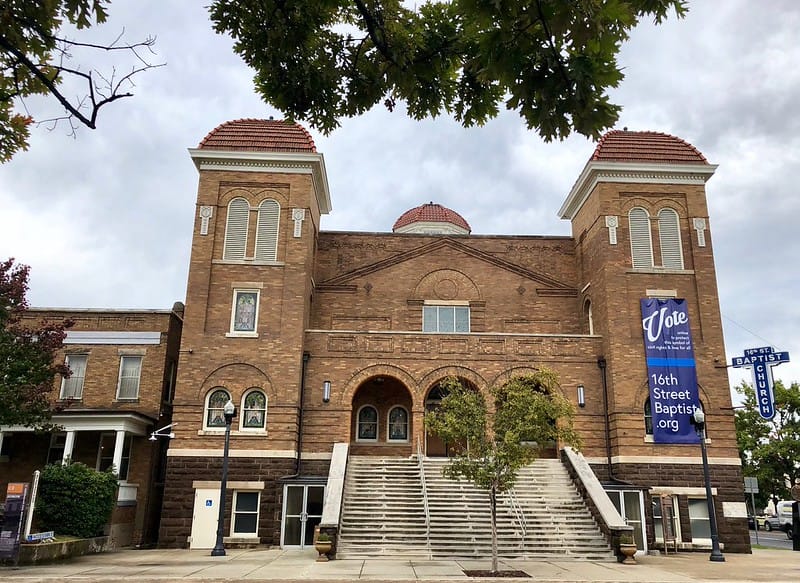
The Birmingham Civil Rights Institute is part of a larger national park complex in downtown Birmingham that includes Kelly Ingram Park, the Sixteenth Street Baptist Church, and the Gaston Motel. Some of the images are violent and disturbing—including the tragic murder of four little girls in the bombing of the Sixteenth Street Baptist Church in September 1963. Racial and labor violence was endemic in Birmingham and central to understanding the history of a people and place.
The Birmingham civil rights campaign of April and May 1963 was arguably the seminal event of the activist phase of the civil rights era. Demonstrations by local and national civil rights activists, although controversial at the time, eventually led to the passage of the Civil Rights Act of 1964 which outlawed segregation in public accommodations. The events that spring (and the March on Washington in August) compelled the “bystander” presidential administration of John F. Kennedy to act on the promises made during his 1960 campaign. Nonetheless, it was Kennedy’s successor, Lyndon B. Johnson, with the support of 80 percent of the Republicans in the U.S. Senate, who saw the passage of the act.
Across Sixteenth Street from the BCRI, Kelly Ingram Park, the site of the violent confrontations between police and protesters, contains several important sculptures worth viewing. Across Sixth Avenue, to the north of the BCRI, the Sixteenth Street Baptist is in the process of building a new education center.
Owned By: The Birmingham Civil Rights Institute
Operated By: The Birmingham Civil Rights Institute
Government Funded: Yes
Did you know?
Adjacent to the Birmingham Civil Rights Institute are the historic Sixteenth Street Baptist Church, Kelly Ingram Park, and the Gaston Motel.
Recommended Reading
- But for Birmingham: The Local and National Movements in the Civil Rights Struggle by Andrew Manis
- A Fire You Can’t Put Out: The Civil Rights Life of Birmingham’s Reverend Fred Shuttlesworth by Andrew Manis
- Blessed Are the Peacemakers: Martin Luther King Jr. by S. Jonathan Bass
- Eight White Religious Leaders by S. Jonathan Bass
- “Letter from Birmingham Jail” by S. Jonathan Bass
Reviewed By
S. Jonathan Bass
Professor of History and University Historian at Samford University
The opinions expressed above are those of the Reviewer who is providing a good-faith historical assessment to educate the public. Reasonable opinions can vary, and the Reviewer’s opinion is not necessarily the opinion of The Heritage Foundation or its affiliates.