Antietam National Battlefield
Site of arguably the most important battle of the Civil War and the bloodiest single day in American military history, with nearly 23,000 soldiers killed or wounded
Site Details
Pin location is approximate.
302 E Main St
Sharpsburg, MD 21782
Family Friendly?
Yes
Visitors Per Year
375,000
Antietam National Battlefield consists of 3,250 acres that encompass all the places where significant combat occurred. It has no entrance gates, and visitors can tour the site by car or on foot. Pets are allowed but must always be on a leash.
The only National Park Service facility is the Visitors’ Center. The center includes restrooms, a bookshop, a small museum, and a theatre showing a 20-minute film about the battle that repeats on the half-hour throughout the day. The film is accurate and a useful introduction for visitors who are unfamiliar with the battle or the history surrounding it.
The museum features large, informative maps that help visitors visualize the battle. However, as of July 2025, the other museum exhibits are in storage because of recent water damage. National Park Service staff at Antietam have not been told when the planned renovations to the museum will get underway or be completed.
The Antietam battlefield offers exceptional accessibility for first-time visitors due to its geography and the battle’s chronological progression. Fighting began at dawn in the famous Cornfield at the battlefield’s north end, then moved southward in successive stages: the attack on the West Woods, the struggle at the Sunken Road, and the crossing of Burnside Bridge. Whether visitors are in a car or walking, getting through the battlefield is a simple matter of following the park road from north to south. The battlefield is also of manageable size for walking tours—it is only three miles from the north end of the Cornfield to Burnside Bridge. The National Park Service has posted narrative plaques at each of the significant parts of the battlefield.
The battlefield has numerous well-maintained trails that enable visitors to get a better sense of the battle than is possible from a car. Three of the best walks, each less than a mile, are:
- Cornfield Trail: Begins where the Union Army’s advance started and ends where the Union troops emerged from the shelter of the cornstalks into the fire of Confederate troops;
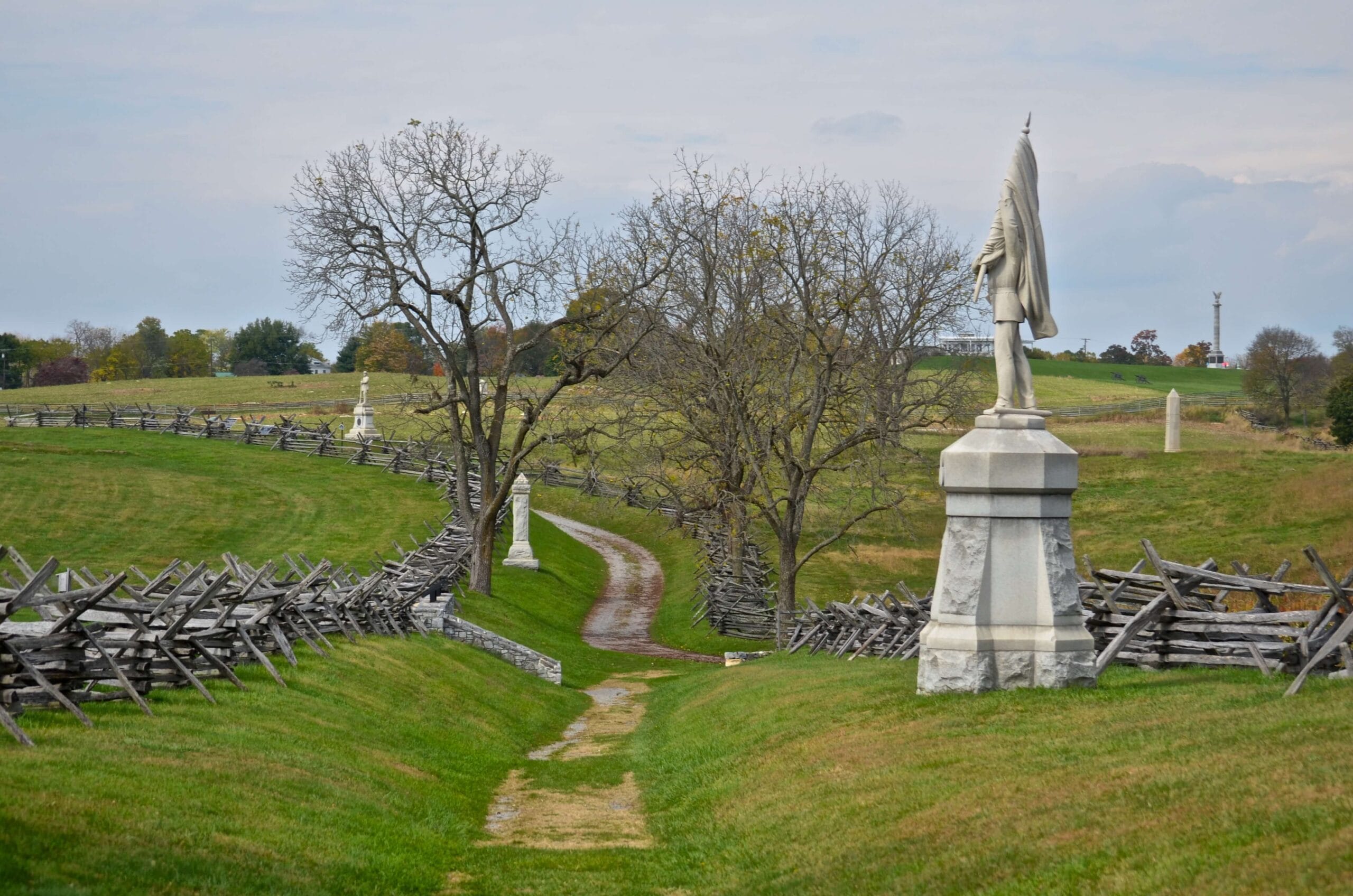
- Bloody Lane Trail: Traces the Union advance from Roulette House up the slope to the bloody Sunken Road;
- Final Attack Trail: Begins at Burnside Bridge and provides the Union view of the day’s final assault on Sharpsburg.
Other battlefield trails are beautiful for scenic walks, especially the Snavely Ford Trail that follows the west bank of Antietam Creek south of Burnside Bridge.
The National Park Service’s Antietam Battlefield website has an extensive collection of resources for planning visits, including a virtual tour, an excellent self-guided Driving Tour Guide, information about ranger tours, and a variety of teaching materials designed to assist K-12 teachers leading field trips to Antietam.
The website of the American Battlefield Trust features a 15-minute animated map of the battlefield that is a remarkably clear presentation of the complicated twists and turns of the battle. Highly recommended. Two useful mobile apps available from the App Store or Google Play are the Antietam Battle App and the Antietam Trail Map.
Even if visitors come to Antietam knowing nothing about the battle, watching the 20-minute film and following the self-guided tour will provide a clear overview of the battle and much of its context. For visitors who want to pursue the subject, the bookshop carries histories and memoirs.
The brief description of the causes of the Civil War in the film is simplistic, focusing exclusively on slavery—the truth, but not the whole truth, about a complicated topic. Overall, the staff sees their mission as accurately portraying the military history of the battle and commemorating the valor of the men who fought on both sides. They accomplish that mission admirably.
The fascination of any battlefield lies in one’s imagination—recreating in the mind’s eye what happened at different points on the peaceful fields the visitor is viewing. For teenagers who are interested in the Civil War, military matters in general, or stories of heroism, Antietam can be a wonderful destination because those acts of the imagination will come easily. Young children or teenagers who are not interested in any of those things are likely to be bored. If visiting Antietam with small children, a self-guided car tour taking one to two hours is probably the best option. For those on their own, or with willing teenagers, consider taking more time to do some walking.
Families with some members who like battlefields and others who don’t have options. One is to let the interested members of the family tour the battlefield while the rest enjoy an extended picnic lunch at one of the many scenic spots on the battlefield. Visitors may spread a blanket and have a picnic anywhere except near monuments, the Mumma Cemetery, Dunker Church, the Observation Tower, or Burnside Bridge. Another option is for members of the family who aren’t touring the battlefield to visit Shepherdstown, West Virginia, a picturesque 19th century town bordering the Potomac River five miles west of the battlefield, and a good place to have lunch.
When the Battle of Antietam took place on September 17, 1862, the Civil War had been going badly for the Union. General McClellan’s campaign to take Richmond had been routed earlier that year. The Army of Northern Virginia’s new commander, Robert E. Lee, had then taken the war north, winning a major victory at the Battle of Second Manassas in August, followed by an advance into Maryland that, if successful, could have won the war for the Confederacy. The Battle of Antietam was the climactic event of the South’s invasion. The result was a tactical draw, but Lee’s losses prevented him from continuing the campaign. The Army of Northern Virginia retreated into Virginia, giving the Union a strategic victory that encouraged President Lincoln to release the preliminary Emancipation Proclamation five days later. In the view of a leading Civil War historian, James M. McPherson, “No other campaign and battle in the war had such momentous, multiple consequences as Antietam.” (Crossroads of Freedom).
Nearby Offerings:
Antietam National Cemetery. Located on Sharpsburg’s eastern side, Antietam National Cemetery is the burial place for 4,776 Union casualties of the battles of Antietam, South Mountain, and Monocacy. The remains of those who could be identified (more than a third could not) are grouped by the home state of their unit. Maps showing the location of the identified individuals are posted online.
Pry House Field Hospital Museum. Pry House was the headquarters of the Union commander, George McClellan. It houses a museum sponsored by the National Museum of Civil War Medicine that includes a re-creation of an operating theatre and objects related to the care of the wounded. It is located off Route 34, about two miles east of Sharpsburg. As of the summer of 2025, the museum is temporarily closed.
Newcomer House. Newcomer House is a nineteenth-century farm home located on Route 34, half-a-mile east of Sharpsburg beside the Middle Bridge. It survived the battle and is now operated by the Heart of the Civil War Heritage Area as a resource for information about the many Civil War sites in Washington, Frederick, and Carroll Counties.
Dunker Church. The most famous visual landmark on the Antietam Battlefield is a reconstruction of the Dunker Church on its original site, located across the road from the Visitors’ Center. The Dunker Church sat at the center of the Confederate line of defense north of Sharpsburg and was directly or indirectly the target of the attacks on the northern half of the battlefield. The interior is a faithful reconstruction of a place of worship, not a museum.
Owned By: National Park Service
Operated By: National Park Service
Government Funded: Yes
Did you know?
General A.P. Hill saved the Army of Northern Virginia from defeat by arriving at the last minute after a 17-mile forced march from Harpers Ferry. In doing so, he came to the rescue of a man he disliked, Stonewall Jackson, and snatched victory from his roommate at West Point and longtime close friend, George McClellan.
Recommended Reading
- Landscape Turned Red: The Battle of Antietam by Stephen Sears
- Crossroads of Freedom: Antietam by James McPherson
- Antietam: The Soldier’s Battle by John Priest
Reviewed By
Charles Murray
Scholar at the American Enterprise Institute, has lived in Burkittsville, Maryland, 11 miles from the Antietam National Battlefield, since 1989. He has walked all the battlefield’s trails, read all the major histories of the battle, and given dozens of tours to visiting friends.
The opinions expressed above are those of the Reviewer who is providing a good-faith historical assessment to educate the public. Reasonable opinions can vary, and the Reviewer’s opinion is not necessarily the opinion of The Heritage Foundation or its affiliates.