Adams National Historical Park
Home of Founders John and Abigail Adams and birthplace of two Presidents: John Adams and his son John Quincy Adams
Site Details
Pin location is approximate.
135 Adams St
Quincy, MA 02169
Family Friendly?
Yes
Visitors Per Year
25,000
The Adams Historical Park features three sites: A Visitors’ Center and two house sites. At one site are two presidential birthplaces—the two adjacent salt box houses in which John Adams and John Quincy Adams were born. The other is the “Old House,” a larger house that John Adams purchased when he returned from his diplomatic assignments in Europe in the late 1780s. The family expanded the house and continued to inhabit it until the 1920s.
At the Visitors’ Center, visitors can catch a bus to tour the two historical sites. The Visitors’ Center features a 26-minute video about the Adams family. It tells the story of the family’s four generations from John to Henry Adams, with a bit more of a focus on the first and fourth generations, but it does tell some of the story of the generations in between. Given the scope of material to cover, it does a good job of presenting the basic story of the family’s lives and time. Laura Linney, who plays Abigail Adams in the John Adams HBO miniseries, narrates. And it features the voices of Tom Hanks, Edward James Olmos, and Paul Giamatti, who plays John Adams in the miniseries.
The Visitors’ Center also has a gift store at which one can buy knickknacks like a John Adams bobblehead doll or coffee mug, and kids’ games and toys. It also features a small selection of books on various members of the Adams family and on the Founding era. The book selection is a bit quirky.
John and John Quincy Adams Birthplaces: While a visitor can tour these houses independently, it is best to sign up for the formal tour, which lasts about 30 minutes. A trolley bus will take you from the Visitors’ Center to the houses, where the tour begins. The tour guides describe the lives of the farmers and the way life was lived in the house, and, in the case of John, the life of a young lawyer before the American Revolution. The tour guides also describe some incidents related to the American Revolution, noting, for example, that Abigail took young John Quincy up the hill nearby to watch the Battle of Bunker Hill.
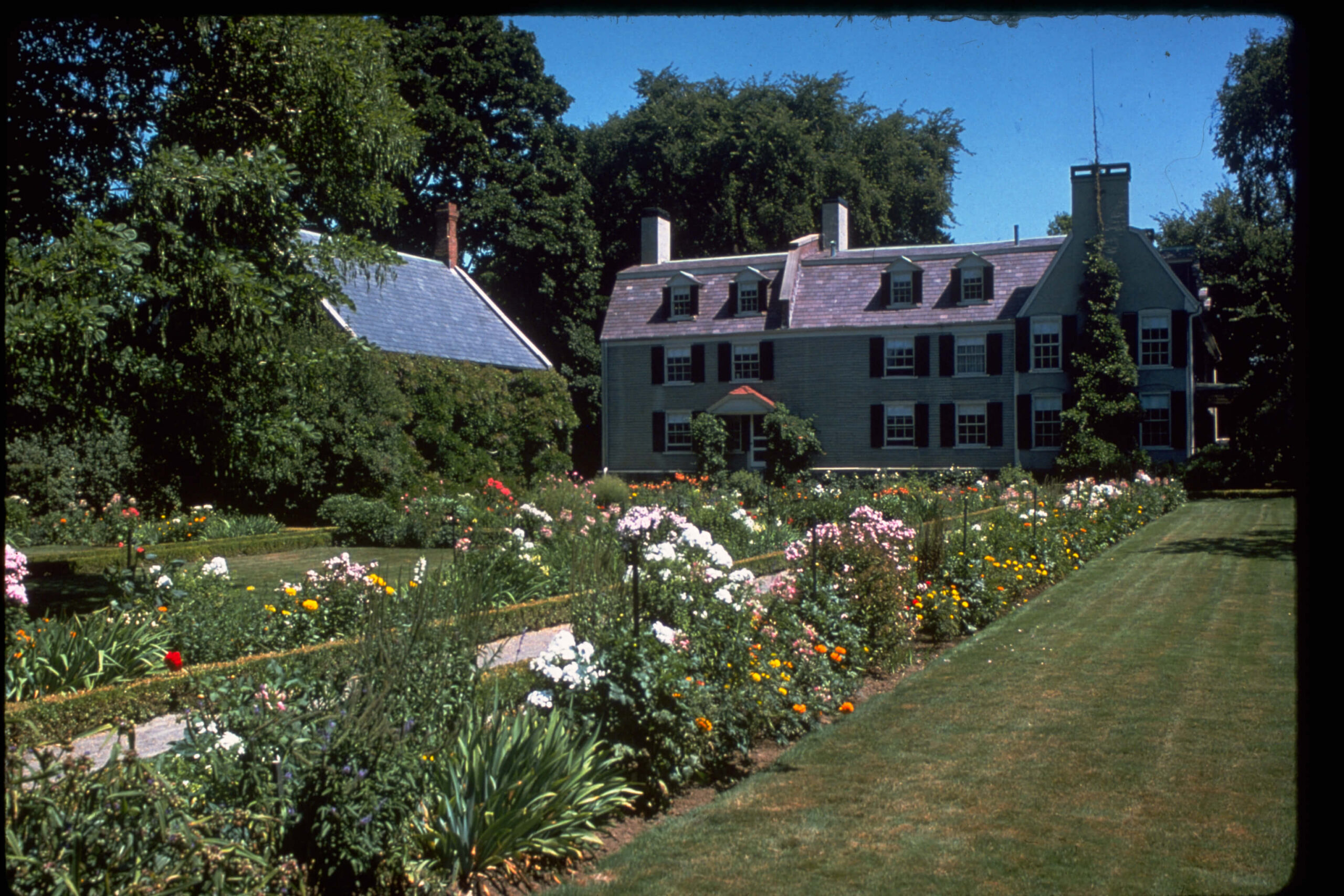
Old House: The Old House can only be toured by taking a formal tour, which lasts about forty-five minutes. The tour takes visitors through a good portion of the house as well as the stone library, which Charles Francis Adams built after the Civil War, and which functioned both as a working space and as a location to house many of the family’s books. The tour guides do a good job of telling stories that span the four generations of Adams family members who lived in the house. They note that when he was President, John Adams spent a good deal of time working, via mail, from this house, and also note the connection that John Quincy Adams, Charles Francis Adams, and Henry and Brooks Adams had with the house. Over time, the family modified and improved the house according to technological advancements of the time, and the visitor can observe the way in which the life of an accomplished family changed over time. The house also features a lovely and well-maintained garden, which visitors are welcome to wander about before boarding the trolley bus to return to the Visitors’ Center.
The tours note the family’s dedication to serving America. Highlights include John Adams’ drafting of the constitution of Massachusetts, which became a model for the U.S. Constitution, featuring as it did a separation of legislative, executive, and judicial power, a bicameral legislature, and an executive with a veto. It was also the first constitution written by a special convention and ratified by the people. The tours also highlight John Quincy Adams working on his speech on behalf of the slaves who mutinied aboard the ship La Amistad, which he successfully delivered on their behalf before the U.S. Supreme Court over the course of eight hours. And they mention the family’s efforts to raise each subsequent generation to be good, patriotic Americans.
The Adams Historical site is unique, perhaps a reflection of the family. When the family turned the site over to the U.S. Government to be a federal historical site, they charged the government with ensuring that the sites help to “foster civic virtue and patriotism.” The site does that, telling the story of the Adams family’s patriotism, service, and dedication to the American republic.
As the sites were part of working farms for quite some time, the tours also discuss that aspect of the lives of the Adamses in the houses. When the family grew wealthier, they note, Charles Francis turned the Old House into more of a gentleman’s country house. They tell the story well, without any noticeable ideological bias. The Adams Historical site’s website is well written and features good accounts about many men and women in the family, their lives, and their contributions to our republic.
The Adams birthplaces and Old House are family friendly. The two houses that are the birthplaces of John and John Quincy Adams are easy to access. The tour remains on the first floor proceeding from room to room. At the Old House, the group goes upstairs and tours the much larger and grander house. The Old House also has a beautiful garden to walk around.
Given the extensive careers of the many characters involved, the tour of the Adams sites can give only a taste of their lives and works.
John Adams was one of the great constitutionalists of the Founding era. He coined the phrase “checks and balances.” In 1779, he drafted the constitution for his home state of Massachusetts, which is the oldest written constitution continuously in use in the world. It features a lower house and senate, and a governor with a veto; and it separates legislative, executive, and judicial powers. It is also the first constitution of the Founding era written by a special convention and ratified by the people.
His eldest son, John Quincy Adams, continued that legacy of service. Like his father, he was a great diplomat (many scholars consider him to be the greatest diplomat that America has produced). His diplomatic career culminated in service as Secretary of State in James Monroe’s Administration. After that, he served a single term as President. Like his father, his term in that office was not particularly happy. But he did not retire. Instead, he went to Congress and became a fighter for the anti-slavery cause. John Quincy Adams had a stroke on the floor of Congress and died in the U.S. Capitol Building in 1848.
The Adams family also featured remarkable women, like Abigail Adams and Louisa Catherine Adams, the wives of John and John Quincy Adams. Abigail had to run the family farm when John was away at the Continental Congress, and then in Europe on diplomatic assignment. She became quite adept at that and was also a key advisor to her husband. Louisa Catherine was also a remarkable woman, accompanying her husband on his diplomatic missions across Europe, and helping him (informally) campaign for the Presidency in 1824. During the War of 1812, she remained in Russia with their young son when John Quincy was sent to Ghent, Belgium, to help negotiate an end to the war. When it finally came time for her to join John Quincy in Paris, Napoleon was retreating from Russia, and she traveled in a carriage with her son across a war-torn Europe—quite an adventure.
The next generations of the family continued the work. Charles Francis Adams helped to sustain the family legacy by publishing the writings of his father and grandfather. He did yeoman service in Congress during the Secession Winter of 1860–1861. President Abraham Lincoln sent him to London, where he did important work for the Union cause. And the fourth generation featured the great historian and man of letters, Henry Adams. His Education of Henry Adams is a masterpiece, as is his History of the United States During the Administrations of Thomas Jefferson and James Madison. Henry’s brother Charles Francis Adams, Jr., served as a soldier in the Civil War, and afterward as a railroad reformer and executive. Their brother, Brooks Adams, an important intellectual in the early 20th century, was the last to live in the house.
The Visitors’ Center is about a block away from the United First Parish Church of Quincy, Massachusetts, which is the burial site of John and Abigail Adams and John Quincy and Louisa Catherine Adams. They are interred in a crypt below the church. John Adams helped to endow the church, which is built with local quarried granite. Unlike the sites run by the National Park Service, there is a small political note at the Church. The only flag flying on the church when this reviewer visited was the Pride flag.
Owned By: National Park Service
Operated By: National Park Service
Government Funded: Yes
Did you know?
Eels were one of John Adams’ favorite foods, and in the living room of the John Adams birthplace, an eel rake (used to catch eels) can be found.
Recommended Reading
- John Adams by David McCullough
- John and Abigail: Portrait of a Marriage by Edith Gelles
- The Adams–Jefferson Letters: The Complete Correspondence Between Thomas Jefferson and Abigail and John Adams
- The Education of Henry Adams by Henry Adams
- 1776 (1972 film adaptation)
- John Adams (2008 HBO mini-series)
- Amistad (1997 film adaptation)
Reviewed By
Richard Samuelson
Associate Professor of Government at Hillsdale College
The opinions expressed above are those of the Reviewer who is providing a good-faith historical assessment to educate the public. Reasonable opinions can vary, and the Reviewer’s opinion is not necessarily the opinion of The Heritage Foundation or its affiliates.