Abraham Lincoln Birthplace National Historical Park
Birthplace and boyhood home of America’s 16th President, Abraham Lincoln
Site Details
Pin location is approximate.
2995 Lincoln Farm Rd
Hodgenville, KY 42748
Family Friendly?
Yes
Visitors Per Year
249,166
The Abraham Lincoln Birthplace and the Lincoln Boyhood Home are separate sites about 10 miles apart. Visitors should visit the Birthplace first and then proceed to the Boyhood Home.
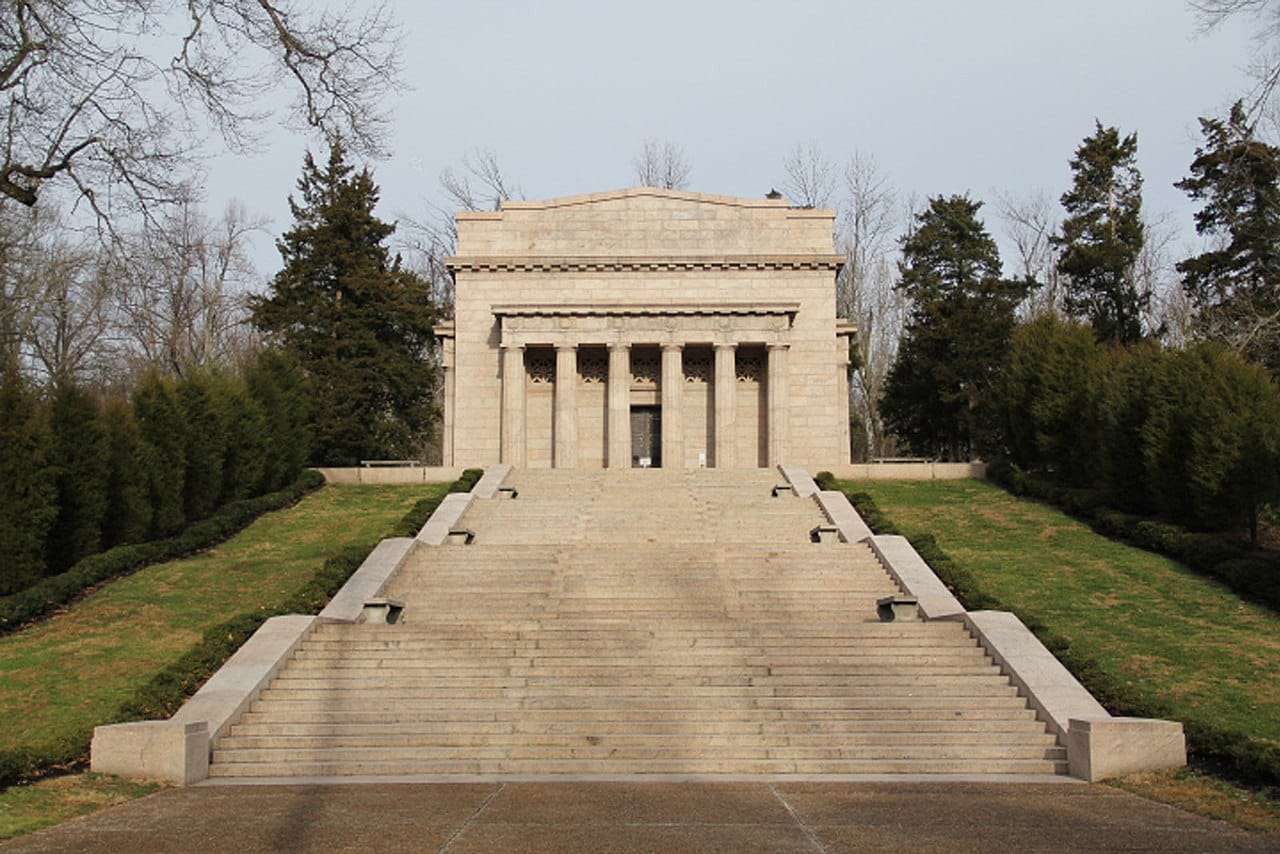
Birthplace: The Visitors’ Center houses the primary historical exhibit, and the Memorial Building stands as a tribute to the Lincoln legacy of preserving the Union and ending slavery. A replica of the Lincolns’ cabin in which Lincoln was born is housed inside the Memorial Building.
The Visitors’ Center is small, with an exhibit on the history of the Memorial Building displayed at the entrance. That exhibit tells the story of the funding and construction of the Memorial Building, as well as how the log cabin was at first believed to be the original cabin of Lincoln’s birth. By the mid-20th century, it was demonstrated that the cabin was not the Lincoln cabin but was a cabin from roughly the same period. The cabin remains inside the Memorial Building.
There is a 15-minute film about how the Lincoln family emigrated to Kentucky in 1782. Lincoln’s grandfather, Abraham (the President’s namesake), moved his five children from the Shenandoah Valley in Virginia to Kentucky through the Cumberland Gap and settled in the vicinity of Louisville, which was then a frontier town. Thomas, Lincoln’s father, became a carpenter and married Nancy Hanks. Thomas and Nancy already had one child, one-year-old Sarah, and Nancy was pregnant with Abraham when Thomas purchased the 230-acre Sinking Spring Farm in December 1808 for $200.
After viewing the film, visitors can take a look at the exhibit on the farm. One interesting feature of the exhibit is its explanation of the Boundary Oak, which marked one of the corners of the farm. The Boundary Oak was a sapling when the Lincoln family acquired the farm, and it stood until 1976. A piece of the oak is on display, and visitors can view the spot on which the Boundary Oak stood as they walk to the Memorial Building.
There is a gift shop and bookstore in the Visitors’ Center. Most of the books on sale have to do with Lincoln, and there are some on Mary Todd Lincoln also. There are books on the Civil Rights Movement, American slavery, and the Civil War. The books on sale are mostly appropriate for the site.
A nice walking tour is available from the Visitors’ Center to the Memorial Building. The walking tour is self-guided and handicapped accessible. It runs through a small forest and ends up at the Memorial Building, where visitors can go in and see the log cabin. There are details about the cabin inside the Memorial Building, which was built in 1911. President Theodore Roosevelt laid the cornerstone in 1909, and the building was dedicated by William Howard Taft in 1911. President Woodrow Wilson officially received and dedicated the log cabin in 1916, and Presidents Franklin Roosevelt and Dwight Eisenhower both visited the site. The Memorial Building is an impressive structure, built in neo-classical style like the Lincoln Memorial in Washington, DC, which was completed in 1922.
Boyhood Home at Knob Creek: The Lincoln family moved from Sinking Spring Farm to the Knob Creek farm in 1811. Thomas leased the 30-acre Knob Creek farm, and this was the farm Lincoln remembered from his childhood. “I was born February 12, 1809, in Hardin County, Kentucky. My earliest recollection, however, is of the Knob Creek place,” Lincoln wrote in 1860 during his first presidential campaign.
In 1816, the Lincoln family had to move from Knob Creek after having been evicted due to a title dispute involving that piece of land. In 1928, Chester and Hattie Howard purchased Knob Creek and built a tavern out of logs from the Gollaher family place. The tavern was owned by the Howard family until 2001, when Congress authorized the acquisition of the site from private donations raised by the local community.
The old tavern serves as the Visitors’ Center for the Boyhood Home. There is an exhibit and a bookstore there. The books are mostly about Lincoln, though there are some about the Civil Rights movement and slavery.
The exhibit covers life on the farm and offers a treatment of slavery. The exhibit notes that Lincoln may have seen slaves being transported down the road in front of the tavern and speculates that some of Lincoln’s earliest misgivings about slavery might have arisen from his seeing the sights of shackled slaves on their way down the road.
There is a replica of the Gollaher cabin alongside the tavern, and a path leading down to Knob Creek, where Lincoln almost drowned during a flash flood as a boy. Picnicking is allowed on the grounds of Knob Creek.
The exhibits at the Birthplace and the Boyhood Home are well done and historically accurate. They focus on farm life of a frontier family in the early 1800s, with appropriate references to slavery that are not ideological. The exhibits include speculation about Lincoln’s early attitudes toward slavery, but this element is not overdone and is true to life.
There is not much explanation of Abraham Lincoln’s life after his move to Springfield, his legal and political career, or his time as President. There are some references to what he accomplished in his later life, but given the context of the sites, the vast majority of the displays focus on his early life in Kentucky.
There is no obvious ideological bias in the exhibits at the Birthplace or at the Boyhood Home.
Both the Birthplace and Boyhood home are child-friendly. The exhibits are accessible to children, and both sites are well laid out for families, with plenty of space to explore and picnic.
There is a self-guided walking tour on a hiking trail that begins at the Sinking Spring, for which the farm was originally named. The Sinking Spring is a cave from which a natural spring proceeds. On a hot day, it is refreshing to go down to the spring because it is much cooler down there. From the Sinking Spring, the Boundary Oak Trail goes just under a half mile through the woods. Trees are identified along the way, and it is a nice walk through what was part of the Lincoln homestead.
One other trail, the Big Sink Trail, is a short distance away from the Visitors’ Center. It is also a short nature trail with a picnic area and restrooms.
The Birthplace and Boyhood Home are in rural settings, and one can easily picture what life would have been like on these sites in the 19th century. The Memorial Building is inspiring and striking. Both sites can be visited and enjoyed for a full day and are within easy driving distance of Louisville, Kentucky, which has a major airport.
Abraham Lincoln, the 16th President of the United States, was perhaps the most consequential President in the history of the republic. He practiced law in Springfield, Illinois and served in the U.S. House of Representatives from 1847 to 1849 (during the Mexican War) as a member of the Whig Party. He ran unsuccessfully for the U.S. Senate in 1858 and was defeated by Stephen A. Douglas. During this campaign, Lincoln and Douglas engaged in debates all around the state of Illinois. Central to their debates was the subject of slavery; Lincoln disputed Douglas’ claim that Thomas Jefferson did not mean to suggest that African Americans were equal to whites in his statement, “all men are created equal.” Lincoln insisted that the statement Jefferson wrote in the Declaration of Independence must be taken literally or it could not be meaningful at all. In 1860, he was nominated by the newly formed Republican Party as its presidential candidate, and he won that election in a four-way contest. His election in 1860 sparked the secession of South Carolina, Mississippi, Florida, Alabama, Georgia, Louisiana, and Texas. Four more states seceded from the Union after the firing on Fort Sumter in South Carolina: Virginia, Arkansas, North Carolina, and Tennessee.
Lincoln was the indispensable leader of the United States during the long, dark years of the Civil War. He was determined to preserve the Union and abolish slavery. He signed the Emancipation Proclamation, which went into effect on January 1, 1863, and led the effort to pass the Thirteenth Amendment. The Civil War ended when Robert E. Lee surrendered the Army of Northern Virginia at Appomattox on April 9, 1865, and Joseph E. Johnston surrendered the last Confederate field army to William T. Sherman on April 26, 1865, at the Bennett Place in North Carolina. Lincoln was assassinated on April 14, 1865.
Owned By: National Park Service
Operated By: National Park Service
Government Funded: Yes
Did you know?
Young Abraham nearly drowned in Knob Creek but was rescued by his friend, Austin Gollaher.
Recommended Reading
- The Story of Abraham Lincoln by Mary A. Hamilton
- Our Ancient Faith: Lincoln, Democracy, and the American Experiment by Allen C. Guelzo
- Battle Cry of Freedom: The Civil War Era by James M. McPherson
Reviewed By
John D. Wilsey
Professor of Church History and Philosophy at The Southern Baptist Theological Seminary
The opinions expressed above are those of the Reviewer who is providing a good-faith historical assessment to educate the public. Reasonable opinions can vary, and the Reviewer’s opinion is not necessarily the opinion of The Heritage Foundation or its affiliates.