Mark Twain House & Museum
Home of the American author and his family from 1874 to 1891, where he produced many of his influential works
Site Details
Pin location is approximate.
351 Farmington Ave
Hartford, CT 06105
Family Friendly?
Yes
Visitors Per Year
60,000
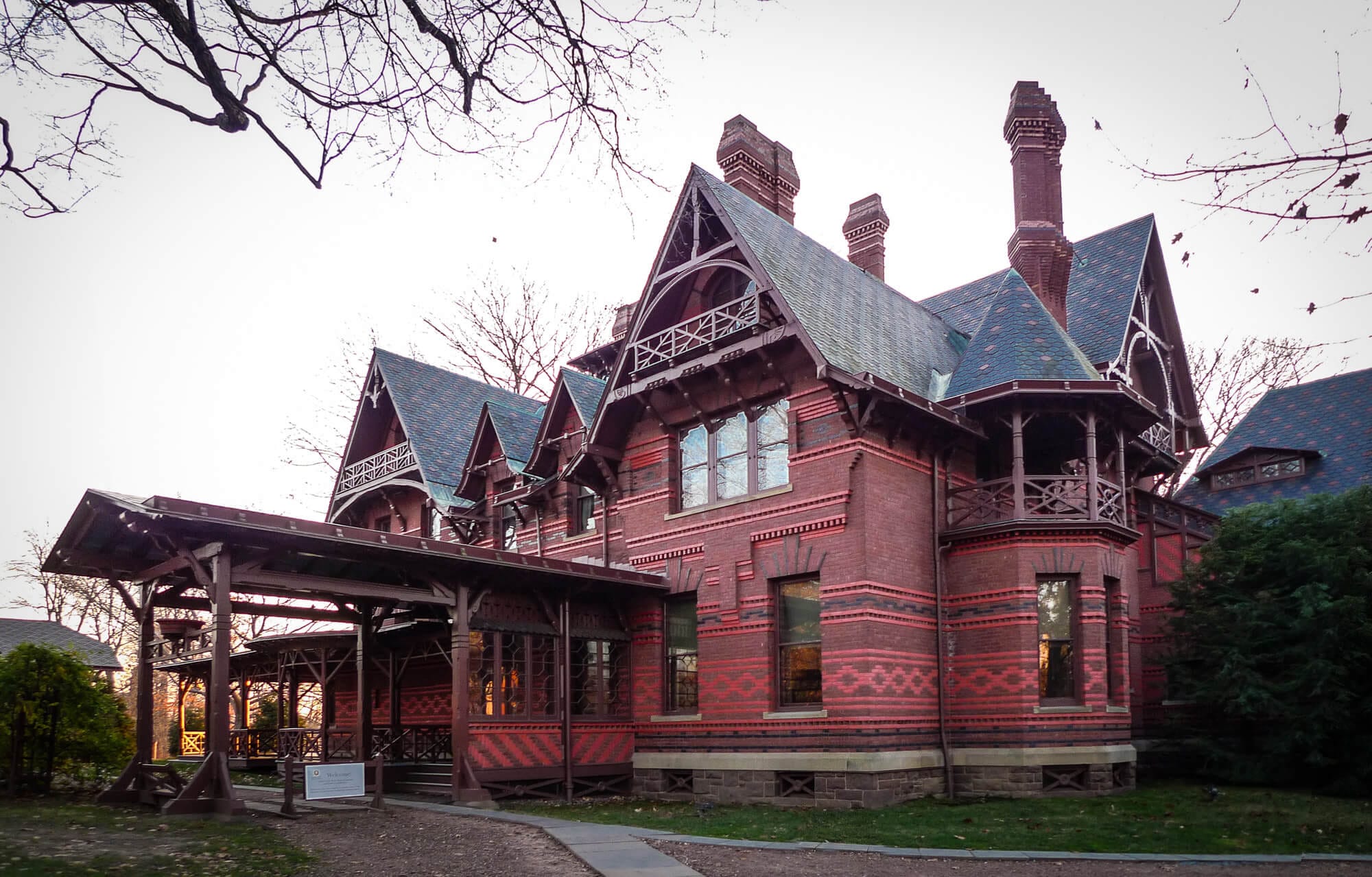
The Mark Twain House and Museum has been called the best house museum in America, and there is ample reason for the claim. It has so many wonderful and engaging features: quirky and inspiring architecture, lush Victorian interior design, lovely and well-cared-for grounds, and stories about its original owners and occupants that are captivating and heart-warming.
The Twain House and Museum staff go to great lengths to preserve the integrity of the house itself and its magnificent contents. The house is shown only by guided tour, and advanced reservations are encouraged. Tickets may be purchased online or over the phone prior to arrival. Be advised that the house has three floors and narrow staircases, and the tour may last up to an hour in an enclosed space. (Large parties of 10 or more people should contact visitor services to make special arrangements.)
- In 1873, Twain and his wife engaged New York architect Edward Tuckerman Potter to design their Hartford home. The couple spent enormous sums of money building the Gothic Revival, Stick Style house, which measures 11,500 square feet and has 25 rooms on three floors. In 1881, they hired Louis Comfort Tiffany and his craft guild, Associated Artists, to decorate the walls and ceilings of the public spaces in their home, particularly the newly enlarged entry hall. The home today contains 50,000 artifacts, including manuscripts, historic photographs, family furnishings, and Tiffany glass. It is a spectacular showcase of Victorian art and design.
- For financial reasons, the family moved to Europe in 1891 and eventually sold the house in 1903. Over the next two decades, it saw use as a school, an apartment building, and a library, and suffered from serious deterioration. In 1929, it was rescued from possible demolition and acquired by the nonprofit Mark Twain Memorial, which restored it and opened it as a house museum in 1974. In 2003, a multimillion-dollar Visitors’ Center was built that includes a museum dedicated to showcasing the author’s life and work.
- Even those who are not fans of Twain’s literary output will be inspired by the exuberance and ambitious American energy of this house. It is the perfect place to learn not only about the work and the life of Mark Twain, but also to see domestic Victorian high style exhibited at its best.
- The house’s guides and other staff are simply extraordinary, full not only of facts about their subject, but with a high degree of Twain-like charm and infectious humor. Their talks are not scripted and seem to emerge more or less spontaneously from their deep knowledge of Twain himself, and his complex record of publication. The guides are not merely Twain scholars; they are equally well versed in the fabulous array of material objects decorating the house, including exotic souvenirs of Twain’s many overseas travels. They can answer most any question, even recondite ones. Their enthusiasm for the house and its owner is contagious, and many visitors will be curious to understand how the complexities of the man are reflected in the building he inhabited for so long. The guides seem to share fully in that curiosity.
The house and museum have been restored with the utmost care and are in the custody of a staff that has both the training and the requisite devotion to their work to ensure that visitors will find their tour to be a satisfying and edifying experience.
Anyone who is acquainted with the trials and travails of the book Huckleberry Finn, which is periodically banned from American schoolrooms, knows that Twain can and always has been a controversial figure. But the house and museum do a marvelous job of neither denying Twain’s potentially controversial aspects—his involvement in the Confederacy, his depiction of African Americans, and his irreverence toward organized religion—nor making them the major focus of attention. It is honest about its subject’s objectionable aspects but does not let those stand in the way of a full and loving embrace of him. Such balance will, I think, be welcome to most museumgoers.
The house is so colorful and interesting that children will be drawn in by the sheer fantastical qualities of it, its profusion of rooms and nooks and crannies; and by the stories that the well-informed guides tell about the activities in different rooms, including the rooms in which Twain read his stories to the young ones in his household. It is a great way to get youngsters to enter imaginatively into the life and works of one of America’s premier writers.
Most children will find the house irresistible, as appealing as a giant gingerbread fantasy. They will also learn a great deal about the ins and outs of running such a household. That said, it might be a challenge to bring a large family through the house in one group. Best to consult with the museum in advance, before undertaking that challenge.
Mark Twain was the pen name of Samuel Langhorne Clemens (1835–1910), indisputably one of the greatest writers in American history. He wrote prolifically in every medium and genre of his day, from newspapers to travelogues and fiction. But he is especially well known for his novels, including The Adventures of Tom Sawyer (1876) and The Adventures of Huckleberry Finn (1884), as well as A Connecticut Yankee in King Arthur’s Court (1889) and Pudd’nhead Wilson (1894). He also coauthored The Gilded Age: A Tale of Today (1873) with Charles Dudley Warner. Ernest Hemingway once famously remarked, “All modern American literature comes from one book by Mark Twain called Huckleberry Finn.”
Mark Twain was raised in the frontier town of Hannibal, Missouri, which later provided the setting for much of his later writing. He worked first as a printer, then as a riverboat pilot on the Mississippi River, which provided him the material for his Life on the Mississippi (1883). Soon the footloose Twain headed to Nevada, where he turned first to mining, and then to journalism and short stories based on his experiences in the rough-and-tumble West.
His first literary success came with a humorous story called “The Celebrated Jumping Frog of Calaveras County,” which was published in 1865. Based on a story that he heard at the Angels Hotel in Angels Camp, California, where he had spent time while working as a miner, the short story showcased his talents not only as a writer, but also as a wit and an entertaining public speaker, launching his literary career and making him famous, wealthy, and much sought after.
Owned By: Mark Twain Memorial
Operated By: Mark Twain Memorial
Government Funded: Yes
Did you know?
Twain loved cats, and he lived with as many as 19 at one point.
Recommended Reading
- Mark Twain by Ron Chernow
- Mark Twain and Southwestern Humor by Kenneth S. Lynn
- Mr. Clemens and Mark Twain: A Biography by Justin Kaplan
Reviewed By
Wilfred McClay
Professor of History at Hillsdale College
The opinions expressed above are those of the Reviewer who is providing a good-faith historical assessment to educate the public. Reasonable opinions can vary, and the Reviewer’s opinion is not necessarily the opinion of The Heritage Foundation or its affiliates.