Harriet Beecher Stowe Center for Literary Activism
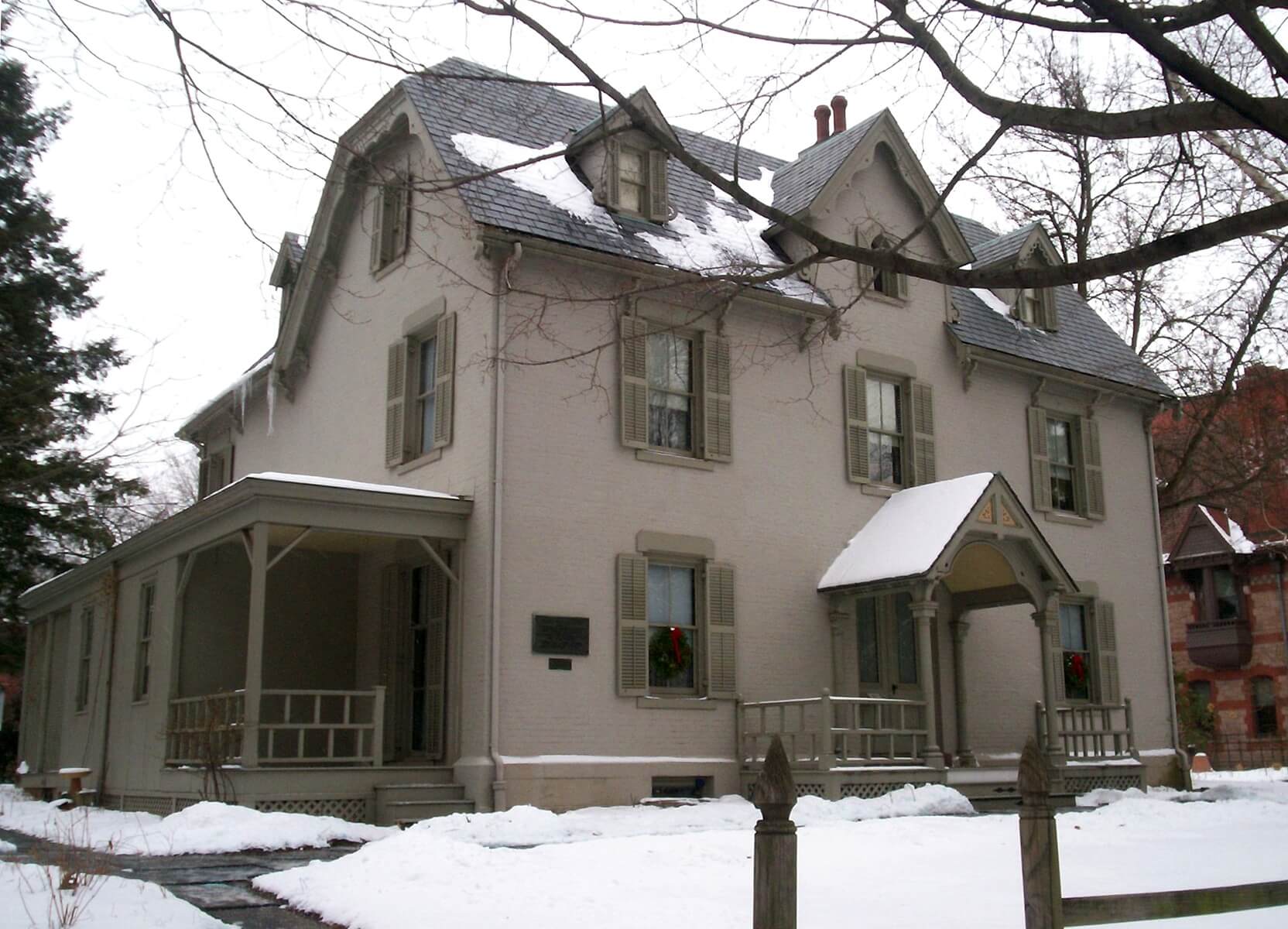
Home of the American author and abolitionist from 1864 until her death in 1896, where she lived after writing her famous novel Uncle Tom’s Cabin
Site Details
Pin location is approximate.
77 Forest St
Hartford, CT 06105
Family Friendly?
Yes
Visitors Per Year
5,000
- There are two house tours available, one lasting a half-hour and the other an hour. Guides discuss Stowe’s childhood in New England, and her important years in Cincinnati, where she experienced firsthand some of the human consequences of slavery and where her own abolitionist sentiments took root.
- Guides pay little to no attention to the contents of the house, which is pleasant but modest, and reasonably well preserved. To be fair, the website materials state clearly that “This is a history tour, not a house tour.” But many visitors will be curious to see what the woman who co-authored, with her sister Catharine, The American Woman’s Home in 1869, a book that historians regard as the most influential guide to domestic life in Victorian America, did with her own domestic setting. They will get no answer from the guides.
- The highly scripted talks given by staff are superficial and preachy, and the historical knowledge in evidence is on the level of a middle-school classroom. Guides are often unable to answer specific questions asked by visitors, especially if those questions involve matters of religion or the internal politics of the abolition movement. More attention is paid to African Americans who distinguished themselves in opposition to slavery than to Stowe herself. This reflects the essential character of the Center as a whole.
- The hour-long tour follows a similar pattern, delving more deeply into the history of racism and slavery in America, and challenging visitors in “a conversational format” to “make connections between inequities then and now.”
- In addition to these two basic tours, there are special tours. “Exploring Hope and Freedom” is a tour of the materials in the Center’s gallery, which celebrate “generations of Black imagination, creativity, and Afro-futurism.” Another tour called “Inheriting Freedom,” is offered as a school tour based around the career and works of abolitionist Frederick Douglass. Another called “Spirits at Stowe” explores the role of spiritualism in the lives of reformers of the 19th century.
The chief complaint to be made on the question of accuracy was what was left out, because, contrary to the website’s contention, there is not a great deal of historical perspective on display in the tour. Nor is there any consideration given to the nature of “literary activism,” and whether it violates the purpose of literature to make it into a weaponized tool of social reform—and whether Stowe herself might have roundly disapproved of such a violation.
Also left out was a consideration of the role of the family in Stowe’s thinking. Stowe’s attitude toward family reflected the powerful emphasis on family and the cultivation of domestic life characteristic of the Protestant middle class of her time. It was a factor in all of her writing—including Uncle Tom’s Cabin, in which the violation of marriage and family by the inhuman institution of slavery is the greatest offense being decried. This is how Stowe captured the hearts of her readers and turned them against slavery. Anyone who looks at Stowe’s literary output as a whole—and that output was enormous—would see at a glance that issues of family, marriage, community, and personal life concerned her much more than questions of social activism.
In that sense, the greatest inaccuracy of the Center can be found at the heart of its self-definition. It has hijacked Harriet Beecher Stowe’s humane, nuanced, and thoroughly literary and Christian understanding of what she was doing, and made a Center bearing her name into something that is quite different from her sensibility and her work.
It will not come as a surprise that there is a bias to this Center that distorts the teaching of history. If it is true that the tour is not a house tour, it is equally true that it is not really a history tour. It is an indoctrination tour, one that elides or suppresses every element of complexity in the American past regarding the story of slavery and presents instead a simplistic and unenlightening vision. It reduces literature to a handmaiden of crusading politics.
The main reason that the Center is unsuitable for the family is that its naked ideological bias will be offensive to many parents, and perhaps disturbing to children. But it is also true that the tour of a 19th-century middle-class home is not likely to excite the interest and imagination of young children.
Harriet Beecher was born in Litchfield, Connecticut, on June 14, 1811, a member of the prominent Beecher family, whose roots extended back to the Puritan “great migration” of the 1630s. The Beecher family loomed large in the religious culture of 19th century America. Harriet was the sixth of 11 children born to the influential Presbyterian minister and preacher Lyman Beecher. Her siblings included author Catharine Beecher, as well as several brothers who became ministers, including Henry Ward Beecher, who became a celebrated preacher and abolitionist.
Harriet received a traditional academic education—rather uncommon for women at the time— with a focus in the classics, languages, and mathematics. This background prepared her well for a career as a writer. At the age of 21, she moved to Cincinnati, where her father had helped found the Lane Theological Seminary. Lane was a hotbed of antislavery sentiment, and it was there that Harriet connected her religious convictions with her opposition to slavery. In addition, she met the widower Reverend Calvin Stowe, a firm abolitionist, who would become her husband. They moved back to New England and spent most of their lengthy married life there, in Maine, and then back to Connecticut.
It was during those years that Harriet Beecher Stowe’s immensely productive literary career began in earnest, including its centerpiece, the 1852 novel Uncle Tom’s Cabin; or, Life Among the Lowly. The book was written in response to the passage of the Fugitive Slave Act of 1850 and reflected the horror that many Northerners felt about a law that required them to be complicit in the perpetuation of an immoral institution. It was her single most important publication and can fairly be called a work with an activist dimension. But that is not all it was. For years it was dismissed as a “sentimental novel,” without artistic merit, but more recently critics have acknowledged its considerable literary and descriptive virtues. Her overall literary output was massive, including some thirty books of both fiction and nonfiction, poetry, devotional literature, children’s literature, and dramatic works.
The Stowe Center was founded in 1941, but its name was changed in 2024, to embrace the concept of “literary activism.” Here are some remarks from the website about that change offered by the Center’s Executive Director, Karen Fisk:
- “The Stowe Center for Literary Activism is a social justice museum and a community hub celebrating the ongoing advocacy of hope and freedom. Taking action to inspire change can take many forms—at the Stowe Center for Literary Activism we focus on creativity that intentionally aims to change hearts and minds. That is literary activism.”
- “The Stowe Center for Literary Activism also offers an array of intersectional explorations of literary activism through programing such as our reading group, Reading for Change, and our Salons at Stowe, which this year will feature a series focused on the topic of the Stowe Prize winner: Education equity.”
- “Additionally, we can explore a variety of topics under the umbrella of literary activism. This year, for instance, we will explore justice in education with topics such as Puerto Rican history, the often-controversial history of sex education with a focus on inclusivity, and the history and current state of Deaf education.”
- “By bringing the past into the present through discussion, the Stowe Center for Literary Activism engages in difficult conversations to better understand history and the present as well as build toward a better future. Civic engagement, literary activism, social justice, and historic contextualization help us better understand the systems that create and support oppression and also those systems that cooperate to dismantle it.”
Visitors should take stock and act accordingly.
Owned By: Harriet Beecher Stowe Center for Literary Activism
Operated By: Harriet Beecher Stowe Center for Literary Activism
Government Funded: No
Did you know?
Uncle Tom’s Cabin was the bestselling novel of the 19th century in America and was second only to the Bible in total sales.
Recommended Reading
- Uncle Tom’s Cabin by Harriet Beecher Stowe
- Harriet Beecher Stowe: A Life by Joan D. Hedrick
Reviewed By
Wilfred McClay
Professor of History at Hillsdale College
The opinions expressed above are those of the Reviewer who is providing a good-faith historical assessment to educate the public. Reasonable opinions can vary, and the Reviewer’s opinion is not necessarily the opinion of The Heritage Foundation or its affiliates.