Franklin D. Roosevelt Presidential Library and Museum
Official site commemorating America’s 32nd president
Site Details
Pin location is approximate.
4079 Albany Post Road
Hyde Park, NY 12538
Family Friendly?
Yes
Visitors Per Year
130,000
- The museum features an excellent balance of written historical information, very wide-ranging memorabilia with usually brief, but good background information about the item. Videos, including films on the Great Depression, the foreign crises leading up to World War II, and Roosevelt’s struggle with polio, are displayed throughout. The museum tour is self-guided.
- The Visitors’ Center comfortable theater plays a 20-minute introductory film about FDR and Eleanor Roosevelt as people. Highlights include very warm but interesting on-camera comments by their grandchildren.
- The museum often hosts specialty exhibits, such as “Signature Moments: Letters from the Famous, the Infamous, and Everyday Americans.” The website notes: “During their extraordinary public careers, the Roosevelts interacted with a ‘who’s who’ of the 20th century.” The exhibit offers “an insider’s view of the remarkable—and sometimes surprising—variety of personal exchanges with an amazing array of famous … people.”
- The Roosevelt family home, Hyde Park, offers visitors a fascinating personal and cultural context for FDR. Due to its formative influence on Roosevelt, it might be best to go there first. Visitors can purchase admission to both the Presidential Library and Museum and Hyde Park at the Visitors’ Center, and there is a small but adequate shuttle to Hyde Park available for those who would rather not walk there.
Visitors with a strong interest in the Roosevelt presidential era (1933–1945) and in Roosevelt’s accomplishments will learn in detail—or, even if they’re highly knowledgeable about it, will be richly reminded of—a great deal of history, all of it important even now. The photographs and the films’ footage are outstanding.
Visitors may notice that no substantial consideration is given to critics of Roosevelt, who deeply feared him and saw him as a would-be dictator. Little attention is given to many people’s belief, supported by some scholarship, that, rather than the New Deal, it took World War II to bring America out of the Great Depression. However, visitors of all opinions will benefit from the museum’s thorough, engaging presentation of its view of the Roosevelt presidency.
Occasionally, a clearly inaccurate generalization is presented. For example, in the personal film at the visitor’s center: “He risked his political career [presumably in 1940] getting ready for the war when no one would listen.” Well, yes and no. Roosevelt was very politically cautious about aid to Britain when it stood alone against German attack. Prime Minister Winston Churchill found Roosevelt’s caution exasperating at times, though he was also extremely grateful for Roosevelt’s crucial help. Nor is it true that “no one would listen” then. By 1940 (when FDR was seeking a historically unprecedented third term), the interventionist and “isolationist” sides were, broadly speaking, evenly matched in American politics.
There’s no detectable “presentism”—the visitor is, appropriately, immersed in the 1930s and early 1940s—and there is no attempt to make people activists. The intent is simply to build or reinforce a deep, extensive appreciation of President Roosevelt, personally and in regard to his accomplishments. Many of those accomplishments involved highly controversial policies, and sometimes highly controversial methods and rhetoric. The opposition to them, and to some extent the reasons for that opposition, are acknowledged, but not in-depth, and always from a pro-FDR perspective.
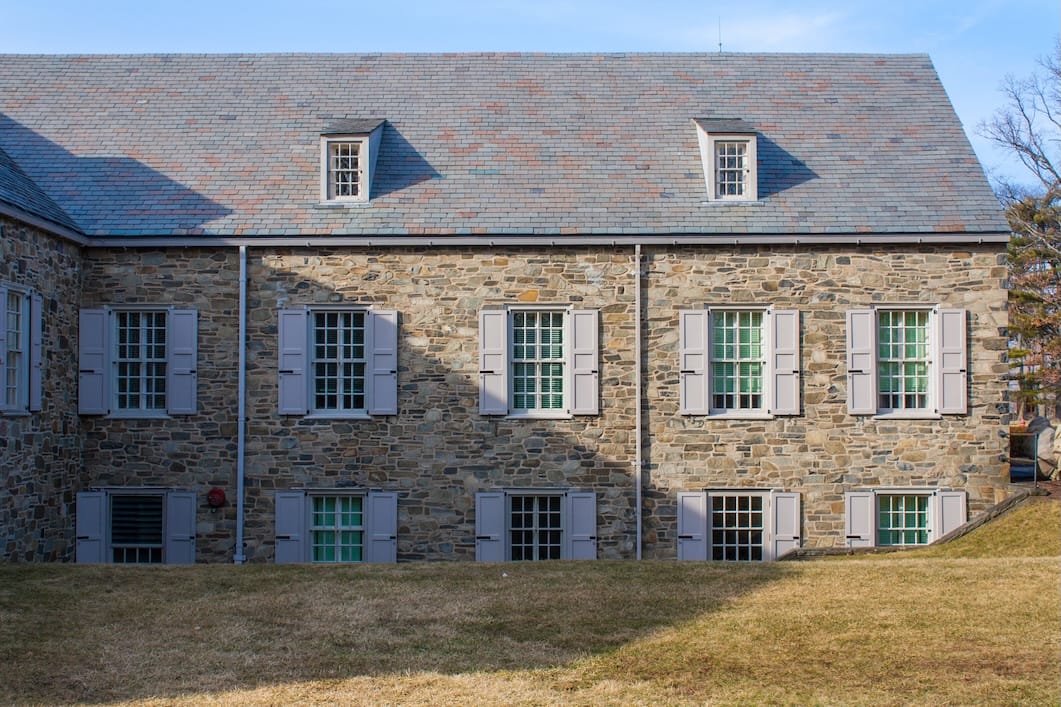
The site is visually pleasant, well-run, and walkable, but most of the museum is not oriented toward children. The library and museum—housed together in a single, easily walkable building—is architecturally low-key and modest, not an imposing presence for children. (The library, consisting of extensive document storage and a fairly small reading room, is in a separate part of it.) The building is also well-protected—even by its design—from the summer heat. It is a short, easy walk from the visitors’ center.
The site is peaceful and relaxed, with a large flat lawn and trees. Picnic tables are available here. Because it’s close to the Hudson River—which due to vegetation, isn’t especially visible—it can be notably humid in hot weather.
Nothing at the site clashes with family values, except that some parts of the main documentary film may be frightening for children. The film shown in the museum at the beginning of the exhibit rooms contains dramatic footage and narration, plus occasional harsh explosive cracks and flashes added for effect. It may be disturbing to some children.
The films, recordings of some of Roosevelt’s “Fireside Chats,” and many great pieces of memorabilia—including his car and massive family Bible—will be somewhat interesting to some children. But the subject matter of the very extensive, multi-room exhibit is factually dense, dealing with what kids may experience as intimidatingly complex issues, and requires much reading or skimming of the many (well-designed, vertically displayed) narrative texts to adequately absorb the Roosevelt story. Some of the World War II features, like a high-tech “Map Room,” may be of more interest to children.
Franklin Roosevelt was probably our most consequential President except for Washington and Lincoln. He served during most of the Great Depression and during nearly all of World War II, dealing with both of these enormous crises in far-reaching ways. In the opinion of many ordinary Americans and many American leaders then and now, his success in addressing and meeting these crises was near total. In the view of some Americans then and now, Roosevelt expanded the federal government well beyond its legitimate constitutional range and his Administration spent, borrowed, regulated, and taxed to dangerous degrees. Some also question his managerial and policy competence, both in economic matters and in the conduct of the war and foreign affairs.
Yet no one doubts FDR’s lasting impact on American society—especially his huge expansion of the federal government’s size and scope, including the enactment of much of today’s “safety net.” No one doubts the large influence of his leadership in the war that made the United States a global power, and the greatest one. Nearly everyone acknowledges his first-rate skills as a political communicator and politician and that many millions of Americans felt tremendous confidence in him and even reverence for him.
The Roosevelt story is also one of surmounting polio to the extent he could, a struggle that began more than a decade before his presidency, when it suddenly struck him. With much help and with awe-inspiring determination, Roosevelt worked effectively in public office, campaigned successfully, and traveled extensively despite his nearly complete inability to use his legs.
FDR’s story includes his emergence from great privilege and substantial family wealth into the gritty worlds of New York and national politics. He served in the state legislature, then as assistant secretary of the Navy—to a large extent running it—before and during World War I, then eventually as governor of New York, instituting some aspects of what would soon be the national New Deal.
Visitors should also tour the Roosevelt family home at Hyde Park, a mansion about a quarter mile away. Roosevelt was born there, grew up there, and visited and stayed there throughout his career. Guided tours by National Park Service staff are offered throughout the day. The talks can seem scripted, but the guides have no trouble answering a range of questions.
Hyde Park has the rich interior features and furnishings of a late 19th-century, upper-class house (although it was heavily remodeled in 1916, so it also dates from that time). Visitors will find it has a somewhat dark and cramped, but cozy, atmosphere inside. It is interesting to see the dining room, bedrooms, many old naval drawings that reflect FDR’s love of ships, and especially his elegant library and study—the most spacious room at Hyde Park. Major consultations often took place there during his presidency.
Across the highway is the cottage called “Val-Kill” (Dutch for “valley stream”), where Eleanor Roosevelt often stayed. Mrs. Roosevelt, it should be noted, is prominently featured in the museum.
Owned By: National Archives and Records Administration
Operated By: National Archives and Records Administration
Government Funded: Yes
Did you know?
The main part of the library and museum, built during Roosevelt’s presidency, was America’s first presidential library. Roosevelt used it on occasion during World War II. His spacious, attractive office is preserved, and visitors may find it one of the museum’s highlights.
Recommended Reading
- Man of Destiny: FDR and the Making of the American Century by Alonzo L. Hamby
- Fear Itself: The New Deal and the Origins of Our Time by Ira Katznelson
- Traitor to His Class: The Privileged Life and Radical Presidency of Franklin Delano Roosevelt by H.W. Brands
Reviewed By
David Frisk
Resident Fellow at the Alexander Hamilton Institute for the Study of Western Civilization
The opinions expressed above are those of the Reviewer who is providing a good-faith historical assessment to educate the public. Reasonable opinions can vary, and the Reviewer’s opinion is not necessarily the opinion of The Heritage Foundation or its affiliates.