Plimoth Patuxet Museums
Living history museum where the Pilgrims first settled Plymouth Colony
Site Details
Pin location is approximate.
137 Warren Ave
Plymouth, MA 02360
Family Friendly?
Yes
Visitors Per Year
300,000
The Plimoth Patuxet Museums are a living history complex that includes the Historic Patuxet Homesite of the Wampanoag people, the recreated 17th-century English village, and a full-scale reproduction of the Mayflower. A morning or afternoon spent at the museum complex is generally pleasant and informative. However, the presentation of how both the Pilgrims and the Native Wampanoag people governed themselves and conceived their religious rituals and responsibilities does not do those subjects justice.
The Historic Patuxet Homesite, as it is called, nicely highlights the typical wetu or home of the Wampanoag people, displaying fur-lined benches (how they warmed themselves on cold days), and other aspects of Native family life. One can also see staff working on making a mishoon or dug-out canoe, used by the Wampanoag for fishing, travel, and to trade with other tribes. Perhaps too much emphasis is placed on Wampanoag interaction with other Native peoples, with no mention of the constant warfare that informed everyday life. A touch of romanticism is evident in this presentation.
At the cooking area, one learns about the diet and meals of the Wampanoag people, but little or no emphasis is placed on how this particular Native people organized their common life or otherwise gave expression to their most cherished beliefs or “values.” In that sense, the presentation of Wampanoag life is too superficial, wholly sympathetic but lacking in depth.
There is indeed something impressive about the portrayal of the friendly encounter between the Pilgrims and the Wampanoag people, a practical alliance of sorts occasioned by the fact that the Wampanoag were surrounded by four hostile tribes (a point that, alas, goes unmentioned).
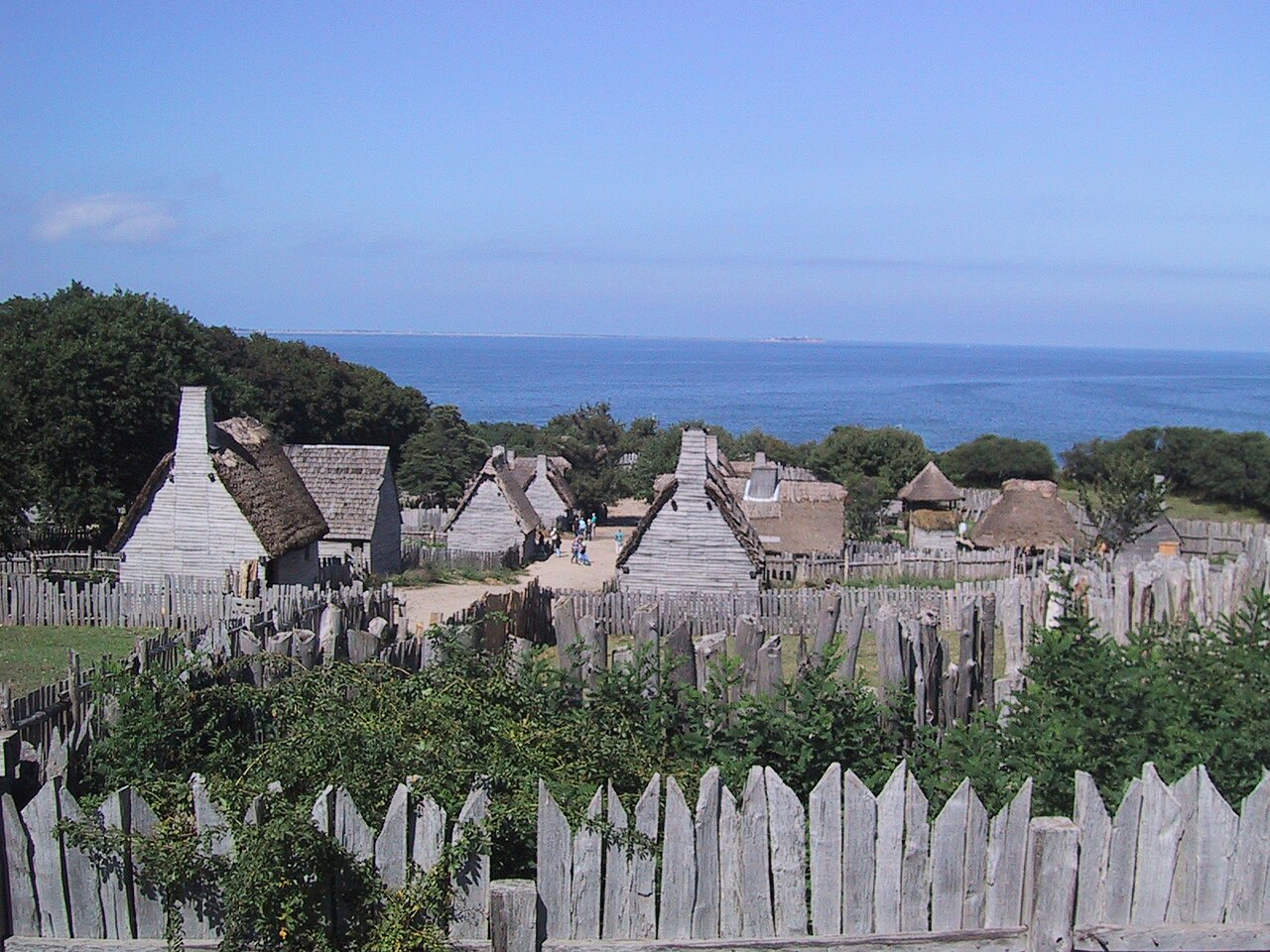
The 17th-century English village is considerably more extensive and constitutes a genuine “village.” Staff, dressed in the clothes of the period, reenact the life of early 17th-century Pilgrim villagers in an impressive and convincing way and answer questions from visitors. The village attempts to convey life in Plymouth circa 1627, with a nod to the original settlement in 1621. But once again, little or nothing is said about how the new English settlers governed themselves or how they worshipped, the two activities that were most dear to them.
The recently renovated Mayflower II, at a little distance from the main complex, is a veritable tour de force. It is located near the famous Plymouth Rock. It provides a striking full-scale reproduction of the original Mayflower that brought the Pilgrims to Plymouth in 1620. It reminds visitors quite palpably why “Plimoth” is of interest to Americans in the first place. Unlike guides at the other sites, those on the Mayflower II dress in modern clothing and answer questions as our contemporaries.
The enactment of “social history” completely crowds out a deeper concern for common life, particularly as embodied in political and religious life. This is a major deficit. A self-described “living history” complex needs to dig deeper and go beyond strictly material concerns.
In 2020, the Plimoth Plantation was renamed, becoming the Plimoth Patuxet Museums. The park’s former emphasis on a truly foundational moment in the political and historical experience of all the American people has thus been replaced by a multiculturalist framework that tends to prioritize (and romanticize) the life of Native peoples (without ignoring the Pilgrim experience). The rough edges of the Native experience, particularly deep-seated enmity between tribes, often harsh mores (accompanied, to be sure, by quite admirable ones), and the valorization of warrior virtues, is hardly to be found. Native peoples are presumed to have been at heart a single people, and to have had friendlier relations among themselves than the historical record justifies.
To their credit, however, the museums generally avoid woke didacticism—though the website refers to “Indigenous Peoples’ Day” instead of Columbus Day, and one sign on the park trail uses the politically correct cliché popularized by “settler colonial” activists, “Turtle Island,” to refer to North America. Despite these concessions to political correctness, the park still highlights some valuable aspects of Pilgrim and Native experiences. The reconstituted Plimoth Pawtuxet Museums have flirted with fashionable ideological currents, but they cannot be said to have fully capitulated to them.
There is something “politicized” about the presuppositions underlying the reconceived Plimoth Pawtuxet Museums, a politicization rooted in multiculturalism, romanticism about Native history, and a refusal to adopt a self-consciously American civic perspective. But the exhibits are generally competent within their limits. Families still can benefit from visiting the museums even if they are self-conscious about the ideological approach that informs them.
Families should take advantage of the Visitor’s Center, which includes helpful booklets and pamphlets, as well as memorabilia, souvenirs, Pilgrim-era pottery and plates, and informative presentations. The books on display are generally balanced.
The Visitor’s Center is useful and pleasant, and the guides at the Historic Patuxet Homesite and the 17th-century English Village interact well with the young and old alike. All ages will enjoy and benefit from the impressive Craft Center and young people can join staff in grinding corn at the Plimoth Grist Mill. A Thanksgiving Exhibit in the Visitor’s Center should pique the interest of the entire family.
The famed ship the Mayflower was a 17th-century merchant ship that transported 102 English Protestant dissenters to the New World in 1620. These “separatists,” now known as Pilgrims, were looking to free themselves from the authority of the established Church of England and to govern themselves through a charter authorized by the King of England. The settlers aimed to create a new life for themselves while still conceiving themselves as English colonists and settlers.
The Mayflower Compact, signed by 41 of the adult male passengers on the Mayflower on November 11, 1620, dedicated them to a “civil body politick” informed by “just and equal laws,” under the judgment of God, and loyal to the British Crown. The original parchment of the Mayflower Compact has been lost, but the full text was reproduced in William Bradford’s Of Plymouth Plantation, the earliest and best account of the settlement at Plymouth. Bradford’s classic work provides a thorough account of the settlers’ initial struggles, relations with friendly and hostile Native peoples, and efforts to govern themselves in what came to be called New England and the Massachusetts Bay Colony.
One can reasonably refer to an initial Puritan or Pilgrim Founding or “pre-Founding” of the United States, one which admirably synthesized colonial and local self-government with the mores of a deeply religious people. The political/philosophical statement par excellence of that original founding is the aforementioned Mayflower Compact of 1620. Unfortunately, these contributions of the Pilgrims to American character and history, emphasized so suggestively by Alexis de Tocqueville in his classic work Democracy in America, hardly register at the museum complex at all. The focus is much more on “social history”—how people of the time lived on a day-to-day basis. Plimoth Pawtuxet is thus comparatively weak on explicitly civic themes or emphases.
However, the first Thanksgiving, bringing together these two peoples, is nicely highlighted in the Visitor’s Center, as are later forms that Thanksgiving took in the United States, culminating in Lincoln’s Proclamation of Thanksgiving as a national holiday in 1863. The religious dimensions of the holiday are not shied away from.
Owned By: Plimoth Patuxet Museums, Inc.
Operated By: Plimoth Patuxet Museums, Inc.
Government Funded: Yes
Did you know?
The Pilgrims, or “separatists” as they were generally called at the time, first landed at Cape Cod in 1620 and then settled in Plymouth, where many perished as a result of a particularly brutal winter. Despite these hardships, the survivors persisted.
Recommended Reading
Mayflower: A Story of Courage, Community, and War by Nathaniel Philbrick
Of Plymouth Plantation by William Bradford; The Landing of the Pilgrims by James Daugherty
Reviewed By
Daniel J. Mahoney
Senior Fellow at the Claremont Institute and Senior Visiting Fellow at Hillsdale College D.C.
The opinions expressed above are those of the Reviewer who is providing a good-faith historical assessment to educate the public. Reasonable opinions can vary, and the Reviewer’s opinion is not necessarily the opinion of The Heritage Foundation or its affiliates.