Chalmette Battlefield
Site of the Battle of New Orleans, the last major battle of the War of 1812.
Site Details
Pin location is approximate.
1 Battlefield Road
Chalmette, LA 70043
Family Friendly?
Yes
Visitors Per Year
70,000
Chalmette Battlefield offers self-guided tours, a daily talk by a National Park Service ranger, and videos and exhibits in the Visitors’ Center.
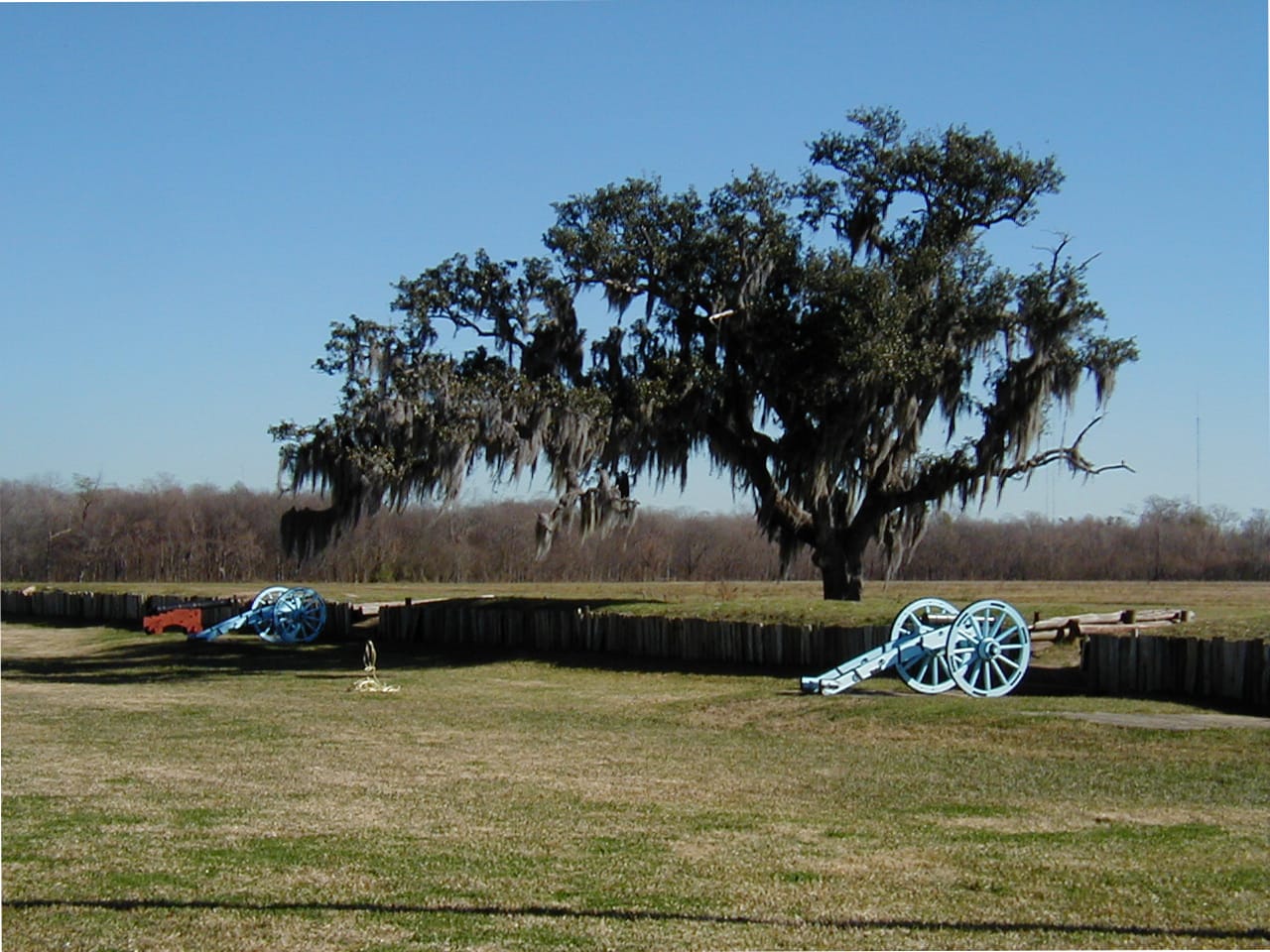
- A self-guided battlefield tour along the 1.5-mile Battlefield Tour Loop Road takes about an hour. Exhibits on the first section of the road identify the American batteries following the Rodriguez Canal and describe the troops, artillery, and defense maneuvers used at each. The road then loops around to the British side of the battlefield, where batteries and offensive attacks are similarly marked and described.
- A 30-minute ranger talk offered daily focuses on the obstacles overcome and the successful strategies employed in the Battle of New Orleans. Guides discuss the historical significance of the battle both on its own terms and as a culmination of a series of contributions made by Louisiana to the fight for American independence, dating back to Spanish colonial governor Bernardo de Gálvez’s vital assistance during the Revolutionary War. Park rangers do not follow a script, so talks may vary depending on the ranger on duty.
- There are two short videos in the Visitors’ Center: one introductory eight-minute video provides an overview of the Battle of New Orleans from the American perspective, while another of the same length provides an overview from the British perspective. Both feature reenactments of the battle as well as illustrative quotes from historical figures.
- While most exhibits inside the Visitors’ Center and around the property concern the Battle of New Orleans and the War of 1812, some detail the history of the property on which the battle took place, including that of the Malus-Beauregard House, which awaits restoration, and the development of the African American community of Fazendeville on the site from 1867 to 1964, when the National Park Service bought the land after contentious negotiations.
Chalmette Battlefield accurately presents the Battle of New Orleans as a turning point for the War of 1812 and, by extension, for the growth and self-understanding of the United States. In doing so, videos, exhibits, and ranger talks celebrate the American project. The site also does a good job of tending to the nuances of the battle and of alliances with Jean Lafitte’s pirates and Choctaw Native Americans.
- The videos in the Visitors’ Center demonstrate both the superior strategy and skill of the Americans as well as mishaps and a “run of bad luck” encountered by the British, who were unused to the swampy terrain of south Louisiana.
- Exhibits also tackle the controversial character of Jean Lafitte, a pirate who profited from theft and illegal importations of enslaved persons yet refused to help the British in the War of 1812 despite their lucrative offers of land, protection, cash, and military rank. Instead, Lafitte warned the Americans of British plans for attack and provided them with crucial arms and manpower.
- Exhibits likewise lament the tragic decision of Shawnee leader Tecumseh to form an alliance between his inter-tribal Native American confederation and the British against the Americans in the War of 1812. They also highlight the courage of Choctaw Chief Pushmataha, who inspired fellow Choctaw to join Jackson’s forces at the Battle of New Orleans, remarking, “The Americans have been our friends, and we shall stand by them.”
Refreshingly free from ideological bias, Chalmette Battlefield reminds visitors of the unity that can be derived from Americans’ shared commitment to self-government. As the Visitors’ Center introductory video explains, when Jackson arrived in New Orleans and realized that he lacked the numbers to defend the city, a diverse array of citizens and allies stepped up to join his forces, including local Creole businessmen, free men of color, Isleño and Irish immigrants, Choctaw from nearby territories, and Jean Lafitte’s Baratarian pirates. Despite British disdain for Jackson’s ragtag troops, the latter handily defeated the former, sustaining fewer than 20 casualties and inflicting more than 2,000. This stunning victory served as a profound source of pride and unity for America, an impact summed up well by a quote from Jackson displayed prominently in the Visitors’ Center:
“Natives of different states, acting together, for the first time, in this camp; differing in habits and in language, instead of viewing in these circumstances the germ of distrust and division, you have made them the source of an honourable emulation, and from the seeds of discord itself have reaped the fruits of an honourable union.”
At a time when the siren song of identity politics constantly threatens to undermine the American project, Chalmette Battlefield offers a welcome corrective.
Chalmette Battlefield encompasses a beautiful piece of property facing the Mississippi River. Live oaks that are over 350 years old grace the grounds, and picnic tables under their shade provide space for families to take a lunch break while kids can run and play. Note that, except for vending machines, food is not sold on the premises, so families visiting for the day may want to pack lunches. The Visitors’ Center also features a children’s corner with educational books and games, such as a storybook on the history and proper treatment of the American flag and a worksheet on the song “Yankee Doodle.”
- Chalmette Battlefield is accessible to vehicles and offers ample free parking. However, travelers visiting New Orleans may find it more convenient to take the Creole Queen Riverboat to Chalmette Battlefield. The boat shuttles guests from downtown New Orleans to the battlefield and back, while local guides on board give talks on the history of the city.
The Battle of New Orleans constituted the most impressive land victory of the War of 1812, securing the end of the war against the British and facilitating American westward expansion. By 1815, the British had set their sights on New Orleans. In attacking the port city, the British hoped to gain control of the mouth of the Mississippi River, a waterway crucial for American commerce and access to the frontier. To do so, British troops successfully invaded Lake Borgne and prepared to enter the city. Under Jackson’s deft leadership of roughly 4,000 men, however, the Americans built a defensive rampart along a canal near British headquarters and roundly defeated the attack of about 7,000 British in just two hours on January 8th.
Because the Treaty of Ghent was signed a few days before British attempts to invade New Orleans began, it is sometimes mistakenly thought that the Battle of New Orleans was fought after the War of 1812 was technically over. However, neither government had ratified the treaty at the time of the battle, meaning the war did not end until after the Americans’ decisive victory, which not only hastened the treaty’s signing, but solidified U.S. control of the Louisiana Purchase. The victory strengthened America’s standing as an independent nation, inspired a sense of pride and unity among America’s diverse citizenry, and, finally, paved the way for future President Andrew Jackson’s political rise over the next few decades.
The nearby National Shrine of Our Lady of Prompt Succor, an important pilgrimage site, is worth visiting in conjunction with Chalmette Battlefield. In preparation for the Battle of New Orleans, Jackson warned the local French Ursuline sisters to evacuate in case of a British invasion and burning of the city. When the sisters refused, Jackson asked them to pray for a successful defense, after which they and many other citizens held vigil the night of January 7th, imploring Our Lady of Prompt Succor to give victory to the Americans. They concluded their vigil with a Mass on the morning of January 8th, during which, as Bishop DuBourg was consecrating the bread and wine, a messenger arrived to share news of victory. After the battle, Jackson wrote to the bishop calling for a day of public prayer in thanksgiving for “the great assistance we have received from the Ruler of all events.” Catholics attribute the battle’s victory to the intercession of Our Lady of Prompt Succor, whom the Church designated Patroness of Louisiana in 1928.
Owned By: National Park Service
Operated By: National Park Service
Government Funded: Yes
Did you know?
For many decades, January 8th, the anniversary of the Battle of New Orleans, was celebrated as a national holiday.
Recommended Reading
- The Battle of New Orleans: Andrew Jackson and America’s First Military Victory by Robert V. Remini
- Historical Memoir of the War in West Florida and Louisiana in 1814-15 by Arsène Lacarrière Latour
Reviewed By
Rachel Alexander Cambre
PhD, teaches political science at Louisiana State University and Franciscan Missionaries of Our Lady University in Baton Rouge, LA
The opinions expressed above are those of the Reviewer who is providing a good-faith historical assessment to educate the public. Reasonable opinions can vary, and the Reviewer’s opinion is not necessarily the opinion of The Heritage Foundation or its affiliates.