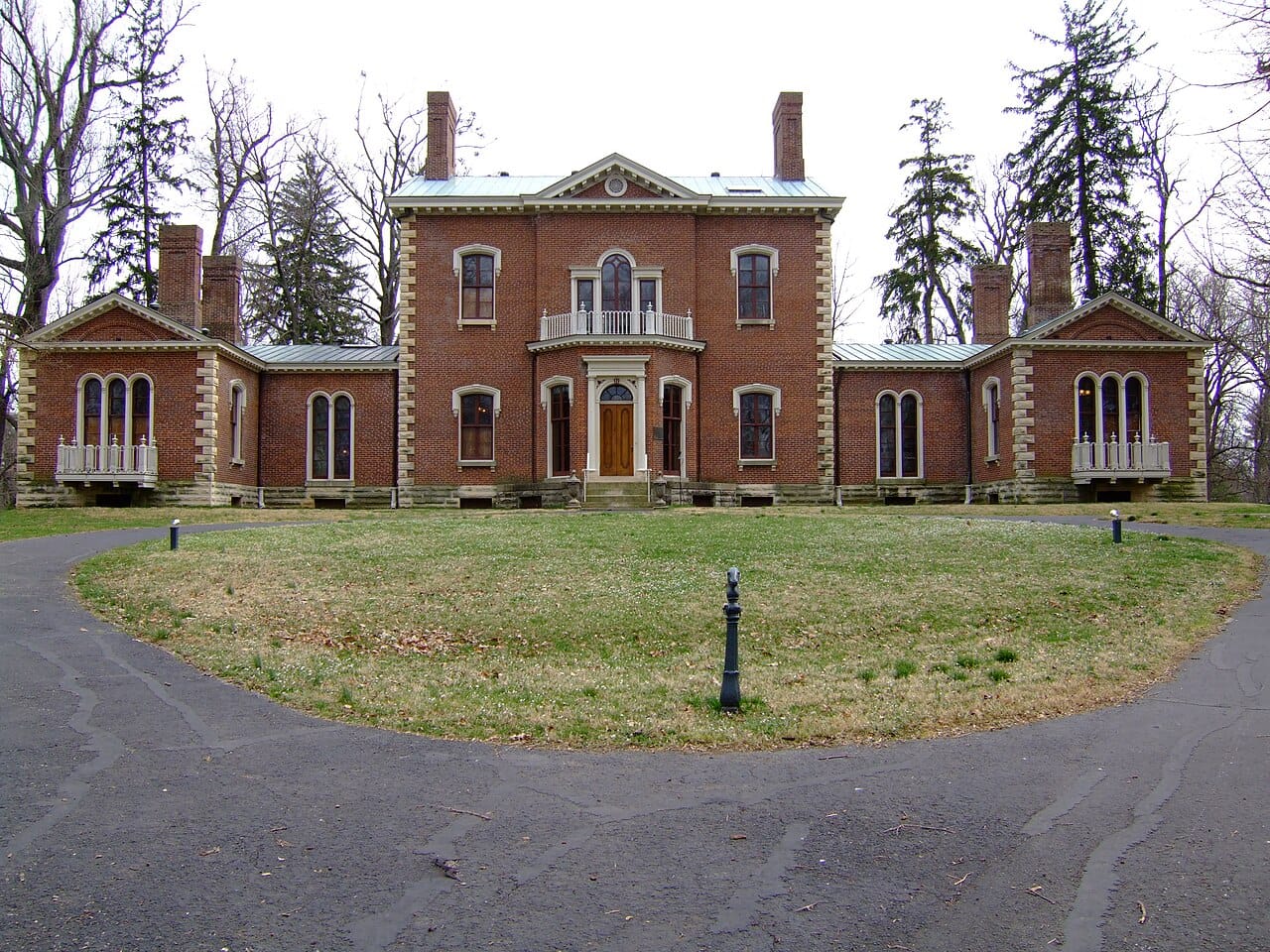
Ashland: The Henry Clay Estate
Home of Henry Clay.
Site Details
Pin location is approximate.
120 Sycamore Rd
Lexington, KY 40502
Family Friendly?
Somewhat
Visitors Per Year
3,000
The first stop for those exploring Ashland is the Visitors’ Center, which contains exhibits on:
- Kentucky Equal Rights Association President Madeleine McDowell Breckinridge, a key figure in the suffragette movement in the early 20th century. Mrs. Breckinridge was a descendant of Henry Clay and was reared at Ashland in a house adjacent to the main house.
- The influence that Henry Clay had on Abraham Lincoln.
- How ice was made and kept all summer, and how dairy products were kept cool in the preserved icehouses and dairy cellar.
Several tours are available: The main house tour, “Traces: Slavery at Ashland,” and a “Living History” tour that tells the story of Ashland through the eyes of African Americans, Indigenous people, and women.
The main house tour begins at the front of the house just outside the front door. Visitors are ushered into the main foyer by a docent, where an introduction to the house and the Clay family is given. The tour proceeds through the main parlor, the dining room, Clay’s study, the children’s rooms, and to the upper floor where the main bedroom and dressing room are located. The furniture of the house consists mostly of replicas, although there are a few original pieces. The docent provides excellent information on the Clay family and on Clay’s career as a Lexington attorney, member of the House of Representatives, Speaker of the House, Secretary of State, presidential candidate, and Senator from Kentucky.
Outside on the grounds of the estate are displays entitled “Archaeology at the Slave Quarters” and “Slavery at Ashland.” These displays are highlighted in the slavery tour.
The main house tour takes about an hour, and the slavery tour is also about an hour long.
The Henry Clay Memorial Association, which owns and operates the Clay estate, was founded in 1926. The website describes the original vision of the Foundation as being dedicated “to preserve Ashland as a historic house museum, ensuring it remained a tribute to Henry Clay’s legacy and a resource for those who revered his memory.” While this vision is still central as demonstrated in the main house tour, there is a disproportionate emphasis on the history of slavery at Ashland, and this history situates Ashland and Henry Clay in terms of a conflict between the oppressed and an oppressor.
Henry Clay was a slaveowner, and according to records, 122 slaves worked Ashland from 1807 to 1865. Slavery is doubtless a part of the history of Ashland and of the career of Henry Clay. Exhibits at Ashland describe in detail the particular work the slaves did in the fields and in the house. This is a necessary part of a full and accurate history of Clay’s life at Ashland.
The interpretation of slavery at Ashland seeks to focus on the lives of particular figures, such as Aaron and Charlotte Dupuy and their son Charles, as well as an escaped slave by the name of Lewis Richardson. Their experiences are generally cast in terms of class grievance between the oppressed slaves and Clay as oppressor.
Examples of this method of interpretation:
- A display entitled “An ‘Unimportant’ Transaction” describes the sale of a slave named “Sol.” A letter is pictured in which the sale describes Sol’s family as “unimportant.” The display notes that the transaction’s significance was “dismissed,” resulting in the intentional dehumanization of Sol and his descendants.
- A display entitled “Lost Information” highlights a document recording the value of 33 slaves at $9,600. The names of the slaves are obscured and lost, but the display notes that the value of the slaves was carefully preserved, concluding that the Clays had little to no regard for the persons listed on the document in comparison to the monetary value assigned to them.
- A display entitled “Crossing Out History,” which pictures a letter containing information about Aaron Dupuy. There is a red X drawn on the information concerning Dupuy, and the conclusion was reached that someone crossed out the section intentionally, and that there was a “decision that this history was deemed unworthy of preservation.”
- A display entitled “Tearing Out the Past” draws attention to a letter describing the storytelling talents of Aaron Dupuy. But the letter is only a fragment of the original, the upper portion having been torn off somehow. The conclusion reached was that someone deliberately tore the upper portion off because that person considered it “unworthy of preservation.”
The problem with these interpretations is that there is no evidence that the conclusions reached are accurate representations of reality. Any number of explanations could account for the discrepancies in these records. Historians look for hard evidence that would point to a conclusive explanation rather than speculating or allowing ideology to color their interpretations.
Postcolonialism is the method of historical interpretation used in the presentation of the history of slavery at Ashland. This ideology is based upon an oppressor/oppressed paradigm, and the point of postcolonialism is to overthrow the traditional historical narrative of the “oppressor” in favor of a narrative that centers on the experience of the oppressed. Thus, Clay is presented as a cruel taskmaster and America as an inherently racist nation. The fact that Clay was against slavery, sought to prevent civil war, manumitted the Dupuy family—and that America abolished the institution of slavery at the cost of hundreds of thousands of lives—is, at best, minimized in the presentation of slavery at Ashland.
Ashland is a beautiful site; the Ashland Gardens are particularly well maintained and a lot of space is available for exploring the grounds. Ashland is also open for locals to walk the grounds because the estate sits adjacent to a residential neighborhood. The main house tour requires a lot of standing and climbing stairs, so parents should be aware before committing to the tour. Parents should also be prepared to help children be attuned to subversive historical interpretations.
Henry Clay (1777-1852), known as the Great Compromiser, served one of the longest tenures as Speaker of the U.S. House of Representatives. He was Secretary of State under President John Quincy Adams and a Senator from Kentucky. He ran unsuccessfully for President in 1824, 1832, and 1844. Although he was a slave owner, he deplored the institution of slavery and was in favor of its gradual abolition. He was the architect of the Missouri Compromise of 1820 and the Compromise of 1850. He also settled the Nullification Controversy of 1832—each of these crises threatened civil war decades before the secession of the Southern states between 1860 and 1861. Clay was the central influence in the political life of Abraham Lincoln, who saved the Union and emancipated the slaves during the Civil War. Clay was one of the most significant figures in the generation of statesmen after the framing of the Constitution, along with Daniel Webster, John Quincy Adams, John C. Calhoun, and Andrew Jackson.
Owned By: Henry Clay Memorial Foundation
Operated By: Henry Clay Memorial Foundation
Government Funded: No
Did you know?
The Clay house that exists now is an exact replica of the original house. It was rebuilt shortly after Clay’s death in 1852 due to the deterioration of the bricks.
Recommended Reading
- The Great Triumvirate: Webster, Clay, and Calhoun by Merrill D. Peterson
- Henry Clay: The Essential American by David S. Heidler and Jeanne T. Heidler
Reviewed By
John D. Wilsey
Professor of Church History and Philosophy at The Southern Baptist Theological Seminary
The opinions expressed above are those of the Reviewer who is providing a good-faith historical assessment to educate the public. Reasonable opinions can vary, and the Reviewer’s opinion is not necessarily the opinion of The Heritage Foundation or its affiliates.