Brown v. Board of Education National Historical Site
Site of the landmark 1954 Supreme Court decision that ended legal segregation in U.S. public schools
Site Details
Pin location is approximate.
1515 SE Monroe St
Topeka, KS 66612
Family Friendly?
Somewhat
Visitors Per Year
20,000-30,000
Tours are self-guided. There is an auditorium, two main exhibits (“Road to Brown” and “Legacy of Brown”), a restored kindergarten room with activities for children, some hallway displays, and a small bookstore.
- Auditorium: “Race and the American Creed,” a 25-minute, multi-screen video, is divided into five segments. Several of the five segments explain the history of slavery and educational segregation. It is framed as an interview between a girl and a friend of her grandfather. The fair and unifying film appears unchanged since the exhibit opened in 2004. The film praises nonviolence and frames both slavery and legal segregation as contrary to America’s Founding principles.
- Hallway: Displays in the hallway provide background on particular classrooms and the history of Monroe Elementary. Displays here and in other galleries delve into the interesting local history, including the concerns that some of Topeka’s black educators expressed regarding desegregation due to worries about the future of employment for teachers and school leaders.
- “Road to Brown” exhibit: This is the strongest portion of the museum. The exhibit provides good background for the five cases that were combined into Brown v. Board of Education and includes video content and interviews. It also includes interesting context on early challenges to segregation laws and sufficient information on other Supreme Court cases that paved the way for Brown v. Board of Education. The exhibit provides sufficient information on the NAACP’s strategy in the desegregation cases and the importance of using places like Topeka to show that relatively equal facilities and teachers for black and white schools still violated the 14th Amendment. Some elements in the exhibit are difficult to access, requiring visitors to work through hard-to-turn flip books and to open drawers underneath main displays. The exhibit includes the most essential aspects of the Supreme Court’s reasoning in Brown v. Board, but omits a discussion of the Supreme Court’s internal deliberations about the case.
- “Legacy of Brown” exhibit: This exhibit depicts the complex legacy of the civil rights movement, but many of the displays are confusing, scattered, and ideological. Taking up approximately half of the museum’s space, it creates a lack of proportion in the museum overall. There are several videos on a loop that lack clear signage explaining their purpose. One of the videos, “Pass It On,” involves a song, dreamlike scenes of historical civil rights figures, and superficial statements by several “young people” (from approximately two decades ago) sharing their views of then-contemporary race relations. There is a “Wall of Courage” honoring others whom the exhibit links to the civil rights movement, including Gloria Steinem and a same-sex couple (Kris Perry and Sandy Stier) who challenged Proposition 8 in California. Such displays emphasize activism.
- Kindergarten room: This room is a re-creation of how the kindergarten room would have looked in the 1950s. It includes a few displays about the history of kindergarten and the school, as well as several toys and activities that might interest small children. There is a QR code to an online video, “Fair Is Fair,” that is not unedifying but also not particularly informative.
- Bookstore: There is a small bookstore near the entrance. Many of the books on sale are highly ideological, including at least five titles by Ibram Kendi (controversial leftist author of How to Be an Antiracist).
The museum is generally accurate when it comes to the origins of the cases that were combined into Brown v. Board of Education, the treatment of America’s Founding principles, and the local history surrounding Monroe Elementary. Several of the videos are superficial and unscholarly, and do not seem suitable for a National Historical Park. The importance of the site suggests that far more attention should be paid to the actual Supreme Court decision in Brown v. Board of Education. The “Legacy” section of the museum ignores the long-standing controversy among justices of the Supreme Court over whether the principal legacy of Brown is the colorblindness of the Constitution or a different kind of anti-subordination principle that might allow the government to continue making racial classifications of various kinds. Insufficient attention is given to the matter of interpreting the Constitution in the Brown decision itself. The exhibits do not adequately explore scholarly criticisms of aspects of the decision.
The museum is fair, for the most part. The “Legacy of Brown” exhibit suggests that the same-sex marriage movement and other modern activist causes are logical outgrowths of the school desegregation movement. Park rangers control an information board within the exhibit hall. At the time of the visit, it featured a lengthy New York Times article from May 2025 titled “Some Republicans Push to Put School Desegregation Officially in the Past.”
Several displays encourage visitors (including children) toward activism. There are two interactive displays that encourage visitors to respond to a prompt on a sticky note that they add to a wall. The first prompt is “How can YOU respectfully challenge injustice found in school systems around the country?” The second is “What can you do to… PROVOKE … your government to change?”
Several of the exhibits, especially those that focus on the Monroe school itself, are accessible to children. The kindergarten room includes blocks for small children to play with. Parents with young children are cautioned by the museum about a particular video display that includes graphic video and racial epithets shouted during the school desegregation movement of the mid-20th century. Parents should also consider skipping the “Legacy of Brown” exhibit, as it promotes activism without sufficient context and links contemporary activist causes to the Brown v. Board of Education decision.
The Brown v. Board of Education National Historical Park is an important venue for conveying the history of racial desegregation and the Constitution’s aversion to legal racial classifications, which are ultimately grounded in the Declaration of Independence’s teaching that all men are created equal.
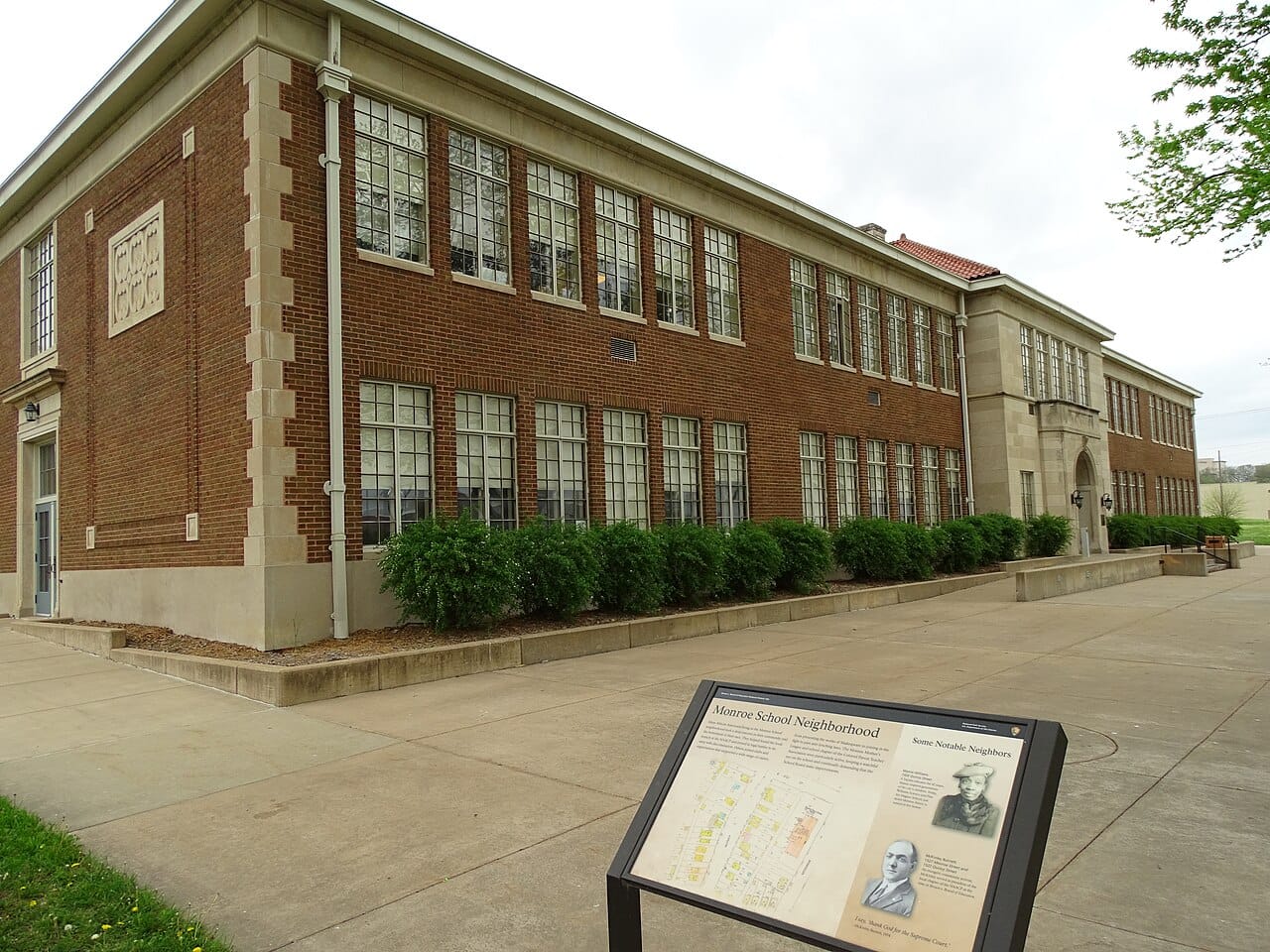
The building itself is a fitting setting to consider the relationship of the Constitution to racial classifications, since it is a beautiful and apparently well-constructed school building. The fact that the facility stands in Kansas—outside of the Deep South and in a state where school segregation was limited to certain elementary grades in certain cities—further sharpens the question that the Supreme Court faced in 1954. The issue before the Court was not unequal facilities but the compatibility of state racial classification with the Constitution’s guarantee of equal protection of the law.
Ratified in 1868, the 14th Amendment required that no state would “deny to any person … the equal protection of the laws.” Yet in Plessy v. Ferguson (1896), the Supreme Court upheld state laws that established separate racial facilities that were purportedly equal. The majority claimed that separation did not imply racial inferiority. Justice John Marshall Harlan famously claimed in dissent that “Our Constitution is color-blind, and neither knows nor tolerates classes among citizens.” He was drawing upon the logic of the Declaration of Independence in interpreting the 14th Amendment of the Constitution to forbid state-enforced racial classifications.
Half a century later, Brown v. Board of Education began to restore that interpretation of the Constitution that brought it into line with the principles of the Declaration of Independence. The Brown I Court relied on a social science experiment to establish that racial separation was inherently unequal, but the Court followed up just one year later in Brown II to urge implementation of its desegregation decision “on a racially nondiscriminatory basis with all deliberate speed.” This suggested that there was something inherently unconstitutional about racial classifications that goes beyond case-specific questions about unequal facilities or the psychological effects of particular racial classifications on particular groups of students.
In 2023, the Supreme Court vindicated the Declaration’s principle that all men are created equal by rejecting racial classification systems in Students for Fair Admissions v. Harvard. In his majority opinion, Chief Justice Roberts explicitly invoked the legacy of Brown v. Board to insist that the government should reject racial classifications in education: “Eliminating racial discrimination means eliminating all of it.”
The museum opened in 2004 for the 50th anniversary of the Brown v. Board of Education decision. In 2022, President Joseph Biden signed a bill that expanded the Brown v. Board of Education National Historic Site into the Brown v. Board of Education National Historical Park. The Park Service is in the process of incorporating additional sites related to school desegregation outside of Kansas into the National Historical Park.
Owned By: The National Park Service
Operated By: The National Park Service
Government Funded: Yes
Did you know?
The Topeka school segregation case was included in the group of cases taken up by the Supreme Court in Brown v. Board of Education precisely because segregated elementary schools in Topeka had relatively equal facilities and faculty quality.
Recommended Reading
- Michael W. McConnell, “Originalism and the Desegregation Decisions,” Virginia Law Review Vol. 81, No. 4 (May 1995), p. 947
- William Voegeli, “Civil Rights and the Conservative Movement,” Claremont Review of Books, Vol. 8, No. 3 (Summer 2008)
- Simple Justice: The History of Brown v. Board of Education and Black America’s Struggle for Equality by Richard Kluger
Reviewed By
Kevin Vance
Associate Professor and Director of the Center for Constitutional Liberty at Benedictine College
The opinions expressed above are those of the Reviewer who is providing a good-faith historical assessment to educate the public. Reasonable opinions can vary, and the Reviewer’s opinion is not necessarily the opinion of The Heritage Foundation or its affiliates.