New Harmony
The site of two utopian experiments, a community of “Christian perfection” and a socialist community
Site Details
Pin location is approximate.
410 Main St
New Harmony, IN 47631
Family Friendly?
Yes
Visitors Per Year
12,000-14,000
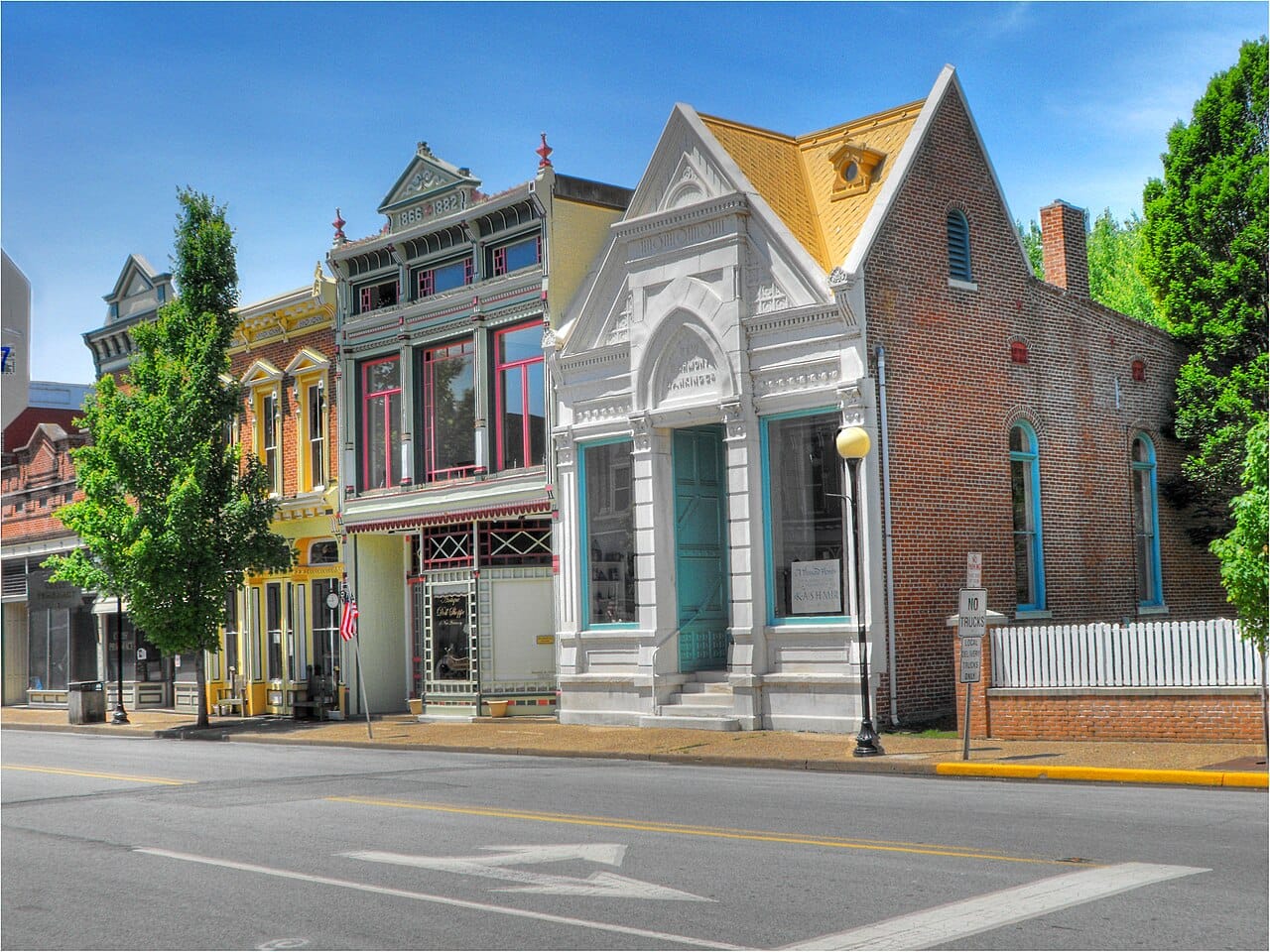
The New Harmony State Historic Site consists of a variety of restored 19th century frame-and-brick homes and communal buildings. The two principal tours—one by the Indiana State Museum, the other by the University of Southern Indiana—each take approximately two hours and enable visitors to enter several buildings. Guides discuss the histories of the two communities, how residents lived and worked, the innovative social and economic arrangements they tried, why the experiments ended, and the lasting legacies of each. A short orientation video, Utopia: The New Harmony Experience, is available in the Visitors’ Center, designed by architect Richard Meier and known as The Atheneum.
Visitors can also explore the site on their own (though they may be unable to access the buildings). New Harmony is a small town (population 750) that has established itself as an arts and crafts center in Southwestern Indiana. It also has several hiking trails, including one along the banks of the Wabash River. A stunning “roofless church,” designed by architect Philip Johnson, anchors the town’s reputation for tranquility.
Since there is little car traffic, walking around New Harmony is easy, though visitors can also rent golf carts or bicycles. One of the two tours uses an electric tram to travel through the site. Restaurants are in short supply, though a tavern that traces its roots to 1815 is a popular place to eat. (The “Rappites” were not teetotalers.)
The tours and exhibits do a good job of explaining the history of the “Rappites,” the key precepts of the “Rappite” faith (including celibacy, communal ownership of property, abstaining from tobacco, and plain clothing). They also cover the success of the “Rappites” as craftsman, farmers, and businessmen, and their relocation in 1824 to Pennsylvania to be closer to their coreligionists.
They also explain who the Owenites were and how they lived in New Harmony, but do not discuss their social and economic ideas at any length. They attribute the failure of the experiment to Robert Owen’s frequent absences and lack of clear directions to community leaders, rather than to problems with the ideas he espoused, such as the lack of incentives to work or amass property, and the personal disputes that resulted.
Although Owen’s “community of equality” dissolved in 1827, it left important legacies. New Harmony helped introduce preschool education and free lending libraries to the United States. It also became a center for research in the natural sciences, especially geology. The 1838 “Working Men’s Institute,” the oldest continuously operating library in Indiana, remains open to visitors. And while Robert Owen returned to England, many of the original settlers remained and made significant contributions to American life, including Owen’s sons, one of whom became a congressman (and helped create the Smithsonian Institution) and another of whom became the first president of Purdue University. Although the tours and exhibits mention these contributions, they provide few details.
Robert Owen’s vision for a new “moral world” was one of the first socialist ideologies to attract widespread attention in the United States. (Owen twice addressed the House of Representatives and met with five Presidents.) In speeches and articles, as well as in practice, he advocated for communal ownership of property, abolition, income and sexual equality, collective child-rearing, shorter working-days, and other changes that were far ahead of their time and still influence socialist and communitarian thinking. Karl Marx and Friedrich Engels recognized the importance of his analysis of capitalism, though they felt he was insufficiently radical in his plans for changing it.
Little that relates to the substance of Owen’s ideas is visible or discussed in the New Harmony State Historic Site, nor are critiques by contemporaneous economists and individualists presented. These critiques foretold many of the problems the residents of New Harmony would encounter. (One line of criticism, for example, accurately predicted that lacking a wage-system, the community would face shortages of carpenters, masons, and other workers the community needed more than the many idealists it attracted.) A series of programs and events for the 200th anniversary of the Owenite experiment, starting in 2026, may change that.
The New Harmony State Historic Site is easily accessible to children and adults, young or old. The Town of New Harmony also has a full calendar of special events, such as a fall “Kunstfest,” a German-themed food and shopping festival. Guides conduct “Haunted Ghost Walks” regularly to explore the mysterious and spiritual aspects of the two settlements. (A reconstructed labyrinth reflects its importance to the “Rappites” for meditation and reflection.) Parks and trails are nearby for those interested in biking or hiking.
Comprised of both volunteers and employees of the site’s sponsoring organizations, the tour guides are knowledgeable, and their presentations are readily understandable. However, older children are more likely than younger ones to appreciate them.
The New Harmony State Historic Site commemorates two efforts to create utopian societies in what was then the frontier of the United States. The first was established in 1814 by The Harmonie Society, a group of devout German Christians, who wanted to live according to religious principles preached by their leader, George Rapp, while awaiting the Second Coming of Christ, which they believed was imminent. The second was a secular utopia, based on principles developed and publicized by a successful textile manufacturer, Robert Owen, who had an influential following in both Europe and the United States during the first half of the 19th century. Seeking a place to test his eclectic, progressive mix of social and economic ideas on how to create a new “moral world,” Owen purchased New Harmony from the “Rappites” and, with a large group of intellectuals, a so-called “boatload of knowledge,” settled there in 1825.
When the Declaration of Independence gave birth to the United States, it became a beacon of hope for the world. Dissenting religious groups like the “Rappites” and the Shakers took advantage of the abundance of land on the frontier to establish settlements permitting them to live and worship as they believed God wanted. Seeking a place to demonstrate that different social and economic arrangements would improve people’s character and industriousness, Robert Owen and his like-minded followers started their own community in New Harmony.
Owen understood that the United States presented a unique opportunity to try out his ideas. In a July 4, 1826, speech entitled “A Declaration of Mental Independence,” he observed that the American Revolution created:
“…the means of preparing a new era in the history of man, and of producing such a change of circumstances as will admit of the introduction of measures to change, entirely the character and condition of the human race.”
The Town of New Harmony continues to attach importance to Independence Day, with a program of speeches, readings, and songs sponsored by the Working Men’s Institute, as well as a golf-cart parade.
Though neither fully succeeded, the New Harmony State Historic Site marks two important efforts to build utopian societies that were made possible by the unique freedom and openness to experimentation possible in the United States.
The New Harmony Resort Inn and Conference Center is located on the grounds of the Historic Site. It offers a range of affordable rooms, as well as a restaurant. It can hold group events, such as conferences and weddings.
Owned By: Indiana State Museum and Historic Sites, Historic New Harmony Program of the University of Southern Indiana
Operated By: Indiana State Museum and Historic Sites, Historic New Harmony Program of the University of Southern Indiana
Government Funded: Yes
Did you know?
Robert Owen and his followers travelled to New Harmony on a flatboat named “The Philanthropist.”
Recommended Reading
- Backwoods Utopias by Arthur Bestor
- A New View of Society and Other Writings by Robert Owen
- The Blithedale Romance by Nathaniel Hawthorne
Reviewed By
Leslie Lenkowsky
Professor Emeritus at Indiana University
The opinions expressed above are those of the Reviewer who is providing a good-faith historical assessment to educate the public. Reasonable opinions can vary, and the Reviewer’s opinion is not necessarily the opinion of The Heritage Foundation or its affiliates.