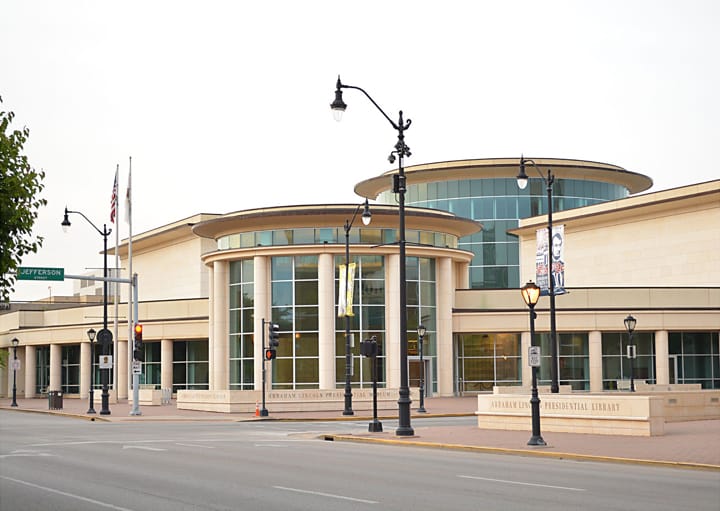
Abraham Lincoln Presidential Library and Museum
Lincoln lived in Springfield from 1837–1861 and kept his home there while he was President from 1861–1865.
Site Details
Pin location is approximate.
212 N 6th St
Springfield, IL 62701
Family Friendly?
Yes
Visitors Per Year
82,000
The museum is divided into two exhibit spaces: “Journey One: The Pre-Presidential Years” and “Journey Two: The White House Years” (which includes Lincoln’s assassination and its aftermath). Many exhibits include life-size figures of Lincoln and related family, political, and historical figures depicting pivotal scenes from his life and political journey. Maps, newspapers, letters, and historical objects of the times are interwoven throughout the museum.
In the large main lobby upon entering the museum proper, visitors immediately see the façade of the White House. To their right is Frederick Douglass standing behind a seated Sojourner Truth, two iconic, black American activists of the antebellum and Civil War period. To the left are Union Generals George C. McClellan and Ulysses S. Grant. Inside the White House is not Lincoln but his wife, Mary Todd, in all her sartorial splendor, with half a dozen dresses to her left and right. The main attraction is the life-size Lincoln family in front of the faux White House, where visitors will become part of the Lincoln family by taking the obligatory selfie alongside Lincoln, Mary, and their three surviving boys, Robert, Tad, and William.
There is plenty to see, hear, and explore in this museum, which includes a 17-minute feature film, Lincoln’s Eyes. It presents Lincoln’s life and times in the museum’s central Union Theater behind the White House: The film is projected onto three screens, incorporating holograms and other special effects.
The museum has another short film, “Ghosts of the Library,” that offers an engaging look at how artifacts are preserved and involves holographs that make a subject that sounds boring worth exploring along with the rest of the exhibits.
The attention to detail is excellent, not just in terms of simulating the past by way of life-size figures and artifacts, but also key influences on Lincoln’s politics. For example, in the law office exhibit, visitors will see a portrait of Henry Clay on the wall, Lincoln’s “beau ideal of a statesman.” In another room, they’ll see a portrait of Daniel Webster, the most famous Whig politician next to Henry Clay. Those are nice touches and not just random portraits of famous American politicians. From the playful (Lincoln’s son atop a table throwing an ink well while Lincoln calmly reads a newspaper) to the tragic (assassin John Wilkes Booth slyly entering Lincoln’s box at Ford’s Theatre), the Lincoln Museum presents a rich variety of episodes that span Lincoln’s personal and public life, as well as the social and political context of a nation wrestling with the Founders’ compromises with slavery.
The exhibit rooms, by design, present scenes that speak to the heart first (by stimulating the senses), but there are also ample short blurbs on the walls. These are more than serviceable to pace visitors through Lincoln’s life and the history of the nation. Occasional plaques present a “Learn More” list of about 10 or so books for those who want to dive into a subject in greater detail. (None of these books are for sale in the gift shop.) The authors represented are scholars and “popular” authors, and the books are not necessarily related to the rooms or scenes depicted (for example, the same list was posted in two different room exhibits).
The exhibit hall depicting Lincoln’s decision to emancipate slaves in rebel-held states misses an opportunity: There should be a “Learn More” list of books to explain that important but controversial decision. Instead, down a short passageway, multiple holographs of people declaring conflicting opinions about the issue combine to create an experience of sensory overload, so the emphasis seems to be on allowing the visitor to experience the confusion that was created by confronting the difficult problem of entrenched slavery, instead of providing a clear presentation of the complexity of Lincoln’s decision to issue the Emancipation Proclamation.
A few issues regarding historical accuracy:
- An important panel briefly describes key political events that indicated the growing sectionalism that led to the Civil War: the 1820 Missouri Compromise, 1850 Compromise Measures, 1854 Kansas–Nebraska Act, and 1857 Dred Scott opinion. It incorrectly describes the 1850 Compromise Measures as organizing the territories of Utah and New Mexico as slave territories, when, in fact, the signature policy of Stephen Douglas—popular sovereignty—was the rule, which meant that the local (white) population of Utah and New Mexico—and not Congress—was granted authority to protect or ban slavery.
- Another exhibit mistakenly says Chief Justice Roger Taney, in his majority opinion in Dred Scott v. Sanford (1857), ruled that “slaves had no rights as citizens” and therefore could not sue in federal court. Actually, Taney ruled that no descendant of African slaves, whether free or enslaved, could be considered an American citizen, and therefore Dred Scott did not have “standing” or the legal right to be heard by a federal court. That said, a different exhibit panel correctly states that Taney “ruled in 1857 that Scott, being Black, was not a U.S. citizen and thus could not sue in federal court.” Race, not slave status, was the disqualifying factor in that notorious case.
- A third display incorrectly describes Lincoln as a presidential elector for the Whig Party in 1852. Even the display’s artifact, a Whig Ticket for the 1852 election, does not list Lincoln’s name as an elector. The correct year is 1856, when Lincoln was an elector for the Republican Ticket of John C. Frémont.
However, these few historical inaccuracies do not diminish all that is vividly and accurately presented by the Lincoln Museum, a site designed to spark an interest in Lincoln and the politics that produced the most important American President since George Washington.
Exhibit descriptions that avoid using the word “slave” or “master” to describe American slavery are the only signs of ideological intrusion. (“Enslaved people” is used instead of “slave”; “freedom seekers” instead of “fugitive slaves” or “escaped slaves”; and “enslaver” instead of “master.”) Because artifacts like newspapers and letters use the commonplace word “slave,” the use of the newer, vogue terms is not ubiquitous, as some descriptions retain the historically accurate term, “slave.”
The museum makes a conscious effort to be family friendly. According to Andrew Ferguson (Land of Lincoln: Adventures in Abe’s America), who interviewed the museum designer and other contractors who constructed the exhibits (including Bob Rogers, who helped Disney produce its animatronics), the experience was pitched at a smart 7th grader. The goal was to engage kids who have grown up in the digital age and therefore will need more than written descriptions of an artifact or display to draw them into the learning experience that is the ultimate aim of the museum.
Abraham Lincoln’s poor upbringing and less than a year’s worth of formal schooling made him an unlikely prospect to ascend to the American Presidency. Born in the slave state of Kentucky, Lincoln became an avid reader during his youth in the free state of Indiana. He eventually found his calling as a lawyer and politician in the frontier state of Illinois. With a penetrating mind and an ambition his law partner William Herndon called “a little engine that knew no rest,” Lincoln sought to apply the principles of the Declaration of Independence to the growing controversy over slavery. His famous debates with Illinois Senator Stephen A. Douglas catapulted him to national prominence in the late 1850s and led to his improbable election to the Presidency in 1860 with an anti-slavery mandate. Lincoln was soon confronted with a rebellion of citizens who sought to preserve slavery by dissolving the union of American states. He exercised his commander-in-chief authority to defend the Union, and eventually chose to emancipate slaves in the rebellious states to help achieve that end. He cemented his reputation as a statesman not only by victory in the Civil War, but also through speeches that have set the gold standard for political oratory ever since.
The downtown Springfield site of the Lincoln Museum is wide open for walking, and quite clean, safe, and family friendly. A visit to the museum should be just the beginning of looking at surrounding sites relevant to Lincoln’s legacy. Free promotional literature advertises other Lincoln-related sites: for example, the Lincoln Home National Historic Site, five blocks away; Lincoln’s tomb, outside town in the Oak Ridge Cemetery; or sites in nearby Illinois cities, like Lincoln’s New Salem Historic Site, where Lincoln lived from 1831–1837 when his family first moved from Indiana to Illinois.
Across the street from the Museum is the Abraham Lincoln Presidential Library. It is a researcher library for those interested in perusing its archives, but the main floor displays copies of artifacts along the walls of a long room, which is free for ticket holders of the Lincoln Museum. There’s also an adjoining room displaying Lincoln-related objects.
Owned By: State of Illinois
Operated By: State of Illinois
Government Funded: Yes
Did you know?
Lincoln is best known as the savior of the American union and emancipator of slaves.
Recommended Reading
- Lincoln: A Very Short Introduction by Allen C. Guelzo
- Lincoln and the American Founding by Lucas E. Morel
- Abraham Lincoln: His Speeches and Writings by Roy P. Basler.
Reviewed By
Lucas E. Morel
John K. Boardman, Jr., Professor of Politics at Washington and Lee University.
The opinions expressed above are those of the Reviewer who is providing a good-faith historical assessment to educate the public. Reasonable opinions can vary, and the Reviewer’s opinion is not necessarily the opinion of The Heritage Foundation or its affiliates.