Historic General Dodge House
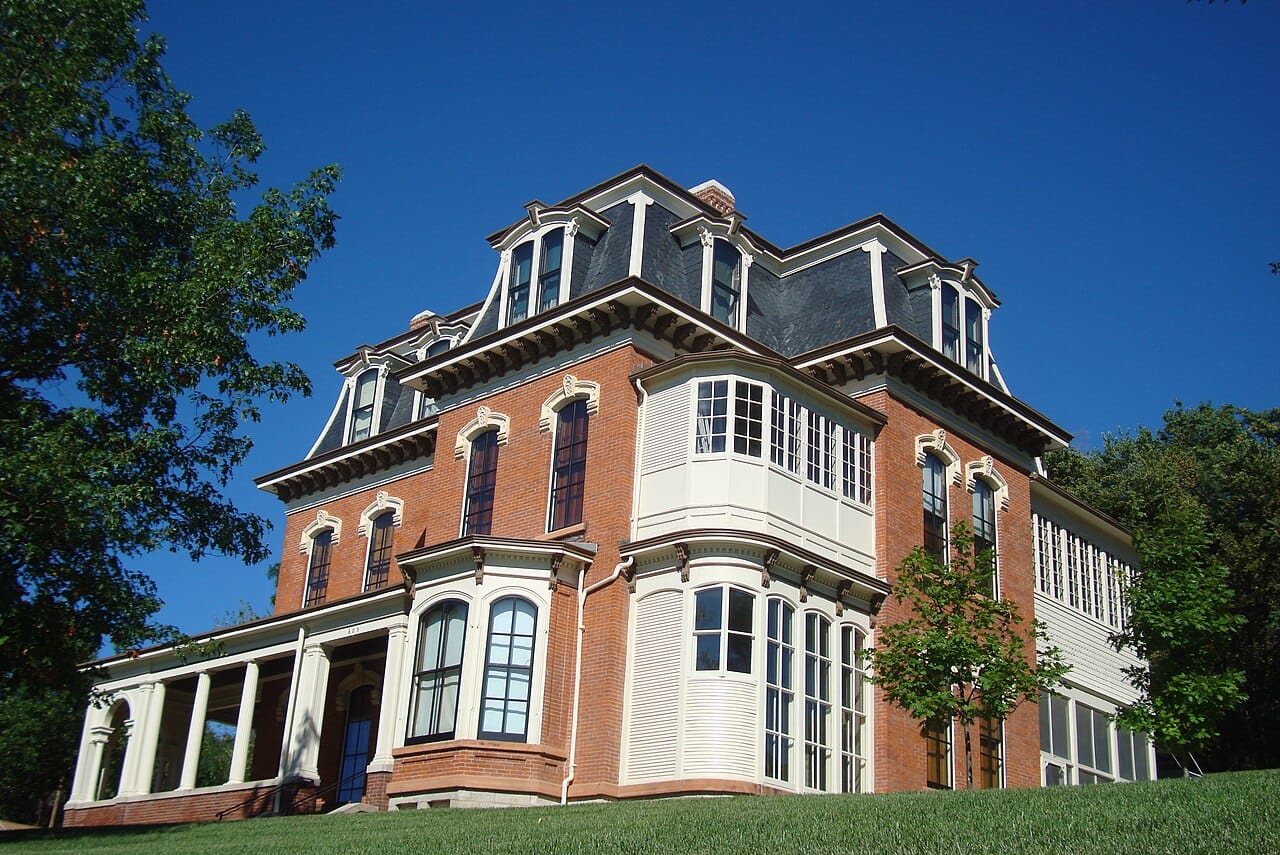
Home of Major General Grenville M. Dodge, who served in the Union Army during the Civil War and was the Chief Engineer for the Union Pacific Railroad and was instrumental in the development and completion of the transcontinental railroad
Site Details
Pin location is approximate.
605 S 3rd St
Council Bluffs, IA 51503
Family Friendly?
Yes
Visitors Per Year
6,000
In 1869, the home of General Grenville M. Dodge was completed. The grand home was designed by the architect William Boyington, who also designed Terrace Hill in Des Moines, which is the residence for the Governor of Iowa. The rooms in the Dodge House contain artifacts that belonged to the General and his family.
- Within the house, each of the rooms is set up to showcase how the Dodge family used that space. Visitors will be able to see the dining room, which contains the golden china dishes used by the family. The golden goblets are referred to as “Lincoln Goblets” because Lincoln drank out of one of them when he visited Council Bluffs.
- The most unique room in the house is General Dodge’s private library, which contains many of his personal items. Both his ceremonial and field sabers are on display, as well as books, the family Bible, portraits, and the General’s 1866 Winchester Rifle, which was given to him as a gift from the Union Pacific Railroad.
- The upper floors contain bedrooms and other spaces that were used for entertainment. A unique aspect of the house is the servants’ wooden staircase, which still has the scuff marks, scrapes, and dents from the servants walking up and down.
- The lower level of the house contains a museum, which is filled with artifacts pertaining to General Dodge’s service during the American Civil War, his relationship with Presidents Abraham Lincoln and Ulysses S. Grant, his work as Chief Engineer for the Union Pacific Railroad, and finally his funeral.
- Visitors can tour the carriage house, which also housed the chauffeurs on the upper floor.
- Throughout the year, the General Dodge House has special events. These are related to the Civil War, the Railroad, and special events surrounding holidays such as Christmas and Memorial Day.
The Historic General Dodge House does not have any historical inaccuracies. The house, exhibits, and artifacts are related to General Dodge or the era.
There is no apparent ideological bias in the exhibits at the Historic Dodge House.
The Historic Dodge House is appropriate for families. Young children might not be able to understand some of the exhibits throughout the home, but overall, the historic site is designed for visitors of all ages.
Overlooking the Missouri River valley in Council Bluffs, Iowa, rests the grand home of General Grenville Dodge. Most Americans will be unfamiliar with General Dodge’s story, but he contributed significantly to both the Union war effort and the uniting of the country economically with the building of the Transcontinental Railroad. In the 1850s, Dodge helped establish the Rock Island Railroad line through Council Bluffs near the Missouri River.
Dodge would settle in Council Bluffs and become a leading citizen not only for his influence as an engineer working with railroads, but also by establishing a bank and organizing the “Council Bluffs Guard” militia in 1856. In 1858, Dodge met a lawyer from Illinois, Abraham Lincoln, and they soon became friends. Both had an interest in establishing a Transcontinental Railroad.
Lincoln won the political support of Dodge, and, with the start of the Civil War in 1861, Dodge helped to organize military supplies for Iowa’s regiments and later organized the 4th Iowa Volunteer Infantry regiment and was awarded the rank of Colonel. Dodge and the 4th Iowa fought in the Western theater; one of their more notable engagements was the Battle of Pea Ridge in which Dodge was wounded and was subsequently promoted to Brigadier General.
During the war, Dodge also helped to build and rebuild railroads in the Western theater of operations, and he was even involved in military intelligence gathering. By 1864, Dodge was placed in command of the XVI Corps in General William T. Sherman’s army, and he participated in the Atlanta campaign and was wounded once again. He was then promoted to Major General, and in 1865, he was reassigned to fight on the Western frontier.
By 1866, Dodge had resigned from the Army and was elected to the United States House of Representatives. In 1868, he declined to run for a second term, having accepted the position of Chief Engineer for the Union Pacific Railroad.
During the Civil War, Congress passed—and President Lincoln signed—the Pacific Railroad Act of 1862, which provided for the construction of a Transcontinental Railroad. The Union Pacific would start in Omaha, Nebraska, and build westward, while the Central Pacific Railroad would start in San Francisco and build eastward.
As Chief Engineer, Dodge planned the route for the Union Pacific, but he clashed with Thomas Durant, who often changed the route to extend the line for his own financial benefit as a result of the federal government subsidizing the construction of the railroad. By May 1869, the Transcontinental Line was completed and was considered to be one of the most remarkable and revolutionary transportation and engineering achievements of its time.
In retirement, Dodge continued to work on railroad related projects, including advising on the trans-Siberian railway in Russia. President William McKinley asked him to lead a special committee to investigate military misconduct during the Spanish–American War, and he led the funeral procession for President Grant. In 1916, General Dodge died, and his funeral was the largest to date in Council Bluffs with over 2,000 mourners present. Camp Dodge, Iowa’s National Guard training camp, was named in his honor.
Owned By: Historical Society of Pottawattamie County
Operated By: Historical Society of Pottawattamie County
Government Funded: Yes
Did you know?
General Grenville Dodge was the youngest general to serve in the United States Army until World War II.
Recommended Reading
- My Recollections of Lincoln, Grant, and Sherman by General Grenville M. Dodge
- How We Built the Union Pacific Railroad by General Grenville M. Dodge
Reviewed By
John Hendrickson
Policy Director of Iowans for Tax Relief Foundation
The opinions expressed above are those of the Reviewer who is providing a good-faith historical assessment to educate the public. Reasonable opinions can vary, and the Reviewer’s opinion is not necessarily the opinion of The Heritage Foundation or its affiliates.